SoylentNews is people
SoylentNews
Site News
Join our Folding@Home team:
Main F@H site
Our team page
Support us: Subscribe Here
and buy SoylentNews Swag
We always have a place for talented people, visit the Get Involved section on the wiki to see how you can make SoylentNews better.
- [khallow] Lessons from evolution?
- [Rich] Zero Local Trust?
- [janrinok] Supreme Court strikes down Trump's sweeping tariffs
- [c0lo] Living on minimal wage
- [Gaaark] It's AI all the way down!
- [mcgrew] EV Myths
- [Runaway1956] geopricing
- [turgid] 4G Internet
- [hubie] GOG Galaxy is Apparently to be Ported to Linux
- [fliptop] Massive Solar Farm Approved in Middle of NY Amish Country
- [Tork] RubyAI's insta-Casettes.. second vid added!
- [Arthur T Knackerbracket] US Pediatricians Give Middle Finger To RFK Jr.
- [Mojibake Tengu] Veterans on Sale
- [bzipitidoo] battling high blood pressure
- [canopic jug] 39C3: Power Cycles Streaming (Saturday through Tuesday)
Older Stuff
-
January 2- Intel 3D XPoint... Still Coming Soon (8)
- Former SETI Human Wants to Send Messages to Proxima Centauri b (35)
- Switching to Daylight Saving Time May Lead to Harsher Legal Sentences in the U.S. (31)
- Uncombable Hair Gene Discovered (13)
- China Plans $503 Billion Investment in High-Speed Rail by 2020 (20)
- These Unlucky People have Names that "Break" Computers (96)
- Indicted Prenda Lawyer Also Under FBI Investigation (4)
- San Francisco Restaurant Uses iPads as Plates (40)
- Languages Still a Major Barrier to Global Science, New Research Finds (31)
-
January 1
Quick Links

from the zzzzzz-WAAAAAAAHHHHHHHHH!!!!!!!! dept.

Some Soylentils have managed to reproduce, so this study, which has findings on how to keep the young ones keep sleeping through the night, might be useful.
Overall, studies indicate that 15 to 20 percent of one to three year olds continue to have nightwakings. According to Stephanie Zandieh, M.D., Director, Pediatric Sleep Disorders and Apnea Center, The Valley Hospital, "Inappropriate sleep associations are the primary cause of frequent nightwakings. Sleep associations are those conditions that are habitually present at the time of sleep onset and in the presence of which the infant or child has learned to fall asleep. These same conditions are then required in order for the infant or child to fall back to sleep following periodic normal nighttime arousals."
Sleep associations can be appropriate (e.g., thumb sucking) or problematic (e.g., rocking, nursing, parental presence). "Problematic sleep associations are those that require parental intervention and thus cannot be reestablished independently by the child upon awakening during the night," adds Dr. Zandieh.
Here are some helpful tips to help your child sleep through the night:
Every child is different, but the techniques seem sensible and worth trying, such as giving them a security blanket (or teddy bear, etc) when being put to bed to signal it's time to sleep.
- Read More...
- 52 comments
Consuming red meat in amounts above what is typically recommended does not affect short-term cardiovascular disease risk factors, such as blood pressure and blood cholesterol, according to a new review of clinical trials from Purdue University.
"During the last 20 years, there have been recommendations to eat less red meat as part of a healthier diet, but our research supports that red meat can be incorporated into a healthier diet," said Wayne Campbell, professor of nutrition science. "Red meat is a nutrient-rich food, not only as a source for protein but also bioavailable iron."
The recommendations to limit red meat from the diet come mainly from studies that relate peoples' eating habits to whether they have cardiovascular disease. While these studies suggest that red meat consumption is associated with a higher risk of cardiovascular disease, they are not designed to show that red meat is causing cardiovascular disease. So Campbell, doctoral student Lauren O'Connor, and postdoctoral researcher Jung Eun Kim, conducted a review and analysis of past clinical trials, which are able to detect cause and effect between eating habits and health risks. They screened hundreds of related research articles, focusing on studies that met specific criteria including the amount of red meat consumed, evaluation of cardiovascular disease risk factors and study design. An analysis of the 24 studies that met the criteria is published in the American Journal of Clinical Nutrition.
Total red meat intake of >=0.5 servings/d does not negatively influence cardiovascular disease risk factors: a systemically searched meta-analysis of randomized controlled trials. DOI: 10.3945/ajcn.116.142521
- Read More...
- 35 comments
Researchers at Johannes Gutenberg University Mainz (JGU) and the Massachusetts Institute of Technology (MIT) have made another important breakthrough in the field of future magnetic storage devices. Already in March 2016, the international team investigated structures, which could serve as magnetic shift register or racetrack memory devices. This type of storage promises low access times, high information density, and low energy consumption. Now, the research team achieved the billion-fold reproducible motion of special magnetic textures, so-called skyrmions, between different positions, which is exactly the process needed in magnetic shift registers thereby taking a critical step towards the application of skyrmions in devices. The work was published in the research journal Nature Physics.
The experiments were carried out in specially designed thin film structures, i.e., vertically asymmetric multilayer devices exhibiting broken inversion symmetry and thus stabilizing special spin structures called skyrmions. Those structures are similar to a hair whorl and like these are relatively difficult to destroy. This grants them unique stability, which is another argument for the application of skyrmions in such spintronic devices.
Since skyrmions can be shifted by electrical currents and feel a repulsive force from the edges of the magnetic track as well as from single defects in the wire, they can move relatively undisturbed through the track. This is a highly desired property for racetrack devices, which are supposed to consist of static read- and write-heads, while the magnetic bits are shifted in the track. However, it is another important aspect of skyrmion dynamics that the skyrmions do not only move parallel to the applied current, but also perpendicular to it. This leads to an angle between the skyrmion direction of motion and the current flow called the skyrmion Hall angle, which can be predicted theoretically. As a result, the skyrmions should move under this constant angle until they start getting repelled by the edge of the material and then keep a constant distance to it.
Journal Reference:
Kai Litzius, et al. Skyrmion Hall effect revealed by direct time-resolved X-ray microscopy. Nature Physics, 2016; DOI: 10.1038/nphys4000
- Read More...
- 15 comments

An Anonymous Coward writes:
Found this interesting bit of history at the NY Times
George H. W. Bush: Hello, Mikhail.
Mikhail S. Gorbachev: George, my dear friend. It is good to hear your voice.
G.B.: I greet you on this momentous day, this historic day. I appreciate your calling me.
M.G.: Let me begin by saying something pleasant to you: Merry Christmas to you, Barbara and your family. I had been thinking about when to make my statement, Tuesday or today. I finally decided to do it today, at the end of the day. So let me say first Merry Christmas and very best wishes.
Well, let me say that in about two hours I will speak on Moscow TV and will make a short statement about my decision. I have sent a letter to you, George. I hope you will receive it shortly. I said in the letter a most important thing. And I would like to reaffirm to you that I greatly value what we did working together with you, first as vice president and then as president of the United States. I hope that all leaders of the commonwealth and, above all, Russia understand what kind of assets we have accrued between the leaders of our two countries. I hope they understand their responsibility to preserve and expand this important source of capital.
Gorbachev goes on to say that he is handing off control of the USSR's nukes to Russia in an organized fashion. Bush thanks him for that and then recalls the fun they had tossing horseshoes at Camp David.
With all the talk of Trump and Putin being business buddies, it looks like there is at least some precedent of the two cold war country leaders carrying on a civil conversation.
- Read More...
- 45 comments
At this point, it's well-known that Facebook is as much an advertising company as it is a social network. The company is probably second only to Google in the data it collects on users, but the info we all share on the Facebook site just isn't enough. A report from ProPublica published this week digs into the vast network of third-party data that Facebook can purchase to fill out what it knows about its users. The fact that Facebook is buying data on its users isn't new -- the company first signed a deal with data broker Datalogix in 2012 -- but ProPublica's report nonetheless contains a lot of info on the visibility Facebook may have into your life.
Currently, Facebook works with six data partners in the US: Acxiom, Epsilon, Experian, Oracle Data Cloud, TransUnion and WPP. For the most part, these providers deal in financial info; ProPublica notes that the categories coming from these sources include things like "total liquid investible assets $1-$24,999," "People in households that have an estimated household income of between $100K and $125K and "Individuals that are frequent transactor at lower cost department or dollar stores." Specifically, the report notes that this data is focused on Facebook users' offline behavior, not just what they do online.
Source: https://www.engadget.com/2016/12/30/facebook-buys-data-on-users-offline-habits-for-better-ads/
- Read More...
- 17 comments
In one of their first moves of the new Congress, House Republicans have voted to gut their own independent ethics watchdog — a huge blow to cheerleaders of congressional oversight and one that dismantles major reforms adopted after the Jack Abramoff scandal.
Monday's effort was led, in part, by lawmakers who have come under investigation in recent years.
Despite a warning from Speaker Paul Ryan (R-Wis.) and Majority Leader Kevin McCarthy (R-Calif.), House Republicans adopted a proposal by Judiciary Chairman Bob Goodlatte (R-Va.) to put the Office of Congressional Ethics under the jurisdiction of the House Ethics Committee.
The office currently has free rein, enabling investigators to pursue allegations and then recommend further action to the House Ethics Committee as they see fit.
Now, the office would be under the thumb of lawmakers themselves. The proposal also appears to limit the scope of the office's work by barring them from considering anonymous tips against lawmakers. And it would stop the office from disclosing the findings of some of their investigations, as they currently do after the recommendations go to House Ethics.
http://www.politico.com/story/2017/01/house-republicans-gut-their-own-oversight-233111
The Office of Congressional Ethics was established in 2008 under House Democrats, in response to the era of lobbying scandals made notable by Jack Abramoff, the former lobbyist who went to prison on corruption charges.
It is the first independent body to have an oversight role in House ethics. There is no Senate counterpart. The OCE independently reviews allegations of misconduct against House members and staff, and if deemed appropriate refers them to the House Ethics Committee for review. The OCE cannot independently punish lawmakers for any ethics violations.
Update: House Republicans pull plan to gut independent ethics panel after Trump tweets
- Read More...
- 101 comments
Carried by an airship, the warehouses would visit places Amazon expects demand for certain goods to boom.
It says one use could be near sporting events or festivals where they would sell food or souvenirs to spectators.
The patent also envisages a series of support vehicles that would be used to restock the flying structures.
- Read More...
- 11 comments

http://wardsauto.com/print/technology/new-9-speed-pushes-tech-limit-gm-says
Like the old 6-speed units, which GM refined over the years and expects to continue applying to its vehicles into the near future, the 9-speed was developed through a partnership with crosstown rival Ford.
Both automakers also derive 10-speed variants from the work. Ford brought that gearbox to market recently in the F-150 large pickup, while GM got first dibs on the 9-speed. GM's first application of the 10-speed will be in the '17 Chevy Camaro ZL1, a 640-hp supercharged version of the sports coupe due later this year in the U.S.
[...] In-house logics software inside a 32-bit transmission control module handles all shift events for smooth, precise ratio changes, GM says. It also monitors transmission performance and compensates for wear in parts such as the clutch plate to maintain consistent performance over time.
"This transmission shifts very smoothly, very precisely," Kline says.
The controller is mounted outside the gearbox to reduce packaging and manufacturing complexity, and it pulls vehicle-specific calibration from the cloud to be added to the core program as the car or truck exits the assembly line. It also enables manual shift control and grade logic, GM says.
The 9T50 features a wider 7.6:1 overall ratio, compared with 6.0:1 in its 6-speed predecessor, a deep 4.69 first gear for off-the-line performance and a tall 0.62 top gear for fuel-efficient, low-rpm highway cruising and optimal NVH.
Sixth gear is equivalent to eighth gear on the new transmission, too, so compared with the 6-speed the 9-speed offers two fuel-saving overdrive gears. Seventh gear is the direct-drive gear, while ninth gear is in use up to 52% of the time.
While the article doesn't say, my guess is that the design is also optimized for automatic/robotic assembly — even though the manufacturing plant is in Mexico.
- Read More...
- 53 comments

As long as humans are writing software, there will be coding mistakes for malicious hackers to exploit. A single bug can open the door to attackers deleting files, copying credit card numbers or carrying out political mischief.
A new program called Shuffler [pdf] tries to preempt such attacks by allowing programs to continuously scramble their code as they run, effectively closing the window of opportunity for an attack. The technique is described in a study [pdf] presented this month at the USENIX Symposium on Operating Systems and Design (OSDI) in Savannah, Ga.
“Shuffler makes it nearly impossible to turn a bug into a functioning attack, defending software developers from their mistakes,” said the study’s lead author, David Williams-King, a graduate student at Columbia Engineering. “Attackers are unable to figure out the program’s layout if the code keeps changing.”
[...] Designed to be user-friendly, Shuffler runs alongside the code it defends, without modifications to program compilers or the computer's operating system. It even randomizes itself to defend against possible bugs in its own code.
The researchers say Shuffler runs faster and requires fewer system changes than similar continuous-randomization software such TASR [pdf] and Remix [pdf], developed at MIT Lincoln Labs and Florida State University respectively.
[...] On computation-heavy workloads, Shuffler slows programs by 15 percent on average, but at larger scales -- a webserver running on 12 CPU cores, for example -- the drop in performance is negligible, the researchers say
[Security through obscurity? --Bytram]
- Read More...
- 15 comments
Weeks after cannabis legalization was passed by voters in California and other states, pranksters edited the famous Los Angeles Hollywood Sign to read "Hollyweed". This previously occurred in 1976 following the passage of a California law decriminalizing cannabis.
Researchers have found (DOI: 10.2105/AJPH.2016.303577) (DX) that legalization of medical cannabis led to an overall decrease in traffic fatalities among 19 states:
The happy side-effect wasn't uniform, however; only seven states saw significant reductions, while two states saw increases. Nevertheless, the authors of the new report in the American Journal of Public Health argue that the data bucks the common criticism that more pot access should increase car crashes and injuries.
Drops in traffic deaths may, in part, be explained by people swapping alcohol for pot, leading to reduced drunk driving, the study's authors speculated. To back that up, the authors note that the lives spared tended to belong to younger people, particularly 25- to 44-year-olds—an age group frequently involved in alcohol-related traffic deaths.
[Continues...]
The Washington Post is reporting on the use of high-cannabidiol (CBD) strains of cannabis to treat epilepsy, PTSD, anxiety, and other disorders "without the high":
What makes CBD especially appealing is that it doesn't get the user high. Most recreational marijuana users want this effect, of course, but many patients would rather avoid it. This has allowed CBD to sidestep many of the political, legal and medical concerns that have hindered the spread of medical marijuana. "CBD has been a game-changer for medical marijuana," says Martin Lee, the director of Project CBD, a Northern California nonprofit that promotes use of the compound. "Its safety and lack of psychoactivity undermines any argument that it should be illegal. It's really shifted the national discussion on this issue."
As more scientists recognize the compound's potential, there has been an "explosion of research," according to Pal Pacher, a pharmacologist and cardiologist at the National Institutes of Health in Bethesda. He has been studying the chemical for more than a decade; his work has shown that CBD may have benefits in both heart disease and diabetes.
CBS is running what some may consider a "fake news" piece about a "mysterious illness" tied to cannabis use: cannabinoid hyperemesis syndrome. According to FreeThoughtProject.com:
[CBS Evening News chief medical correspondent] Dr. LaPook writes: "He co-authored a study showing that since 2009, when medical marijuana became widely available, emergency room visits diagnoses for CHS in two Colorado hospitals nearly doubled. In 2012, the state legalized recreational marijuana." Dr. LaPook equivocates CHS with cyclic vomiting syndrome (CVS), but the two are not the same. CVS is caused by any number of things. [...] "The authors reviewed 2,574 visits and identified 36 patients diagnosed with cyclic vomiting over 128 visits. The prevalence of cyclic vomiting visits increased from 41 per 113,262 ED visits to 87 per 125,095 ED visits after marijuana liberalization..." This corresponds to an increase from 0.036 percent of visits to 0.07 percent of visits. This seems hardly significant to warrant concern, especially since the data comes from two hospitals and there is no indication of controlling for other factors, such as migraines or childhood history. In other words, this 'study' appears to be manufactured to make its point.
Finally, the United Nations is beginning a process that may lead to the alteration of the 1961 Single Convention on Narcotic Drugs:
The World Health Organization (WHO) Expert Committee on Drug Dependence (ECDD) recently met and initiated the first steps in a long process that could lead to the rescheduling of medical marijuana under international law, and has committed to hold a special session to discuss medical marijuana in the next eighteen months.
[...] According to an extract from the 38th Expert Committee on Drug Dependence that convened from November 14-18 in Geneva, the committee recognized an increase in the use of cannabis and its components for medical purposes, the emergence of new cannabis-related pharmaceutical preparations for therapeutic use, and that cannabis has never been subject to a formal pre-review or critical review by the ECDD. Over the next eighteen months, the committee has requested pre-reviews for cannabis plant matter, extracts and tinctures, delta-9-tetrahydrocannabinol (THC), cannabidiol (CBD), and stereoisomers of THC. This pre-review is a preliminary analysis used to determine if a more in-depth critical review will be undertaken by the ECDD, and will represent the first new scientific guidance on marijuana to the United Nations since 1935, when cannabis was first classified as a Schedule I/IV substance by the Health Committee of the League of Nations.
- Read More...
- 766 words in story
- 13 comments

French companies will be required to guarantee a "right to disconnect" to their employees from Sunday as the country seeks to tackle the modern-day scourge of compulsive out-of-hours email checking. From January 1, a new employment law will enter into force that obliges organisations with more than 50 workers to start negotiations to define the rights of employees to ignore their smartphones.
Overuse of digital devices has been blamed for everything from burnout to sleeplessness as well as relationship problems, with many employees uncertain of when they can switch off. The French measure is intended to tackle the so-called "always-on" work culture that has led to a surge in usually unpaid overtime—while also giving employees flexibility to work from outside the office.
http://phys.org/news/2017-01-french-workers-disconnect.html
[Also Covered By]: The Guardian , Sky News
- Read More...
- 36 comments
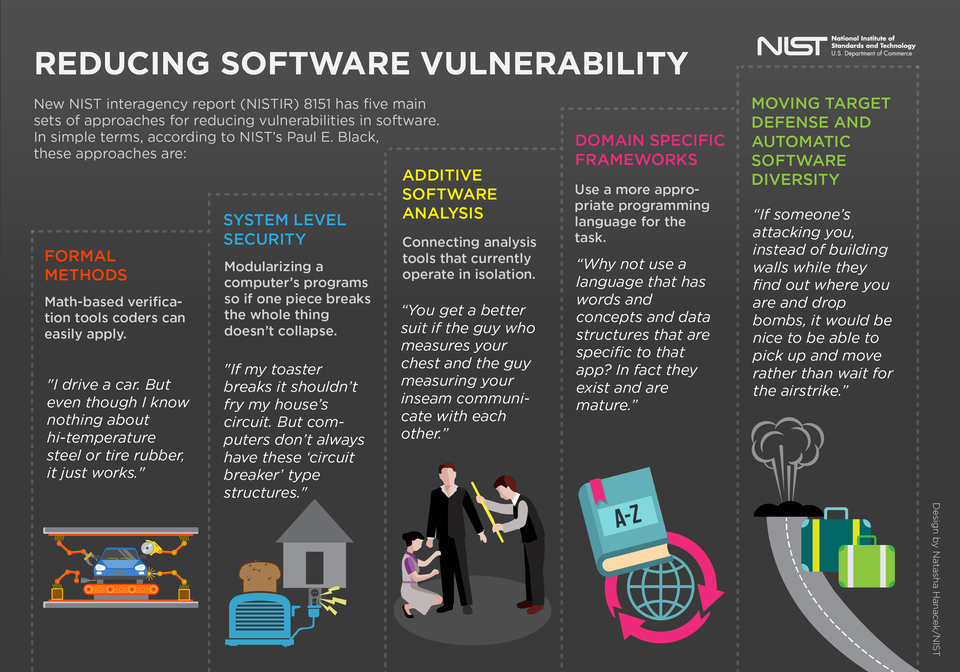
The National Institute of Standards and Technology (NIST) published a report last month, Safer, Less Vulnerable Software Is the Goal of New NIST Computer Publication:
We can create software with 100 times fewer vulnerabilities than we do today, according to computer scientists at the National Institute of Standards and Technology (NIST). To get there, they recommend that coders adopt the approaches they have compiled in a new publication.
The 60-page document, NIST Interagency Report (NISTIR) 8151: Dramatically Reducing Software Vulnerabilities, is a collection of the newest strategies gathered from across industry and other sources for reducing bugs in software. While the report is officially a response to a request for methods from the White House's Office of Science and Technology Policy, NIST computer scientist Paul E. Black says its contents will help any organization that seeks to author high-quality, low-defect computer code.
"We want coders to know about it," said Black, one of the publication's coauthors. "We concentrated on including novel ideas that they may not have heard about already."
Black and his NIST colleagues compiled these ideas while working with software assurance experts from many private companies in the computer industry as well as several government agencies that generate a good deal of code, including the Department of Defense and NASA. The resulting document reflects their cumulative input and experience.
The report recommends five main approaches as described in lay terms in this infographic.
The report is available at: http://nvlpubs.nist.gov/nistpubs/ir/2016/NIST.IR.8151.pdf
- Read More...
- 28 comments
from the employees-will-now-lead-lives-of-leisure dept.

Foxconn, the Chinese manufacturer of Apple's iPhones and other electronic devices, aims to replace human workers with "FoxBots" and achieve nearly full automation of entire factories:
The slow and steady march of manufacturing automation has been in place at Foxconn for years. The company said last year that it had set a benchmark of 30 percent automation at its Chinese factories by 2020. The company can now produce around 10,000 Foxbots a year, Jia-peng says, all of which can be used to replace human labor. In March, Foxconn said it had automated away 60,000 jobs at one of its factories.
[...] Complicating the matter is the Chinese government, which has incentivized human employment in the country. In areas like Chengdu, Shenzhen, and Zhengzhou, local governments have doled out billions of dollars in bonuses, energy contracts, and public infrastructure to Foxconn to allow the company to expand. As of last year, Foxconn employed as many as 1.2 million people, making it one of the largest employers in the world. More than 1 million of those workers reside in China, often at elaborate, city-like campuses that house and feed employees.
In an in-depth report published yesterday, The New York Times detailed these government incentivizes for Foxconn's Zhengzhou factory, its largest and most capable plant that produces 500,000 iPhones a day and is known locally as "iPhone City." According to Foxconn's Jia-peng, the Zhengzhou factory has some production lines already at the second automation phase and on track to become fully automated in a few years' time. So it may not be long before one of China's largest employers will be forced to grapple with its automation ambitions and the benefits it receives to transform rural parts of the country into industrial powerhouses.
To undermine American manufacturing, ditch the meatbags.
- Read More...
- 77 comments
Glenn Greenwald reports via The Intercept
The Washington Post on Friday [December 30] reported a genuinely alarming event: Russian hackers have penetrated the U.S. power system through an electrical grid in Vermont. The Post headline conveyed the seriousness of the threat:
[Russian hackers penetrated U.S. electricity grid through a utility in Vermont, officials say]The first sentence of the article directly linked this cyberattack to alleged Russian hacking of the email accounts of the DNC and John Podesta--what is now routinely referred to as "Russian hacking of our election"--by referencing the code name revealed on Wednesday by the Obama administration when it announced sanctions on Russian officials: "A code associated with the Russian hacking operation dubbed Grizzly Steppe by the Obama administration has been detected within the system of a Vermont utility, according to U.S. officials."
The Post article contained grave statements from Vermont officials of the type politicians love to issue after a terrorist attack to show they are tough and in control.
[...] The article went on and on in that vein, with all the standard tactics used by the U.S. media for such stories: quoting anonymous national security officials, reviewing past acts of Russian treachery, and drawing the scariest possible conclusions ("'The question remains: Are they in other systems and what was the intent?' a U.S. official said").
The media reactions, as Alex Pfeiffer documents, were exactly what one would expect: hysterical, alarmist proclamations of Putin's menacing evil.
[...] The Post's story also predictably and very rapidly infected other large media outlets. Reuters thus told its readers around the world: "A malware code associated with Russian hackers has reportedly been detected within the system of a Vermont electric utility."
What's the problem here? It did not happen.
There was no "penetration of the U.S. electricity grid". The truth was undramatic and banal. Burlington Electric, after receiving a Homeland Security notice sent to all U.S. utility companies about the malware code found in the DNC system, searched all its computers and found the code in a single laptop that was not connected to the electric grid.
Apparently, the Post did not even bother to contact the company before running its wildly sensationalistic claims, so Burlington Electric had to issue its own statement to the Burlington Free Press, which debunked the Post's central claim (emphasis in original): "We detected the malware in a single Burlington Electric Department laptop not connected to our organization's grid systems."
- Read More...
- 56 comments

An introduction to networking for game programmers:
Hi, I'm Glenn Fiedler and welcome to the first article in my article series Networking for Game Programmers
In this article we start with the most basic aspect of network programming, sending and receiving data over the network. This is just the beginning – the simplest and most basic part of what network programmers do, but still it is quite intricate and non-obvious as to what the best course of action is. Take care because if you get this part wrong it will have terrible effects on your multiplayer game!
You have most likely heard of sockets, and are probably aware that there are two main types: TCP and UDP. When writing a network game, we first need to choose what type of socket to use. Do we use TCP sockets, UDP sockets or a mixture of both?
The choice you make depends entirely on what sort of game you want to network. So from this point on, and for the rest of this article series, I'm going to assume you want to network an action game. You know games like Halo, Battlefield 1942, Quake, Unreal, CounterStrke, Team Fortress and so on.
- Read More...
- 26 comments