


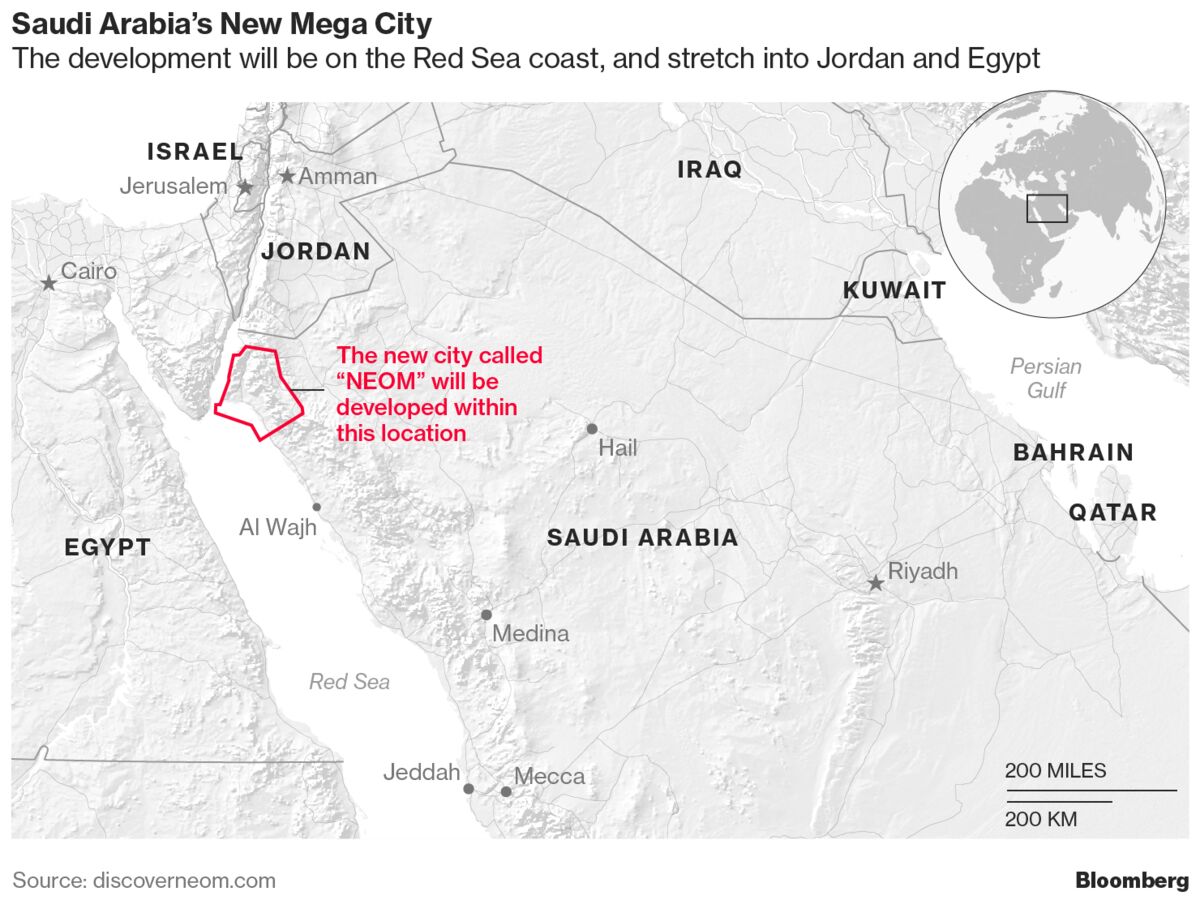
Saudi Arabia is planning to build a new $500+ billion city on the coast of the Red Sea. The zone will be connected to Jordan by land and Egypt by a bridge across the Red Sea. SoftBank's Vision Fund will buy a stake in the state-owned Saudi Electricity Co., which will power the city using clean energy. The project is called NEOM:
Saudi Arabia has unveiled plans to build a new city and business zone - a project that will be backed up by more than $500bn (£381bn) in investment.
Crown Prince Mohammed bin Salman says the 26,500 sq km (10,232 sq mile) NEOM zone will be developed in the north-west, extending to Egypt and Jordan.
It will focus on nine sectors including food technology and, energy and water.
The crown prince has been leading a drive to move Saudi Arabia away from its dependence on oil revenues.
In August, the Gulf kingdom launched a massive tourism development project to turn 50 islands and other sites on the Red Sea into luxury resorts.
However, the extremely ambitious nature of Mohammed bin Salman's vision is sure to raise questions about how realistic it is, the BBC's economics correspondent Andrew Walker says.
What is "NEOM"? "Neo" (Latin for "new") + "Mostaqbal" (Arabic for "future").
Also at Bloomberg (alternate editorial) and Reuters.
Related: SoftBank's $80-100 Billion "Vision Fund" Takes Shape
SoftBank May Sell 25% of ARM to Vision Fund; Chairman Meets With Saudi King
Related Stories
Saudi Arabia, SoftBank, Apple, Qualcomm, and Larry Ellison are creating a massive investment fund, and SoftBank's CEO Masayoshi Son is sounding increasingly Kurzweilian:
[SoftBank Group Corp.'s Masayoshi] Son reiterated his belief that computers will exceed humans in intelligence in three decades, and that within this period he expects one computer chip to have the equivalent of a 10,000 IQ. "I really believe this," he said at a keynote speech at the Mobile World Congress in Barcelona on Monday. The growth in computer ability was "why I acquired ARM," he said.
[...] SoftBank is aiming to close the first round of investment in its technology Vision Fund by the end of this month, people familiar with the matter have said. The initial investments will likely include $45 billion from Saudi Arabia and $25 billion from SoftBank, as well as $1 billion each from Apple Inc., Qualcomm Inc. and Oracle Corp. Chairman Larry Ellison, they said. The initial round is likely to exceed $80 billion and the timing of the closing may still change, said one of the people.
"We believe the singularity is inevitable and all businesses will be redefined as computers overtake humans in intelligence," Son said at an earnings briefing in November.
SoftBank recently bought U.S. private equity firm Fortress, which oversees around $70 billion of assets. It paid $3.3 billion, $1 billion more than the firm's market value. Fortress will help manage the SoftBank Vision Fund.
NBF articles one and two. Also at TechCrunch.
SoftBank will reportedly sell a 25% stake in ARM ($8 billion) to the ~$100 billion investment fund it has jointly created with Saudi Arabia, Apple, and others. ARM Holdings was bought by SoftBank for around $32 billion last year.
SoftBank Chairman Masayoshi Son met with Saudi King Salman during the King's state visit to Japan. Son gave the King one of his company's humanoid robots. Saudi Arabia is seeking investors as it prepares to launch an initial public offering for Saudi Aramco. Toyota agreed to conduct a feasibility study into the idea of production in Saudi Arabia, the result of one of twenty memorandums of understanding signed by Japanese companies and institutions with Saudi Arabia.
Also at The Telegraph, and Arab News (extra).
Related: Softbank to Invest $50 Billion in the US
Saudi Aramco and Alphabet/Google may cooperate on a "technology hub" within Saudi Arabia, or at least build some data centers:
Saudi Aramco, the world's largest energy company, and Google parent Alphabet have entered discussions to create a technology hub in Saudi Arabia, the Wall Street Journal reports.
The kingdom is embarking upon an ambitious plan, led by the 32-year-old Crown Prince Mohammed bin Salman, to diversify the nation's oil-dependent economy. The foundation of the effort is a plan to create a huge sovereign wealth fund, underwritten by selling shares in the state-owned Aramco.
The initial public offering, which could happen this year, is expected to be the world's biggest-ever share sale. Aramco President and CEO Amin Nasser recently told CNBC his company is ready for the IPO this year, but is waiting on the government to choose an international list venue.
Alphabet and Aramco have discussed forming a joint venture that would build data centers around the kingdom, sources familiar with the matter tell the Journal. It remains to be seen which customers the data centers would serve and how large the joint venture would be, but it could be listed in the Saudi stock exchange, the sources said.
Data centers are just a "tangible" area of cooperation, not necessarily the entire purpose of the joint venture. Saudi Arabia has talked about building a $500+ billion "megacity" that would be technology-focused.
Meanwhile, slightly-less-of-a-billionaire Prince Alwaleed bin Talal has been put back to work:
Saudi Arabia to extract uranium for 'self-sufficient' nuclear program
Saudi Arabia plans to extract uranium domestically as part of its nuclear power program and sees this as a step towards "self-sufficiency" in producing atomic fuel, a senior official said on Monday.
Extracting its own uranium also makes sense from an economic point of view, said Hashim bin Abdullah Yamani, head of the Saudi government agency tasked with the nuclear plans, the King Abdullah City for Atomic and Renewable Energy (KACARE).
In a speech at an international nuclear power conference in Abu Dhabi, he did not specify whether Saudi Arabia seeks to also enrich and reprocess uranium – steps in the fuel cycle which are especially sensitive as they can open up the possibility of military uses of the material.
The world's top oil exporter says it wants to tap atomic power for peaceful purposes only in order to diversify its energy supply and will award a construction contract for its first two nuclear reactors by the end of 2018.
Meanwhile, women will be allowed to attend sporting events at stadiums. And here's a message for the skeptics (editorial).
Also at Newsweek.
Previously: Saudi Arabia Will Lift Ban on Women Drivers Next Year
Saudi Arabia Planning $500 Billion Megacity and Business Zone
Robot Granted "Citizenship" in Saudi Arabia, Sparking Backlash
Something is definitely going on in Saudi Arabia:
Saudi authorities arrested at least 11 princes, several current ministers and dozens of former ministers in a sweeping move reportedly designed to consolidate power for the son of King Salman bin Abdul-Aziz Al Saud. According to media reports citing Saudi-owned television network Al Arabiya, an anti-corruption committee ordered the arrests hours after King Salman directed the creation of the committee, headed by his favorite son and adviser, Crown Prince Mohammed bin Salman.
The committee was established by the royal decree, The Associated Press reports, "due to the propensity of some people for abuse, putting their personal interest above public interest, and stealing public funds." Billionaire investor Prince Alwaleed bin Talal is among those detained, The Wall Street Journal reports. Alwaleed holds stakes in some of the world's major companies, including Apple and Twitter.
Remember Prince Alwaleed? Bitcoin could outlive him.
It's unclear what those arrested are accused of doing, but Al-Arabiya reported that new investigations into the 2009 Jeddah floods and 2012 MERS virus outbreak have been launched.
Separately, the heads of the Saudi National Guard and Saudi Royal Navy have also been replaced.
BBC notes that the reform faction is in control here:
BBC security correspondent Frank Gardner says Prince Mohammed is moving to consolidate his growing power while spearheading a reform programme. [...] Prince Mohammed recently said the return of "moderate Islam" was key to his plans to modernise Saudi Arabia. Addressing an economic conference in Riyadh, he vowed to "eradicate the remnants of extremism very soon". Last year, Prince Mohammed unveiled a wide-ranging plan to bring social and economic change to the oil-dependent kingdom.
Some Soylentils have been skeptical of Saudi Arabia's recent moves towards liberalization (some listed below). Has this apparent purge of internal political opposition changed your mind about the viability of these reforms?
SoftBank and Toyota team up to develop services powered by self-driving vehicles
SoftBank is getting into self-driving car services after the Japanese tech giant announced a joint-venture with Toyota in its native Japan.
SoftBank is invested in Uber and a range of other ride-hailing startups like Didi in China and Grab in Southeast Asia, but this initiative with Toyota is not related to those deals. Instead, it is designed to combine SoftBank's focus on internet-of-things technology and Toyota's connected vehicle services platform to enable new types of services that run on autonomous vehicle tech.
Called MONET — after 'mobility network' — the joint venture will essentially assign autonomous vehicles to various different "just in time" services. That just in time caveat essentially means more than on-demand. SoftBank suggests it'll mean that services are performed in transit. That could be food prepared as it is delivered, hospital shuttles that host medical examinations, or mobile offices, according to examples given by SoftBank.
Related:
Toyota Invests $1 Billion in AI and Robots, Will Open R&D Lab in Silicon Valley
A Company Called Nauto Has Partnered With Toyota, BMW to Log Driver Habits
SoftBank Acquires Boston Dynamics and Schaft From Google
Saudi Arabia Planning $500 Billion Megacity and Business Zone
SoftBank to Invest Billions in Uber
SoftBank Acquires 20% of Uber While Massively Devaluing It
Japan Teams up With Uber, Airbus and 19 Others on Flying Taxi Plan
Saudi Arabia Shelves Work on SoftBank's $200 Billion Solar Project
Uber board strikes agreement to pave way for SoftBank investment
Uber Technologies Inc's warring board members have struck a peace deal that allows a multibillion-dollar investment by SoftBank Group Corp to proceed, and which would resolve a legal battle between former Chief Executive Travis Kalanick and a prominent shareholder.
Venture capital firm Benchmark, an early investor with a board seat in the ride-services company, and Kalanick have reached an agreement over terms of the SoftBank investment, which could be worth up to $10 billion, according to two people familiar with the matter.
The Uber board first agreed more than a month ago to bring in SoftBank as an investor and board member, but negotiations have been slowed by ongoing fighting between Benchmark and Kalanick. The agreement struck on Sunday removed the final obstacle to allowing SoftBank to proceed with an offer to buy to[sic] stock.
Also at TechCrunch.
Related: Softbank to Invest $50 Billion in the US
SoftBank's $80-100 Billion "Vision Fund" Takes Shape
SoftBank May Sell 25% of ARM to Vision Fund; Chairman Meets With Saudi King
SoftBank Acquires Boston Dynamics and Schaft From Google
Travis Kalanick Appoints Two New Uber Board Members in "Power Play"
Saudi Arabia Planning $500 Billion Megacity and Business Zone


(Score: 3, Interesting) by c0lo on Wednesday October 25 2017, @10:47AM (1 child)
Aramco [wikipedia.org] (the Saudi national petroleum and natural gas company) is in need for money and plans a $2T float next year [telegraph.co.uk]
https://www.youtube.com/@ProfSteveKeen https://soylentnews.org/~MichaelDavidCrawford
(Score: 2) by DeathMonkey on Wednesday October 25 2017, @05:43PM
Wonder if that's to help cover that $5 billion in renewables. [bloomberg.com]
Even Saudi Oil-Barons get it....
(Score: 1, Insightful) by Anonymous Coward on Wednesday October 25 2017, @10:51AM (7 children)
Tourism is a very sensitive industry to external factors (world economy, terrorism, etc.). Oil is less sensitive to that, sure, oil prices could drop when the world economy cools down, but then you just pump up less (together with your other cartel buddies) in that sense it is like a currency.
Oil is something many people need. Going on holiday is optional and easily moved to some other place.
(Score: 5, Interesting) by takyon on Wednesday October 25 2017, @11:21AM (2 children)
Sure, but if they diversify, they can lower oil exports even more when oil prices are low.
However, by developing a bunch of islands as tourist destinations and housing for the rich, they run the risk of overextending themselves like Dubai [wikipedia.org] has:
https://en.wikipedia.org/wiki/Palm_Jumeirah [wikipedia.org]
https://en.wikipedia.org/wiki/The_World_(archipelago) [wikipedia.org]
https://en.wikipedia.org/wiki/The_Universe_(Dubai) [wikipedia.org]
NEOM seems to be more about making their own version of Silicon Valley (or other "innovation hubs") rather than building a few tourist attractions. Saudi Arabia has been investing a lot in education and technology companies (such as through the SoftBank Vision Fund, check the related articles).
It also appears that they aim to make NEOM a haven away from the country's conservatives. From the first Bloomberg article:
[SIG] 10/28/2017: Soylent Upgrade v14 [soylentnews.org]
(Score: 0) by Anonymous Coward on Wednesday October 25 2017, @09:51PM (1 child)
Do you think it will help their society get out of the middle ages?
(Score: 2) by takyon on Wednesday October 25 2017, @11:46PM
I think the Saudi royalty would genuinely like to see Wahhabism disappear and will make a sincere attempt to marginalize them as the younger generations are less conservative. But it could lead to bloodshed, which is hardly good for tourism.
[SIG] 10/28/2017: Soylent Upgrade v14 [soylentnews.org]
(Score: 3, Interesting) by c0lo on Wednesday October 25 2017, @12:12PM (1 child)
Mmmm... no, you can't just pump less when your OPEC frenemies what as much money as possible, and this yesterday. Why do you think the oil prices went from $120/barrel in 2012 to under $40 in 2015?
For now, they still need it bad enough for around $60/barrel.
Give it another 10 years and they won't want that much oil anymore.
What the Saudis seem to have in mind is not the "bucket list holiday destination", but rather highest luxury any 0.1%-er can find.
And those 0.1%-ers are a special breed: their vanity and sense of entitlement are as prominent a feature as baboon red asses when in heat - they simply can't and won't accept something second best. [onionstatic.com]
Or at least that's what Saudis based their business case on.
https://www.youtube.com/@ProfSteveKeen https://soylentnews.org/~MichaelDavidCrawford
(Score: 3, Informative) by DeathMonkey on Wednesday October 25 2017, @05:44PM
Why do you think the oil prices went from $120/barrel in 2012 to under $40 in 2015?
Fracking.
(Score: 2, Insightful) by khallow on Wednesday October 25 2017, @03:10PM (1 child)
The real problem is internal. This should be already a huge sector for Saudi Arabia. But it's not due to their conservative, authoritarian culture. They have the Hajj [wikipedia.org] and significant business travel, but that's not good enough to spark an increase in leisure travel from other cultures who don't want to have to deal with the onerous and brutal laws that the Saudis enforce.
A sector of the economy doesn't have to be risk-free to be extremely useful. That's not a useful viewpoint. Sure, don't become extremely reliant on that one sector (like say their oil industry), but a sector that has an occasional few, really good years can still contribute immensely to the well-being of a country.
(Score: 2, Disagree) by bob_super on Wednesday October 25 2017, @04:54PM
> that's not good enough to spark an increase in leisure travel from other cultures who want to drink booze and walk around half-naked women during their vacations.
FTFY.
(Score: 3, Interesting) by FatPhil on Wednesday October 25 2017, @12:14PM (4 children)
http://www.minyanville.com/mvpremium/2011/11/10/burj-khalifa-toilets-poop-waste/
Great minds discuss ideas; average minds discuss events; small minds discuss people; the smallest discuss themselves
(Score: 4, Funny) by takyon on Wednesday October 25 2017, @12:21PM
It's a green city. Maybe the poop will be used for rooftop farms.
[SIG] 10/28/2017: Soylent Upgrade v14 [soylentnews.org]
(Score: 5, Interesting) by GreatAuntAnesthesia on Wednesday October 25 2017, @12:56PM (2 children)
Luckily the "they" you are talking about are an entirely different "they" to the ones in the article. The Burj Kalifa is in Dubai, UAE. The article is about a project in the neighbouring country of Saudi Arabia.
Something worth adding to this discussion is the fact that this economic revolution will be accompanied by a cultural one: https://www.theguardian.com/world/2017/oct/24/i-will-return-saudi-arabia-moderate-islam-crown-prince [theguardian.com]
Hopefully this will mean better rights for women, less beheadings and torture, less fundamentalism. They've already given women the right to drive. It may seem like a small thing, but it's a welcome first step in the right direction.
If Saudi Arabia could sort its shit out then a lot of the problems in the middle east would get a lot easier.
(Score: 4, Informative) by takyon on Wednesday October 25 2017, @02:48PM
Saudi Arabia wants to return to ‘moderate Islam.’ Skeptics say it’s a marketing ploy. [washingtonpost.com] (archive [archive.is])
[SIG] 10/28/2017: Soylent Upgrade v14 [soylentnews.org]
(Score: 2) by PartTimeZombie on Wednesday October 25 2017, @11:58PM
I will believe that when I see it.
(Score: 2, Funny) by Anonymous Coward on Wednesday October 25 2017, @01:41PM (1 child)
It will be a progressive place. Unlike the surrounding Kingdom, here they will attach parachutes to the homosexuals they throw off tall buildings. And the stones used to stone them on the bottom, will have smooth surfaces, polished down by children's hands.
(Score: 1) by Ethanol-fueled on Thursday October 26 2017, @12:37AM
And the children who polished those stones would have to reach a reasonable age before being forced into arranged marriages?
(Score: 4, Insightful) by Kilo110 on Wednesday October 25 2017, @02:05PM (4 children)
That backward and repressive place needs to hurry up and run out of oil so they can go back to herding camels. Any attempts to appeal to an international audience are a joke until they fix their incompatible toxic culture. I foresee that happening sometime shortly after the heat death of the universe...
(Score: 2) by takyon on Wednesday October 25 2017, @02:11PM (1 child)
I have faith that people don't really care about such things, although they are making progress as has been noted. The real trick will be ensuring low terrorism at their tourist hangouts and miracle city.
[SIG] 10/28/2017: Soylent Upgrade v14 [soylentnews.org]
(Score: 2) by Kilo110 on Thursday October 26 2017, @01:52PM
Oh that's an easy one. They'll just threaten to cut off their funding. SA exports as much terrorism as oil.
(Score: 0) by Anonymous Coward on Wednesday October 25 2017, @04:22PM
That was pretty much my first thoughts as well, but humans evolve and culture changes. Perhaps desperation to stave off the transition away from oil will spur their tourist activities and rapidly get their laws updated to more sane modern standards. At the very least they'll need to let bars exist, from there it is a slippery slope to loosening up. The number one requirement for cultural evolution is the same as regular species evolution, you gotta mix the things together!
Not that I'll be going on vacation over there any time soon, let some die-hard German beer missionaries do the heavy lifting.
(Score: 0) by Anonymous Coward on Wednesday October 25 2017, @07:55PM
Islam is very resistant to change. You can't directly change a country from Islam to some other religion.
You can however do that if you take an intermediate step. That step is something like what we see in North Korea. When you have communism with a dictator who requires complete submission, you can wipe out Islam. After a few generations, eliminating the former population, you can introduce a mild religion like Christianity or Buddhism.
(Score: 4, Funny) by Phoenix666 on Wednesday October 25 2017, @03:20PM (3 children)
Free burka and caning for each applicant? No thanks.
Saudi Arabia would do better to cover their entire country in solar farms and export the energy, if they want to diversify their economy away from oil.
Washington DC delenda est.
(Score: 3, Interesting) by takyon on Wednesday October 25 2017, @05:23PM (2 children)
They indicate that religious laws will be relaxed within this city. It also seems to be primarily for Saudi Arabian residents, so your participation is not required.
Probably covered under ENERGY sector, but as I said in another comment, Saudi Arabia is trying to become a center for innovative research and technology.
They have massively increased education funding:
http://saudigazette.com.sa/article/29940/Saudi-investment-in-education-tripled-in-just-a-decade-focuses-on-enhancing-human-capital- [saudigazette.com.sa]
https://www.reuters.com/article/saudi-education/saudi-arabia-approves-21-bln-five-year-education-plan-spa-idUSL6N0O53HU20140519 [reuters.com]
It remains to be seen whether they are really on a path towards secularization:
https://www.theguardian.com/world/2017/oct/24/i-will-return-saudi-arabia-moderate-islam-crown-prince [theguardian.com]
http://archive.is/rNHTs [archive.is]
I'll go ahead and predict that we will see significant secularization in both Saudi Arabia and Iran within the next 20-30 years or so. I also think that it will happen faster in Iran. They have a youthful population and a government that is more fragile and isolated than Saudi Arabia's monarchy.
[SIG] 10/28/2017: Soylent Upgrade v14 [soylentnews.org]
(Score: 4, Insightful) by Phoenix666 on Wednesday October 25 2017, @05:52PM (1 child)
That is remarkably optimistic. Innovation rests on much more than money. Saudis have been coddled and spoiled for generations now by easy oil money. That is, they've had all the money in the world with which to innovate, but they haven't. Did Saudi Arabia even produce amazing cars to burn their oil? No. Did they use that wealth to crack the nut of reclaiming arable land from the desert? No. Did they figure out cheap, easy desalinization? No.
In short, in very short order to come through on a proposal like this they'd have to as a people transform themselves from spoiled brats to hard-bitten engineers like the Dutch or incredibly driven like the Japanese or South Koreans. Even then it takes decades to accomplish. Trying to start only three minutes before midnight when the oil boom turns bust is too late. They have run out of time.
Next to that whether or not they secularize is immaterial. It doesn't matter.
Washington DC delenda est.
(Score: 0) by Anonymous Coward on Wednesday October 25 2017, @07:48PM
> Did Saudi Arabia even produce amazing cars to burn their oil?
Agree with most of your post, it may be too late for Saudi Arabia to change their culture to producing anything but oil. Personally, I'd like to see them fund a long term effort to re-tree large parts of their country, I keep hearing about struggling pilot projects that are able to reclaim small chunks of desert.
However, they do produce some amazing cars -- Saudi money is behind McLaren and other high end car companies, including some Formula 1 teams. It's true that the work is done in England (mostly) but no way England could have ever funded supercar and F1 technology to its current level.
(Score: 2) by srobert on Wednesday October 25 2017, @08:26PM
Perhaps I can get a position there building the new city. Wait, let me check with my wife to see if she minds moving to a country where she would be considered property.
....OK. Looks like we won't be doing that.