SoylentNews is people
SoylentNews
Site News
Join our Folding@Home team:
Main F@H site
Our team page
Support us: Subscribe Here
and buy SoylentNews Swag
We always have a place for talented people, visit the Get Involved section on the wiki to see how you can make SoylentNews better.
- [khallow] Lessons from evolution?
- [Rich] Zero Local Trust?
- [janrinok] Supreme Court strikes down Trump's sweeping tariffs
- [c0lo] Living on minimal wage
- [Gaaark] It's AI all the way down!
- [mcgrew] EV Myths
- [Runaway1956] geopricing
- [turgid] 4G Internet
- [hubie] GOG Galaxy is Apparently to be Ported to Linux
- [fliptop] Massive Solar Farm Approved in Middle of NY Amish Country
- [Tork] RubyAI's insta-Casettes.. second vid added!
- [Arthur T Knackerbracket] US Pediatricians Give Middle Finger To RFK Jr.
- [Mojibake Tengu] Veterans on Sale
- [bzipitidoo] battling high blood pressure
- [canopic jug] 39C3: Power Cycles Streaming (Saturday through Tuesday)
Older Stuff
-
January 28- By Learning to Hunt Otters, Wolves Decimate (Annihilate) a Deer Population (28)
- Federal Court Says Scraping Court Records is Most Likely Protected by the First Amendment (18)
- Ketchup Isn't a Good Thermal Paste, but It's Better Than Cheese or Toothpaste (25)
- Scientists Propose Turning Abandoned Mines Into Super-Efficient Gravity Batteries (17)
-
January 27- RSA's Demise From Quantum Attacks is Very Much Exaggerated, Expert Says (7)
- NASA Ultrasound Technique Eliminates Kidney Stones Painlessly (3)
- US Marines Defeat DARPA Robot by Hiding Under a Cardboard Box (22)
- 20 Years Since the Spread of the Microsoft Sapphire/SQL Slammer Worm (4)
- Webb Telescope Spectrograph Suffers Software Glitch (8)
- Nasa to Test Nuclear Rockets that Could Fly Astronauts to Mars in Record Time (23)
- The FAA Grounded All US Flights Because Contractors Mistakenly Deleted Files (8)
- U.S. Approves First Small Modular Nuclear Reactor Design (6)
- Earth's Inner Core Might be Reversing its Spin (15)
-
January 26
Quick Links

https://www.righto.com/2023/01/reverse-engineering-intel-8086.html
The 8086 processor was introduced in 1978 and has greatly influenced modern computing through the x86 architecture. One unusual instruction in this processor is HLT, which stops the processor and puts it in a halt state. In this blog post, I explain in detail how the halt circuitry is implemented and how it interacts with the 8086's architecture.
In this section, I'll explain how the HLT instruction is decoded and handled in the Execution Unit. The 8086 uses a combination of lookup ROMs, logic, and microcode to implement instructions. The process starts with the loader, a state machine that provides synchronization between the prefetch queue and the decoding circuitry. When an instruction byte is available, the loader provides a signal called First Clock that loads the instruction into the Instruction Register and starts the instruction decoding process.
Before microcode gets involved, the Group Decode ROM classifies instructions by producing about 15 signals, indicating properties such as instructions with a Mod R/M byte, instructions with a byte/word bit, instructions that always act on a byte, and so forth. For the HLT instruction, the Group Decode ROM provides two important signals. The first is one-byte logic (1BL), indicating that the instruction is one byte long and is implemented with logic circuitry rather than microcode.1 The second signal is produced for the HLT instruction specifically and generates the internal HALT signal. This signal travels to various parts of the 8086 to halt the processor.
- Read More...
- 5 comments

I found this on one of Devuan's forums
There's a software package called Zeitgeist that's been finding its way into nearly every Linux and BSD package repository. It's also on Devuan. Be sure to read the note at the bottom of this post even if you are not impacted by this.
It reads your emails, it monitors the websites you visit, listens to private conversations, and logs the files on your computer. and then it shares this information freely over D-Bus to any application that wishes to use it. You are given no warning and have no option to say which software can access it, and which can't. Any software can access D-bus, including closed-source software like Discord or Telegram (whether they do or not, who knows).
From the description, it looks as if it is designed to make spyware's job easy. Do you have it on your system? Do you want it on your system?
[Editor's Comment: The package has been around for quite some time (since at least 2012) without any security problems being reported. Ubuntu's repo describes it as:
Zeitgeist is a service which logs the user's activities and events (files opened, websites visited, conversations held with other people, etc.) and makes the relevant information available to other applications.
It does not appear to be installed as default on the small number of distros that I have looked at but it might be installed on others.]
- Read More...
- 28 comments

Intel's two biggest business units were hit hard during the last three months of 2022:
Poor sales of PC and server chips caused Intel's revenue for the fourth quarter of 2022 to dive 32% year on year, leading to a $664 million net loss for the quarter.
The outlook for Q1 of 2023 is not an optimistic one either, with CEO Pat Gelsinger telling analysts in a call, "Our results and our Q1 guidance are below what we expect of ourselves."
However, he said that Intel is "working diligently to address the challenges brought on by current demand trends" and the company continues to have confidence in its long-term plans and trajectory.
Intel took the biggest hits across its two largest business units, with the chip maker's Client Computing Group (CCG) and Data Center and AI group (DCAI) posting year-on-year revenue drops of 36% and 33%, respectively.
The CCG business unit, which makes desktop and laptop CPUs, posted $6.6 billion in revenue, down from $10.3 billion a year earlier. This freefall can largely be attributed to a significant and ongoing slump in the PC market. A report from IDC found that sales of PCs had fallen by 28.1% during the same period, findings that were echoed by research firms Canalys and Gartner, whose estimates showed a 29% and 28.5% drop, respectively. Gartner reported that this was the steepest decline since it started tracking the PC market in the mid-1990s.
This trend is likely to carry on into the first quarter of 2023, Gelsinger said on the call with analysts.
[...] Intel's DCAI unit, which makes server chips, memory and field-programmable gate arrays (used to accelerate specific functions such as cryptography or signal processing), saw its revenue for the quarter fall to $4.3 billion from $6.4 billion a year earlier. Intel CFO David Zinsner told analysts this decline was largely driven by lower demand and cheaper competition.
Newer chip designs could save the company, though. Intel is already seeing significant customer demand for its newly launched 4th-generation Xeon scalable processors, Sapphire Rapids, Gelsinger said, adding that he expected that to ramp up further throughout the year.
Intel also plans to roll out its 5th-generation Xeon server processors, Emerald Rapids, during 2023 and follow that up in 2024 with the Granite Rapids and Sierra Forest server chips, its first to feature a mix of high-performance and high-efficiency cores.
Intel's Network and Edge unit, which makes chips for networking products, brought in $2.06 billion in revenue for the quarter, down 1% year on year. By comparison, Intel's Accelerated Computing Systems and Graphics (AXG) division reported a 1% increase in revenue, to $247 million.
- Read More...
- 444 words in story
- 11 comments

from the new-license-is...[rolls_dice]...withdrawn dept.

Wizards of the Coast changes course, gamers win:
Dungeons & Dragons publisher Wizards of the Coast will abandon attempts to alter the Open Gaming License (OGL). The announcement, made Friday, comes after weeks of virulent anger from fans and third-party publishers caused the story to make international headlines — and on the eve of a high-profile movie starring Chris Pine.
The OGL was developed and refined in the lead-up to D&D's 3rd edition, and a version of it has been in place for more than 20 years. It provides a legal framework by which people have been able to build their own tabletop RPGs alongside the Hasbro-owned brand. It has also buoyed the entire role-playing game industry, giving rise to popular products from Paizo, Kobold Press, and many individual creators. But proposed changes to the OGL, leaked to and first reported on by io9 on Jan. 5, seemed like they would create an adversarial relationship between Wizards and its community. The story has since made headlines around the world — including a nearly 10-minute segment this week on NPR's All Things Considered and lengthy write-ups by organizations such as CNBC.
Previously:
- Dungeons & Dragons' New OGL Will be 'Irrevocable' and Bring Mechanics to Creative Commons
- Dungeons & Dragons' New License Tightens its Grip on Competition
- Read More...
- 28 comments
That's conditional hands-free driving and only in Nevada for now:
At CES earlier this January, Mercedes announced that it would become the first car company to achieve certification from the SAE for a Level 3 driver assist system. That became official on Thursday when the automaker confirmed its Drive Pilot ADAS (automated driver assist system) now complies with the requirements of Nevada Chapter 482A, which governs the use of autonomous vehicle technology on the state's roads. That makes Drive Pilot the only legal Level 3 system in the US for the moment.
[...] Level 3 capabilities, as defined by the National Highway Transportation Safety Administration (NHTSA), would enable the vehicle to handle "all aspects of the driving" when engaged but still need the driver attentive enough to promptly take control if necessary. That's a big step up from the Level 2 systems we see today such as Tesla's "Full Self-Driving," Ford's Blue Cruise, and GM's Super Cruise. All of those are essentially extra-capable highway cruise controls where the driver must maintain their attention on driving, typically keeping their hands on or at least near the wheel, and be responsible for what the ADAS is doing while it's doing it. That's a far cry from the Knight Rider-esque ADAS outlook Tesla is selling and what Level 2 autonomy is actually capable of.
[...] Drive Pilot is only available on the 2024 S-Class and EQS Sedan for now. Those are already in production and the first cars should reach the Vegas strip in the second half of this year.
- Read More...
- 13 comments
from the a-topologist-doesn't-know-his-ass-from-a-hole-in-the-ground dept.

In three-dimensional space, the surface of a black hole must be a sphere. But a new result shows that in higher dimensions, an infinite number of configurations are possible.
The cosmos seems to have a preference for things that are round. Planets and stars tend to be spheres because gravity pulls clouds of gas and dust toward the center of mass. The same holds for black holes — or, to be more precise, the event horizons of black holes — which must, according to theory, be spherically shaped in a universe with three dimensions of space and one of time.
But do the same restrictions apply if our universe has higher dimensions, as is sometimes postulated — dimensions we cannot see but whose effects are still palpable? In those settings, are other black hole shapes possible?
The answer to the latter question, mathematics tells us, is yes. Over the past two decades, researchers have found occasional exceptions to the rule that confines black holes to a spherical shape.
Now a new paper goes much further, showing in a sweeping mathematical proof that an infinite number of shapes are possible in dimensions five and above. The paper demonstrates that Albert Einstein's equations of general relativity can produce a great variety of exotic-looking, higher-dimensional black holes.
[...] As with so many stories about black holes, this one begins with Stephen Hawking — specifically, with his 1972 proof that the surface of a black hole, at a fixed moment in time, must be a two-dimensional sphere. (While a black hole is a three-dimensional object, its surface has just two spatial dimensions.)
Little thought was given to extending Hawking's theorem until the 1980s and '90s, when enthusiasm grew for string theory — an idea that requires the existence of perhaps 10 or 11 dimensions. Physicists and mathematicians then started to give serious consideration to what these extra dimensions might imply for black hole topology.
[...] In 2002, three decades after Hawking's result, the physicists Roberto Emparan and Harvey Reall — now at the University of Barcelona and the University of Cambridge, respectively — found a highly symmetrical black hole solution to the Einstein equations in five dimensions (four of space plus one of time). Emparan and Reall called this object a "black ring" — a three-dimensional surface with the general contours of a doughnut.
[...] Learning about that result gave hope to Rainone, a topologist, who said, "Our universe would be a boring place if every planet, star and black hole resembled a ball."
[...] Galloway was particularly impressed by the strategy invented by Khuri and Rainone. To prove the existence of a five-dimensional black lens of a given p and q, they first embedded the black hole in a higher-dimensional space-time where its existence was easier to prove, in part because there is more room to move around in. Next, they contracted their space-time to five dimensions while keeping the desired topology intact. "It's a beautiful idea," Galloway said.
The great thing about the procedure that Khuri and Rainone introduced, Kunduri said, "is that it's very general, applying to all possibilities at once."
[...] Meanwhile, an even bigger mystery looms. "Are we really living in a higher-dimensional realm?" Khuri asked. Physicists have predicted that tiny black holes could someday be produced at the Large Hadron Collider or another even higher-energy particle accelerator. If an accelerator-produced black hole could be detected during its brief, fraction-of-a-second lifetime and observed to have nonspherical topology, Khuri said, that would be evidence that our universe has more than three dimensions of space and one of time.
Such a finding could clear up another, somewhat more academic issue. "General relativity," Khuri said, "has traditionally been a four-dimensional theory." In exploring ideas about black holes in dimensions five and above, "we are betting on the fact that general relativity is valid in higher dimensions. If any exotic [nonspherical] black holes are detected, that would tell us our bet was justified."
- Read More...
- 661 words in story
- 3 comments
Risk to humans is low, but epidemiologists fear a future pandemic by such a flu:
The ongoing bird flu outbreak in the US is now the longest and deadliest on record. More than 57 million birds have been killed by the virus or culled since a year ago, and the deadly disruption has helped propel skyrocketing egg prices and a spike in egg smuggling.
Since highly pathogenic avian influenza (HPAI) A(H5N1) was first detected in US birds in January 2022, the price of a carton of a dozen eggs has shot up from an average of about $1.79 in December 2021 to $4.25 in December 2022, a 137 percent increase, according to data from the US Bureau of Labor Statistics. Although inflation and supply chain issues partly explain the rise, eggs saw the largest percentage increase of any specific food, according to the consumer price index.
[...] Still, America's pain in grocery store dairy aisles likely pales compared to some of the devastation on poultry farms. HPAI A(H5N1) has been detected in wild birds in all 50 states, and 47 have reported outbreaks on poultry farms. So far, there have been 731 outbreaks across 371 counties. At the end of last month, two outbreaks in Weakley County, Tennessee, affected 62,600 chickens.
[...] In the current outbreak, the CDC has tracked more than 5,000 people who have had contact with infected birds but only found a single case of bird flu in a human. The reported case in Colorado came from a person who worked directly with infected birds and was involved with a cull. The person had mild symptoms and recovered.
Although the current data is comforting, virologists and epidemiologists still fear the potential for flu viruses, such as bird flu, to mutate and recombine into a human-infecting virus with pandemic potential. [...]
[...] As such, the authors say it is necessary to "strengthen the culture of biosafety and biosecurity in this farming system and promote the implementation of ad hoc surveillance programs for influenza A viruses and other zoonotic pathogens at a global level."
- Read More...
- 19 comments
Scientists Say 'Rubble Pile' Asteroids are Surprisingly Hard to Kill
Rubble pile asteroids are more common and durable than previously thought, according to new research. The scientists behind the study say this could pose a problem for planetary defense measures. But there may be reason for optimism, given recent insights gleaned from NASA's successful DART mission to deflect an asteroid.
Once just a hypothesis, rubble pile asteroids appear to be a common fixture of the solar system, as evidenced by missions to asteroids Itokawa, Ryugu, Bennu, and Dimorphos, the latter asteroid not yet officially confirmed as such but very likely is. As the name suggests, rubble pile asteroids are loosely bound conglomerations of rock and dust held together by exceptionally weak gravity. And by weak, I mean weak; the forces involved at the surface are comparable to the weight imposed by a couple of pieces of paper held in your hand.
[...] The researchers analyzed dust particles brought back to Earth in 2010 by the Japanese Space Agency's Hayabusa 1 probe, which extracted surface samples from the near-Earth asteroid Itokawa five years earlier. [...]
Or as Jourdan explained in a Curtin press release: "In short, we found that Itokawa is like a giant space cushion, and very hard to destroy." And because rubble pile asteroids are hard to destroy, the solar system is likely chock full of them.
Space Dust Reveals Earth-killer Asteroids Hard to Destroy
Good luck blowing up a pile of rubble:
An asteroid named Itokawa that's been identified as potentially hazardous to Earth would be difficult to destroy, according to new research analyzing dust particles collected from the ancient rock.
Measuring 330 metres across, Itokawa is the first-ever asteroid to be sampled in a space mission. Japan's Aerospace Exploration Agency launched its Hayabusa 1 probe in 2003 to study Itokawa, and managed to return about a milligram of stuff taken from the asteroid's surface to Earth seven years later.
Now, an international team of researchers led by Curtin University, Australia, has studied three dust particles from the sample to estimate Itokawa's age and disposition. Argon dating revealed the asteroid is older than 4.2 billion years, and has been described as having a cushion-like structure. The team discovered Itokawa is older and tougher than previously thought.
[...] "Now that we have found they can survive in the solar system for almost its entire history, they must be more abundant in the asteroid belt than previously thought, so there is more chance that if a big asteroid is hurtling toward Earth, it will be a rubble pile," said Nick Timms, co-author of the paper and geology professor also from Curtin University.
[...] "The good news is that we can also use this information to our advantage – if an asteroid is detected too late for a kinetic push, we can then potentially use a more aggressive approach like using the shockwave of a close-by nuclear blast to push a rubble-pile asteroid off course without destroying it," he said.
Journal Reference:
Fred Jourdan, Nicholas E. Timms, Tomoki Nakamura, et al., Rubble pile asteroids are forever, PNAS, 120, 2022. (DOI: https://doi.org/10.1073/pnas.2214353120)
- Read More...
- 549 words in story
- 18 comments

Can Science Finally Create a Decent Cup of Decaf?:
Who cares about decaf coffee? I do. I'm a slow caffeine metabolizer, like many millions of others. We folks with a particular type of CYP1A2 gene may adore a perfectly pressed single-origin Arabica but cannot drink a fully caffeinated cup without the caffeine accumulating too quickly, making our hearts beat like bass drums and our brains feel momentarily vaporized. [...] But now there's a chance for us, the metabolically mismatched. A whole new kind of coffee may be on the horizon.
[...] "We begin our time today with a coffee that has faced an extinction of its own: Eugenioides," she said into a light pink jawbone microphone. She went on to explain that the Coffea Eugenioides plant, the genetic parent to Coffea Arabica, was almost extinct until recently. Arabica is the earthy, full-bodied, chocolatey coffee that most of the world finds delectable. Eugenioides is a bit different—still strong, but with hints of citrus fruit and marshmallow. The kicker: Eugenioides has half the caffeine.
Although Eugenioides helped Eckroth win second place, it's unlikely we mortals will ever enjoy its pleasantly light buzz. It's tough to grow. Even in the lush soil of Inmaculada Farms in Colombia, where Eckroth's coffee was sourced, it struggles along. But Eugenioides might offer another path toward a quaffable coffee we can all enjoy. Now, Eugenioides is giving scientists clues about how to make a more metabolically friendly Arabica, to tweak the way it makes caffeine, and create a half-caff or decaf plant in the laboratory with the same full flavor of the ones found in nature.
[...] In 2021, Schaart and one of his students, Nils Leibrock, became particularly interested in coffee and using the CRISPR system to quiet the caffeine-making pathway inside Coffea Arabica. "When it comes to the genetics, it seems quite easy," Schaart says. "And coffee will taste much better because you don't need a chemical process to get rid of caffeine in the coffee beans."
[...] Coffee is a moody fellow. The only way to potentially get around this caffeine conundrum (other than just drinking less, but who wants to do that) is to find a way to reduce caffeine in the coffee beans without affecting the leaves. (And don't say Swiss Water—more on that in a moment.)
"We think when we treat it in such a way that caffeine is still produced in leaves but not in the beans, and then you can have a solution to this problem," says Schaart. CRISPR machinery along with a wealth of public knowledge about the coffee genome may allow them to do it, or at least come up with a plan. [...]
How idyllic, the thought of sipping a full-strength, robust latte in one sitting, start to finish, no jitters (and no hundred-dollar price tag). Of course, no one has grown a mature CRISPR-edited coffee plant yet (or if they have, they're not disclosing). Perhaps more crucially, nobody yet knows whether consumers would buy genetically engineered coffee. Schaart is optimistic. "I like to call it inspired by nature," he says. [...]
For now, there's only one method of making decaf coffee for the masses—harvesting fully caffeinated beans and running them through a caustic or scalding solution, wrestling away hundreds of flavor molecules along with the caffeine. Now you can say Swiss Water. [...]
[...] And of course, living in California, I couldn't help but hear about a new West Coast startup company focused on decaffeinating coffee after it has been pulled or poured. Founded by Andy Liu, Decafino makes a teabag-like product that can 80 percent decaffeinate any 16-ounce cup of coffee in less than four minutes. Inside is microbeads made from algae with pores that bind the caffeine molecule exclusively, they say, leaving all other flavor molecules untouched. It's up for pre-sale on their website. Although I can't imagine dunking a perfectly poured cappuccino and watching it grow flat and cold while it decafs, I will try it anyway. In the meantime, I'll keep ordering my half-caffs and enduring the ever-present barista wince.
Decaf drinkers may have a future.
- Read More...
- 693 words in story
- 17 comments

Researchers Release PoC Exploit for Windows CryptoAPI Bug Discovered by NSA
Proof-of-concept (Poc) code has been released for a now-patched high-severity security flaw in the Windows CryptoAPI that the U.S. National Security Agency (NSA) and the U.K. National Cyber Security Centre (NCSC) reported to Microsoft last year.
Tracked as CVE-2022-34689 (CVSS score: 7.5), the spoofing vulnerability was addressed by the tech giant as part of Patch Tuesday updates released in August 2022, but was only publicly disclosed two months later on October 11, 2022.
"An attacker could manipulate an existing public x.509 certificate to spoof their identity and perform actions such as authentication or code signing as the targeted certificate," Microsoft said in an advisory released at the time.
CryptoAPI bug makes 99% of Windows servers vulnerable
According to Redmond's security bulletin, CVE-2022-34689 can be exploited to spoof an attacker's true identity and perform actions "such as authentication or code signing as the targeted certificate."
As explained by Akamai, the gist of the issue is that CryptoAPI makes the assumption that "the certificate cache index key, which is MD5-based, is collision-free." MD5 has been known for being vulnerable to collision issues – two chunks of data which happen to have the very same MD5 hash – for a long time now, but old software versions using CryptoAPI are still vulnerable to the flaw.
Your apps and Windows devices could be facing a whole new kind of threat
A critical flaw in Windows-powered datacenters and applications, which Microsoft fixed in mid-2022, remains unpatched in almost all vulnerable endpoints, putting countless users at risk of different malware, or even ransomware, attacks.
Cybersecurity researchers from Akamai published a proof-of-concept (PoC) for the flaw, and determined the high percentage of yet unfixed devices.
The vulnerability Akamai is referring to is CVE-2022-34689, a Windows CryptoAPI spoofing vulnerability that allows threat actors to authenticate, or sign code, as the targeted certificate. In other words, threat actors can use the flaw to pretend to be another app or OS and have those apps run without raising any alarms.
- Read More...
- 352 words in story
- 2 comments
from the good-luck-trying-to-pry-that-off-the-bed dept.

A 3D printer is taking home building to a new level — literally:
The enormous printer weighing more than 12 tons is creating what is believed to be the first 3D-printed, two-story home in the United States.
The machine steadily hums away as it extrudes layers of concrete to build the 4,000-square-foot home in Houston.
Construction will take a total of 330 hours of printing, said architect Leslie Lok, co-founder of design studio Hannah and designer of the home.
[...] The project is a two-year collaboration by Hannah, Peri 3D Construction and Cive, a construction engineering company.
Also at NPR and Yahoo! News. Originally spotted on The Eponymous Pickle.
Related: Texas Company Plans to Sell Country's First Permitted, 3D-Printed House
- Read More...
- 29 comments
Bacteria evolve drug resistance more readily when antidepressants are around:
Jianhua Guo is a professor at the Australian Centre for Water and Environmental Biotechnology. His research focuses on removing contaminants from wastewater and the environmental dimensions of antimicrobial resistance. One of those dimensions is the overuse of antibiotics, which promotes resistance to these drugs.
Guo wondered if the same might hold true for other types of pharmaceuticals as well. His lab found that they definitely do. Specific antidepressants—SSRIs and SNRIs—promote resistance to different classes of antibiotics. This resistance is heritable over 33 bacterial generations, even once the antidepressant is removed.
[...]
Antibiotic resistance is an enormous threat to human health. Since antidepressants are prescribed and used in such massive quantities, the fact that they can induce antibiotic resistance should not be considered one of the more trivial of their side effects. It might even be taken into account in the design of new, more effective antidepressants.PNAS, 2023. DOI: 10.1073/pnas.2208344120
Also reported at:
- Read More...
- 15 comments

Due to a changing economic climate, tech companies like Google and Apple have been laying off employees to cut costs and prepare for a potential recession. Meanwhile, automakers like GM have been taking advantage of this influx of talented workers by hiring them to develop the new age of digital vehicles:
According to a report from Detroit Free Press, GM has loosened up its hiring freeze to exploit the new surplus of skilled workers. This makes sense given that The General had a goal to hire 8,000 employees last year to help it focus on the development of the technology needed for electric vehicles. In fact, GM was looking to hire a number of software developers and engineers for its new end-to-end software platform, Ultifi. As a whole, this incursion of digital-focused employees will help the Detroit-based automaker further develop its EVs and self-driving technologies, like Super Cruise and Ultra Cruise.
"While this isn't a major growth year from a hiring standpoint, we're continuing to hire tech talent," said GM spokeswoman Maria Raynal. "This includes some of the talent in the market due to the tech downsizing, particularly in areas such as EV development, software development and defined vehicle."
The auto industry is not immune to the nationwide problems of too few applicants and employees who just stop showing up. Also, I'm wondering how motivated Silicon Valley tech workers will be to move to Detroit.
Previously: Google Employees Brace for a Cost-Cutting Drive as Anxiety Mounts
- Read More...
- 13 comments
Washed out to sea, a giant beast and its armored skin were left in pristine condition:
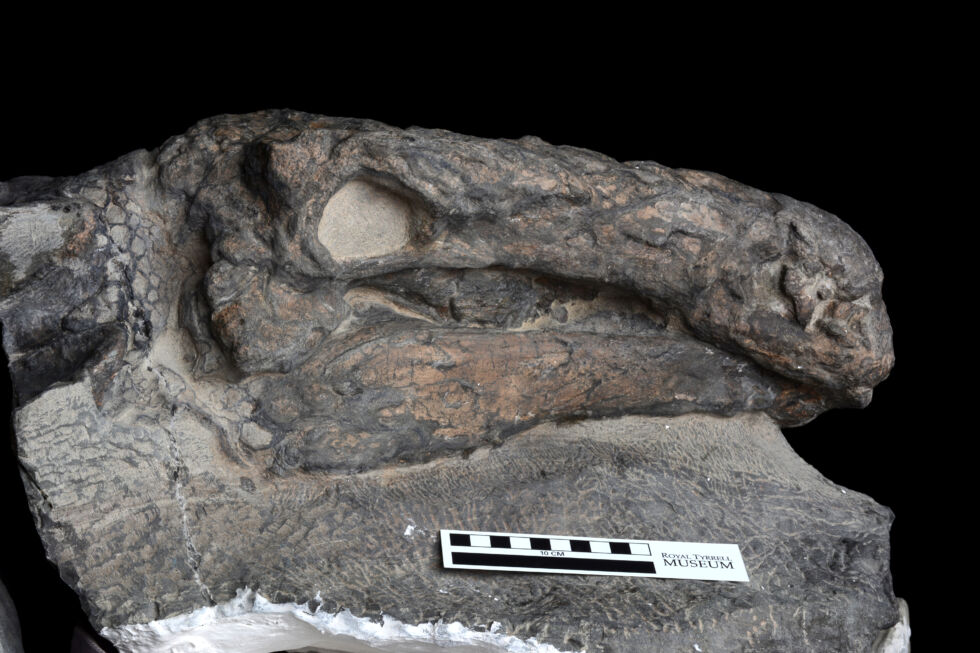
Borealopelta mitchelli found its way back into the sunlight in 2017, millions of years after it had died. This armored dinosaur is so magnificently preserved that we can see what it looked like in life. Almost the entire animal—the skin, the armor that coats its skin, the spikes along its side, most of its body and feet, even its face—survived fossilization. It is, according to Dr. Donald Henderson, curator of dinosaurs at the Royal Tyrrell Museum, a one-in-a-billion find.
Beyond its remarkable preservation, this dinosaur is an important key to understanding aspects of Early Cretaceous ecology, and it shows how this species may have lived within its environment. Since its remains were discovered, scientists have studied its anatomy, its armor, and even what it ate in its last days, uncovering new and unexpected insight into an animal that went extinct approximately 100 million years ago.
Borealopelta is a nodosaur, a type of four-legged ankylosaur with a straight tail rather than a tail club. Its finding in 2011 in an ancient marine environment was a surprise, as the animal was terrestrial.
[...] One of the reasons this fossil was so well-preserved is because it was covered in a very thick, very hard concretion—a solid mass that sometimes forms around fossils. The concretion maintained the fossil in 3D, unlike the typically 2D-flattened fossils that occur after millions of years of pressure from overlying rock. Henderson said the concretion helped preserve the skin, preventing even bacteria from breaking it down.
It took the researchers 14 days to excavate the find and bring it back in separate enormous blocks to the museum. There, senior preparation technician Mark Mitchell was tasked with separating the fossil from the stone. This was no small endeavor, taking Mitchell seven hours per day over five and a half years. That task, he wrote in an email, took him a staggering 7,000 hours. The length of time it took and the quality of his work are why this dinosaur was named after him (he's the "Mitchell" in the Borealopelta markmitchelli).
[...] Few people can claim to be the first to see the actual face of an extinct animal with no modern analogs. Mitchell described that experience as "absolutely amazing. This was the first dinosaur I've worked on with skin actually covering the skull, so being able to see what this animal looked like when it was alive was really cool."
But he was also "amazed at the skin impressions on the bottom (pad) of the foot. These matched the patterns seen in footprints left behind by other ankylosaurs preserved in Alberta [and British Columbia]."
[...] "The specimen is impressive in its own right, even without any of the research," Brown wrote. "The combination of preserved soft tissues and retained 3D shape results in the animal looking much like it did back in the Cretaceous... I think ongoing and future research, specifically looking at features such as the preserved skin and stomach contents will continue to add to our understanding of this animal."
A really cool picture of the dinosaur head from the article.
- Read More...
- 535 words in story
- 6 comments
https://inventlikeanowner.com/blog/the-story-behind-asins-amazon-standard-identification-numbers/
During Amazon's earliest days (1994-1995), CTO Shel Kaphan and Software Engineer Paul (then) Barton-Davis had to write all the software needed to power Amazon.com on the day it offered its website to the world to sell books (official launch date was July 16, 1995). The book catalog was online, and it needed an index (well, it needed several indexes, but that's another story); specifically, it needed a unique key for each item in the catalog. Because the databases they were using to create the catalog were indexed by 10-character-long ISBN (International Standard Book Number), Shel and Paul decided to use ISBN as their key.
Unfortunately — and Shel was well aware of this very quickly, but of course by that time, it was too late — ISBNs are terribly abused in the United States. The company that issues ISBNs, Bowker, charges a lot of money for ISBNs (from the perspective of small publishers, anyway), and publishers don't necessarily read all the rules. Small publishers were re-using ISBNs, and they also took their range of ISBNs and numbered through the entire range, rather than respecting the rule that the final character is actually a checksum, and you can only iterate through some of the digits. (It's actually worse than just not using the last digit, but I'm not getting into that here.)
Shel very quickly removed all 'checksum software checks' (which would have made sure it was a legal ISBN), but Amazon was still stuck with a code base that stored the key value in 10 character strings, and which also stored them in other databases with similar constraints.
Read on to see how the problem was finally resolved - but it wasn't as simple as you might first have thought...
- Read More...
- 8 comments