SoylentNews is people
SoylentNews
Site News
Join our Folding@Home team:
Main F@H site
Our team page
Support us: Subscribe Here
and buy SoylentNews Swag
We always have a place for talented people, visit the Get Involved section on the wiki to see how you can make SoylentNews better.
- [c0lo] Are we crashing?
- [day of the dalek] Will the Rioting and Looting in Europe Come to the US?
- [Rich] ArtCraft
- [DannyB] Don't make Daylight Savings time permanent
- [mcgrew] False Propaganda
- [turgid] Runaway's Contentious Sig
- [linuxrocks123] Nonprofits in Capitalism
- [hubie] The Guardian Reviews AI Generated Sitcom
- [Runaway1956] More about GrapheneOS
- [Arthur T Knackerbracket] It’s OK To Tell ICE Their Actions Will Haunt Them, Judge Rul
- [Ingar] The devil is in the router
- [fliptop] FAFO
- [khallow] Evolutionary also-rans
- [bzipitidoo] How copyright warped Earthsea
- [istartedi] Forget the politics. Let's get back to our roots.
Older Stuff
-
Thursday October 29 -
Wednesday October 28- Australia Ponders Robotaxi Introduction as Unions Bark Warnings (3)
- Human Receives AI-Designed Virus for the First Time (4)
- US Official: Russia's Stalker Satellite Sure Looks Like an Orbital Weapon (9)
- Walter Koenig, Actor Best Known as Chekov on Star Trek, Dies Aged 90 (21)
- Anthropocene: Rejection Revisited (9)
-
Tuesday October 27- Max-Severity GitLab Bug Allows Remote Code Execution Over 12 Years Of Releases (1)
- Comcast Loses More Customers, Claims Other ISPs' Cheap Prices Are "Irrational" (14)
- Alzheimer’s Damage May Begin Outside the Brain (2)
- New Study Rekindles Contested Question: Earth and Mars Had Different Origins (7)
- Terence Tao: AI Turns Beautiful Mathematics Into ‘Toxic Waste’ (40)
-
Monday October 26
Quick Links

Microsoft, on Monday, announced a voluntary exit offer open to about one quarter of its employees.
The company's HR chief, Amy Coleman, explained the deal in a letter later posted to Redmond's corporate blog. While scant on specifics, Coleman's note dangles an opportunity for anyone considering a move to get out while the getting's good.
Eligible employees in participating organizations "who may be considering a future outside the company," Coleman wrote, can seize "the opportunity to leave Microsoft with financial support and career planning resources."
Microsoft tells us that 60,000 of its employees in the UK, US, Canada, and India are being given the opportunity to take the VEO. Microsoft told us it isn't classifying the deal as a buyout since no one is being incentivized to leave. We're told that the offer is akin to a standard severance deal in terms of monetary and career assistance bonuses. Some employees will also be given the option for extended healthcare and stock shares.
The company declined to get specific on which roles or teams are up for the exit offer, but Coleman's note does state that employees in those four markets up to employment level 70 will be eligible, which translates to everyone at or below the VP level.
"Some organizations are providing the Voluntary Exit Offer, and some are not," Coleman's note stated. "Participation varies based on each business's priorities, customer commitments and workforce needs."
Microsoft employed around 223,000 people as of June, 2026 when it issued its last annual report, and since then has eliminated around 4,800 roles. By that count, the VEO is being offered to around a quarter of Microsoft's remaining employees, though Microsoft tells us it doesn't expect everyone to take the offer.
Microsoft said it doesn't have a target number for the VEO. Google, which made a similar offer to employees in 2025, saw between three and five percent of those eligible take the offer.
If that holds in Microsoft's case, anywhere between 1,800 and 3,000 employees could accept the deal before the window closes on December 31.
It would be easy to blame increasing automation for the plans to reduce staff, but Microsoft insisted otherwise in our conversation. The verbiage about "changing needs" isn't a euphemism for AI, in other words.
Rather, we're told, the deal reflects the success of a previous early retirement offer from April, which saw Microsoft extend a voluntary buyout to employees whose age plus years of employment at Microsoft exceeded 70.
The April offer only applied to around 9,000 employees, and Microsoft said it received feedback from others who would've taken it if it had been available to them.
What could Redmond do but acquiesce? Especially given those recent earnings that saw Microsoft make serious bank across its portfolio. As we well know from watching the tech industry over the years, big earnings is the perfect time to shave off some headcount to keep the line going up.
- Read More...
- 14 comments

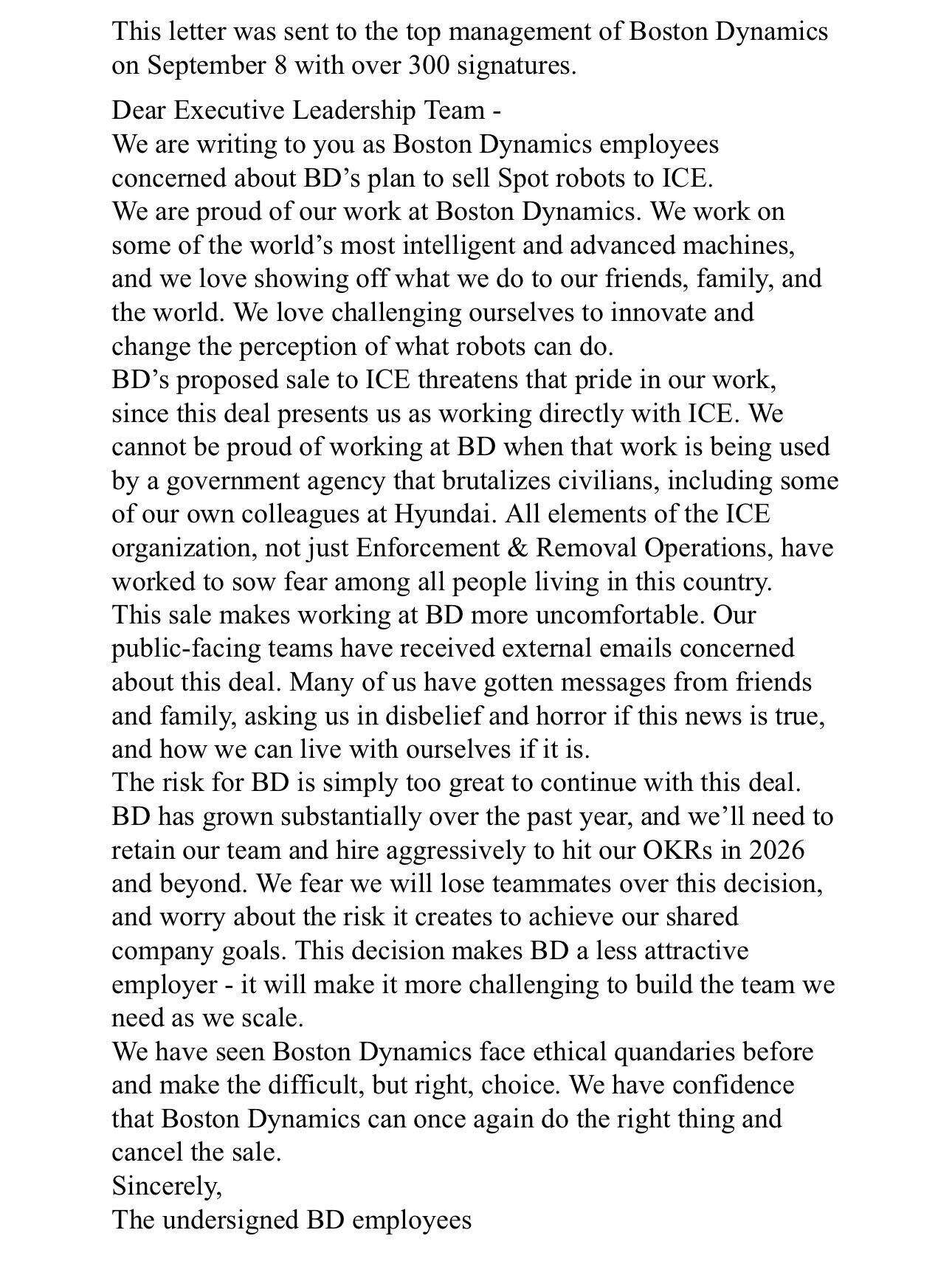
Hundreds of employees at the US robotics firm Boston Dynamics signed a petition calling for executives to halt a sale of the company's robot dogs to US Immigration and Customs Enforcement—but executives stood by the deal, while saying the robots would not be weaponized.
On September 25, the Department of Homeland Security contract awarded $1.3 million to a Connecticut company called Radeco to provide ICE with modified versions of Boston Dynamics' quadruped robots. But Boston Dynamics workers sent the petition letter with more than 300 signatures—half of them anonymous—to the company's executives in early September and shared copies with The Boston Globe and WBUR public radio station.
"Many of us have gotten messages from friends and family, asking us in disbelief and horror if this news is true, and how we can live with ourselves if it is," according to the petition. "The risk for Boston Dynamics is simply too great to continue with this deal."
The petition described the signatories as employees who normally "love showing off what we do to our friends, family and the world" and who "love challenging ourselves to innovate and change the perception of what robots can do." The 300 signatures come out of a total Boston Dynamics workforce of approximately 1,400 people.
The ICE contract covers the purchase of four Boston Dynamics Spot robots that were modified by Radeco to be marketed as a robot platform named Cerberus. The contract describes these Cerberus robots as being intended to "detect radiation, toxic gas leaks and explosive threats in urban environments or disaster zones," along with enabling other remote observation and inspection missions.
A centerpiece of the upgraded robot is an oxygen sensor that is intended to "ensure the air quality is breathable when personnel are placed in confined spaces such as tunnels." The Cerberus robot dog also has a camera equipped with 30-times zoom capability, 360-degree cameras, and infrared thermal imaging.
The Cerberus robot dog would come with an optional Spot robotic arm that enables it to manipulate objects and open doors, along with providing additional camera views when extended. The ICE contract describes the robot as being generally capable of navigating complex industrial environments on its own and executing "repeatable autonomous missions with minimal human intervention."
Such a purchase was justified in the ICE contract as supporting the Homeland Security Task Forces' mission to carry out "counter-illicit cross-border tunnel operations" and dismantling "cross-border human smuggling and trafficking networks" being conducted by "criminal cartels, foreign gangs and transnational criminal organizations throughout the United States."
"Spot robots are tools that help keep people out of harm's way," a Boston Dynamics spokesperson told Ars in a statement. "Regardless of any political implications or personal feelings about the organizations involved, if our robot can help keep people safe, we believe it should."
Boston Dynamics has also emphasized that the robots would primarily be used by ICE's Homeland Security Investigations unit that is focused on combating transnational criminal organizations, according to WBUR.
However, the Brennan Center for Justice has documented the Homeland Security Investigations unit as frequently being involved in deporting undocumented workers and conducting workplace raids during the first administration of President Donald Trump. These operations occurred between 2018 and 2021, before being halted by US Secretary of Homeland Security Alejandro Mayorkas early in the term of President Joe Biden.
During Trump's second term that began in January 2025, the Homeland Security Investigations unit once again diverted thousands of agents to immigration enforcement and deportations after one of Trump's executive orders redefined the unit's primary mission, according to the Immigration Policy Tracking Project.
The Boston Dynamics employee petition specifically referenced an ICE and Homeland Security Investigations workplace raid that detained 475 primarily South Korean workers at the Hyundai Motor Group Metaplant America facility in Georgia on September 4, 2025. Hyundai Motor Group became the parent company of Boston Dynamics after acquiring the US robotics company in June 2021.
"We cannot be proud of working at Boston Dynamics when that work is being used by a government agency that brutalizes civilians, including some of our own colleagues at Hyundai," according to the employee petition. "All elements of the ICE organization, not just Enforcement & Removal Operations, have worked to sow fear among all people living in this country."
That single largest immigration enforcement operation of its kind sparked public outrage in South Korea and led to South Korean leaders questioning the country's business investments in the United States. However, Hyundai has maintained its operations at the US electric vehicle production at the Metaplant America factory and still plans to deploy thousands of Boston Dynamics' Atlas humanoid robots starting at its US facilities.
The Boston Dynamics leadership team has stood by the ICE contract with Radeco, which would mainly involve Boston Dynamics providing technical support for the modified robots, according to The Boston Globe.
The company also responded to the employee petition via an email from Amanda McMaster, former interim CEO for Boston Dynamics. That email was obtained and quoted in part by both The Boston Globe and WBUR.
"We believe this decision is in line with our purpose of ethically advancing intelligent machines in service of humanity," McMaster wrote in her email. She urged workers to "respect and accept this decision, even if you do not agree with it."
McMaster also pointed to the company's terms and conditions for sale of the Spot robots that prohibit "intentional use of the Product to harm or intimidate any person or animal, as a weapon, or to enable any weapon." The company previously signed an open letter opposing the weaponization of "advanced-mobility general-purpose robots."
The Boston Dynamics spokesperson told Ars that the company has "worked productively" with the Department of Homeland Security and Homeland Security Investigations unit for years, and said the latter have abided by the company's terms and conditions of sale.
The robotics company said it would also "take immediate action" if any customer misused Spot, although it said "there have been no cases of a customer violating those terms and conditions" while working with the Department of Homeland Security and other "public safety agencies."
"That would include specific steps like voiding the warranty, refusing all future software updates, terminating their license, taking any appropriate legal action available to us, and likely never selling to that customer again," said the Boston Dynamics spokesperson.
The Boston Dynamics employee backlash to the ICE contract comes as the company is developing a new advanced robotics and AI facility in Waltham, Massachusetts, near its headquarters. The $100 million project includes creating 1,250 new jobs by 2033, according to a company press release.
The ICE contract represents "a complicated and emotionally charged topic for many people, including some of our own employees," said the Boston Dynamics spokesperson. "As our company continues to grow at a rapid pace, we will continue welcoming a highly diverse group of employees with views on every side of the social and political spectrum."
But as Boston Dynamics ramps up its production capabilities and deployment of robots such as Spot and Atlas, the employees who signed the petition expressed concerns that the company's association with the ICE contract will threaten both workforce hiring and retention.
"We fear we will lose teammates over this decision, and worry about the risk it creates to achieve our shared company goals," according to the petition. "This decision makes Boston Dynamics a less attractive employer—it will make it more challenging to build the team we need as we scale."
- Read More...
- 1251 words in story
- 13 comments

IBM touts its Z series mainframes as the most reliable and cost-effective environments for certain workloads, but on Monday also acknowledged that the platform can drift towards hard-to-manage complexity that reduces resilience and therefore needs some help from AI.
Big Blue admitted that not all mainframe estates exist in a state of perfect bliss in a Statement of Direction for a forthcoming product called "IBM Z Atlas" that the document describes as "an AI-native solution that uses system intelligence to ground AI skills and agents in the context of key workflows like planning and validating changes or modernizing applications and infrastructure."
"It intends to map a client's entire z/OS stack across infrastructure, middleware, and applications, and then use that system intelligence to reduce the manual effort of tasks like patch management, regulatory response, and sharing knowledge across every team, from systems programmers to application developers."
Big Blue also hopes the tool helps mainframe techs and ops teams "better understand how components connect, interact, and depend on one another."
"IBM Z Atlas intends to eliminate the leading cause of unplanned z/OS outages – changes that aren't proven to be safe – by mapping how a change impacts the z/OS stack, testing it, and validating it," the Statement of Direction adds. "This design accelerates clients' modernization efforts by keeping experts in control and giving every practitioner, in operations or development, the same shared Z system visibility to reduce risk."
IBM reckons Z Atlas will help mainframe shops do four things:
Understand systems and dependencies before making decisions or initiating changes
Assess potential impacts, risks, and operational considerations
Accelerate planning for modernization, deployment, and provisioning
Provide trusted context for AI-native experiences and automation
While IBM clearly sees AI has a role in helping its customers to manage mainframes, it appears not to be going all-in on AIOps – the emerging practice of allowing agents to either keep tech infrastructure humming, or autonomously find issues and develop proposed fixes.
"IBM intends for AI-assisted insights and recommendations to preserve appropriate human review and decision authority," the Statement of Direction reads.
The multiple mentions of modernization caught your correspondent's eye, because IBM's many rivals often suggest the best way to modernize mainframes is by trashing them and moving the applications they run to another platform. In recent years, vendors have suggested using generative AI to rewrite mainframe apps in other languages, an idea that analyst firm Gartner thinks is highly overrated.
IBM clearly wants modernization to mean making mainframes easier to live with so that customers persist with the platform, a critical outcome as the company's revenue spikes when each new generation of Z-series machines hits the market. Indeed, IBM CEO Arvind Krishna last week said the current Z17 generation of mainframes has outsold all others by $1 billion.
That kind of result well and truly puts to bed the "death of the mainframe" narrative that, like next year becoming the Year of Linux on the Desktop, is a prediction that never goes away and never comes to fruition. With Z Atlas, IBM seems to be trying to ensure rumors of the mainframe's demise are even more exaggeratedly false.
- Read More...
- 10 comments

On October 22, an attacker gained unauthorized access to Luanti's ContentDB's servers, including emails, hashed passwords, and uploads. ContentDB is the official source to download content such as mods, games and texture packs (collectively referred to as "packages") that have been developed by the Luanti community, for the game formerly known as Minetest.
Users are asked to take the necessary actions.
- Read More...
- 6 comments
Payload blobs measuring 12.9 to 13.7 MB were large enough to evade GitHub code search:
A new Miasma-family npm worm, originally believed to be just a test with no victims, secretly armed 42 real GitHub repositories from 11 owners, hijacking accounts as early as July and using a stealthy payload built to stay hidden from GitHub and automated scanners, according to JFrog researchers.
Threat hunters at SafeDep, an open source supply chain security firm, first spotted the "testmetest" npm campaign last week, identifying 18 packages linked to the same operator between October 19 and October 25, including releases containing credential-stealing malware. As with earlier npm worms, the malware is self-replicating, steals credentials, and installs a wiper that deletes the home directory when the victim revokes the stolen GitHub token, the security researchers noted.
The new npm worm shares code with June's Miasma Phantom Gyp worm, and adds Mini Shai-Hulud's token-revocation wiper.
As of October 22, however, SafeDep had found no compromised third-party packages or victims. "All observed activity belongs to the operator's own test accounts," the team wrote.
As with most happy-ending security stories, that proved too good to be true.
In a Monday report, supply chain security company JFrog said its analysis proved otherwise, and found the testmetest campaign operator "had already armed real repositories belonging to established developers and organizations."
This isn't just about timing, either, according to JFrog researchers Guy Korolevski and Yair Benamou. "The payload blobs were large enough to evade the GitHub search and API paths normally used to find this kind of compromise," they wrote.
The attackers planted execution hooks for AI coding assistants and development tools, including Claude, Gemini, Cursor, and VS Code, alongside polymorphic wrappers measuring 12.9 to 13.7 MB that decode a hidden CI-publisher payload. Separately, the npm worm steals credentials, modifies repositories and CI configurations, and spreads through npm packages.
The malware also uses a compiled native add-on to decrypt and launch a separate payload. Before executing, the loader checks for CI runners, containers, sandboxes, debuggers, and other signs of automated analysis, exiting silently when it detects them to reduce the likelihood of detection by security scanners.
The researchers also found a second build that skips the encrypted file. "It forks, detaches and runs a hard-coded command that pulls a loader from a repository on the operator's own GitHub account," they wrote. That account – CementBeetleSteeple – hosted 17 campaign repositories in total.
JFrog connected this account to a shellpanel scanner, previously documented by Socket in a large-scale campaign that abused GitHub Actions in compromised repositories to exploit CVE-2026-41940 and steal server credentials.
CVE-2026-41940 is an authentication bypass affecting cPanel and WHM. CISA added it to its Known Exploited Vulnerabilities catalog in April, and cPanel has since published patched versions.
"C2 infrastructure were previously reported by Socket; our findings connect them to the testmetest GitHub victim cluster through artifacts and workflows on the same hijacked owners," the JFrog researchers wrote. They added that while they found 42 armed GitHub repositories and attempted internet-wide exploitation, they did not confirm any downstream cPanel compromises.
- Read More...
- 526 words in story
- 0 comments
Harddrives and storage are getting so expensive in the age of AI that companies are looking for old, reliable and working solutions. Solution --> Magnetic tapes. They never really went away but are now in for a resurgence.
Fujifilm's magnetic tape investment targets fivefold output by 2028
Advanced tapes will offer capacities reaching 100 TB.
Tape storage can cost one-quarter as much as HDD storage.
Will we see the return of other old tech to cover the gaps? Eco friendly giant punch-cards?
https://en.cryptonomist.ch/2026/10/28/fujifilm-magnetic-tape-investment/
https://vgtimes.com/tech-and-hardware/172697-fujifilm-plans-fivefold-magnetic-tape-output-increase-as-ai-demand-grows.html
https://asia.nikkei.com/business/technology/artificial-intelligence/as-ai-revives-magnetic-tape-fujifilm-plans-biggest-buildup-in-two-decades
- Read More...
- 17 comments
Two US senators say the Trump administration is breaking the law by withholding the FISA court decision while it presses Congress to renew America's most sweeping surveillance program.
Congress is being asked to renew one of the most expansive surveillance authorities in US law. The administration, reportedly, just won't say what the court overseeing it actually found.
That is the situation senators Ron Wyden and Adam Schiff described publicly on October 26, alleging the Trump administration missed a legally required deadline to release a significant Foreign Intelligence Surveillance Court opinion concerning how intelligence agencies handle Americans' communications intercepted under Section 702.
The deadline passed September 13. No opinion appeared. No waiver. No public explanation.
[Source]: GADGET REVIEW
[Also Covered By]: WIRED
- Read More...
- 22 comments

from the favorite-fruit-flavored-technology dept.
https://www.raspberrypi.com/news/emulate-apple-ii-on-raspberry-pi/
The Apple II was not the first personal or home computer, but it was part of the iconic 'trinity' of computers that came out in 1977: Apple II, Commodore PET, and TRS-80.
[...]
In designing the Apple II, Steve Wozniak took inspiration from his work on the Breakout arcade game during his time at Atari. It's why the Apple II has colour graphics, support for paddle controllers, and even audio.
[...]
The Apple II included a version of the BASIC language that only supported integer numeric data types: by eschewing floating-point numbers, Wozniak's Integer BASIC, as it was called, processed numbers extremely fast. This made it less than ideal for certain programming tasks, but it was fantastic for video games.
[...]
For Apple II emulation on Raspberry Pi, we are using the LinApple emulator. It's a fork of the AppleWin emulator which was originally created by Mike O'Brien. David Baucum (maxolasersquad) and several other contributors got it running on Linux. You may also want to have a look at audetto's fork of the AppleWin emulator. Because audetto's fork is regularly synchronised with the original AppleWin GitHub repository, it tracks AppleWin features more closely.
[...]
Here's a little BASIC program you can try running. You can either type it into the emulator, or you can find the program in the ch03/AppleIIBasicPrograms.dsk file in the GitHub repository.
[...]
This will draw a small square on screen. Use the W, A, S, and D keys to move it around the screen. The program is quite simple.
[...]
After you run a graphical program, you'll only have a small text area below the graphics mode portion of the emulator screen. You can type the TEXT command and press ENTER to return to text-only mode. You'll also find these commands helpful:LIST — lists all the lines of the current BASIC program.
RUN — runs the current program.
NEW — erases the current program and lets you start afresh.
CATALOG — lists all files on the disk image.
SAVE NAME — saves the current BASIC program under whatever file name you specify.
LOAD NAME — loads the program with the specified file name.
CTRL+C — use this key combination to stop a running BASIC program.Apart from CATALOG, these commands only apply to BASIC programs. Many games are binary executable files that don't include BASIC source.
You can find some fun type-in programs in Lee Fastenau's collection of short programs.
[...]
This tutorial is part of a series of emulation guides in The Raspberry Pi Guide to Retro Gaming — a definitive guide on how to play your favourite games of yesteryear on a Raspberry Pi. You can also find it in the latest issue of Raspberry Pi Official Magazine.
- Read More...
- 8 comments
The findings suggest possible surveillance interest in countries where Starlink is banned or restricted.
Discover-Tech, an Israeli advertising firm previously linked to the delivery of zero-click spyware, is the top bidder for Starlink ad impressions in 105 countries, according to a new report from Reuters. Researchers say it all points to a large-scale tracking effort aimed at users of SpaceX's satellite internet service.
John Scott-Railton, a senior researcher at the University of Toronto's Citizen Lab, posted on X that data from TrendAI suggest the existence of a "worldwide surveillance op targeting @Starlink users."
Discover-Tech was previously named in Citizen Lab's October 15th report as the buyer of ordinary-looking ads that delivered Candiru spyware to devices at Al Jazeera without any user interaction. Candiru is an Israeli mercenary spyware vendor (now rebranded as Integrity Labs) that develops tools capable of silently compromising phones and computers. In 2021, the U.S. Department of Commerce's Bureau of Industry and Security added Candiru to their trade restriction list, known as the Entity List, over concerns it supplied surveillance technology used against journalists, activists, and government officials.
[Source]: GIZMODO
- Read More...
- 9 comments

https://www.engadget.com/2295033/warhound-genetically-engineering-dogs-military/
Warhound, a new startup that has just raised $200 million in funding, aims to genetically engineer war dogs for the US military and fit them with high-tech gear. It's a project by Colossal Biosciences' Ben Lamm and Anduril's Palmer Luckey. Lamm has told Wired that Warhound has already started editing genes of the cell samples taken from its first batch of donor dogs. Specifically, the startup collected samples from top-performing military, police and first responder dog breeds in the US, mostly Belgian Malinois, some labradors and some shepherds. The goal is to clone them after scientists working for Colossal have tweaked their genes.
Those scientists will initially focus on making them less likely to develop health conditions that commonly affect their breeds, such as hip dysplasia and certain cancers. In the future, Lamm thinks the dogs could be enhanced further. Scientist could incorporate more genetic changes to make them faster and more agile or to enhance their sense of smell, Lamm told TechCrunch.
Luckey, if you'll recall, founded Oculus VR and designed the Oculus Rift headset. His company Anduril teamed up with OpenAI in 2024 to develop AI for the Pentagon. More recently, it secured a contract with the US Army to create its next-gen battlefield intelligence system alongside Palantir. Meanwhile, Lamm's biotech company is behind several "de-extinction" initiatives, including one that claims to have revived the dire wolf and another that aims to bring back the woolly mammoth.
So where does Luckey's Anduril come in? Warhound doesn't seem to have plans to create cyborg dogs — for now. Anduril will be designing tools and the software powering them, which will help protect the dogs while they work. Think goggles, vests and body armor. Luckey is a partner in the business, but neither he nor Anduril has a stake in the startup. Colossal Biosciences has equity in the company, and Lamm is on its board. David Spirk, who most recently worked at Palantir, now serves the startsup's CEO.
Warhound expects its first batch of genetically engineered dogs to be born in early 2027. They will be trained to perform various tasks working dogs do, such as detect bombs and aid in search-and-rescue operations.
- Read More...
- 19 comments
How much are you willing to pay to keep using your favorite app?
Maybe you've used it for years. Perhaps it performs a function so essential and specific that you couldn't imagine what you'd do without it.
[...]
Earlier this year, Evernote, a note-taking app, changed its subscription tiers, forcing some users to go from paying $130 per year to $250.
[...]
10 times more than what Evernote charged for annual subscriptions from its 2008 launch until 2016.
[...]
When Bending Spoons bought Evernote in 2023, the app had a sizable customer base. In a June SEC filing, Bending Spoons explained that it was attracted to Evernote's 200 million accounts and high user engagement.
[...]
Although price hikes risk eroding customer loyalty, Bending Spoons investigated how much change in pricing and subscription tiers Evernote users would tolerate.
[...]
Shortly after the acquisition, Evernote prices increased (from $8 per month to $15/month, or from $70/year to $130/year). The new prices aimed to better align "with how different customer segments... engage with" Evernote, and, in combination with product improvements, led to "average revenue per monthly active user being 2.5 times as high in 2025 as in 2022," Bending Spoons said.
[...]
Evernote released over 150 product updates in 2025, the filing says. Evernote v11, a huge update, came out in 2026.While issuing layoffs in July 2023, Bending Spoons said Evernote had been "unprofitable for years." By November 2024, the app had reportedly reached record levels of profitability.
[...]
Comments from Inkdrop's developer also help explain steep price hikes imposed on longtime app users.In 2024, the Markdown note-taking app's price doubled from $5/month to $10/month or $50/year to $100/year. At the time, Inkdrop's creator, Takuya Matsuyama, wrote a blog post
[...]
Inkdrop's developer was less concerned about growing its customer base and more interested in extracting additional revenue from current users.
[...]
Mature apps with longtime subscribers, initially drawn in through low prices and reliable features, face a predicament. Those loyal users are good for business, but they're often content with software that functions as it always has—and don't expect to pay more for it.But stagnant growth doesn't mix well with inflation or stockholder expectations.
[...]
prices apps launch with aren't sustainable in the long term, as Plex has said about its lifetime pass, which has seen its price increase by 525 percent over two price hikes since March 2024. We've seen a similar pattern with streaming apps.
[...]
when price hikes are unavoidable, giving customers advance warning can go a long way toward showing loyal users they're valued.Another option is to offer more subscription tiers in general. Developers often cite new features to justify higher subscription prices, but not all users want those features.
[...]
Sometimes, various internal and external factors make higher prices inevitable. When that happens, users would be wise to reexamine whether that beloved app is still the best option after all these years.
Related Stories:
DMCA Takedowns Remove Perfectly Legal Plex Pages from Google - 20210131
Critical Flaw in Evernote Add-On Exposed Sensitive Data of Millions - 20190622
Plex is Shutting Down its Personal Cloud Streaming Service - 20180912
Forget Fast-Forwarding, Plex DVR Can Now Remove Commercials for You - 20171130
Evernote, the Wounded Silicon Valley Unicorn - 20151006
Samsung Allegedly Inserts Ads into Locally-Stored/Played Movies - 20150212
- Read More...
- 11 comments
https://www.engadget.com/2295216/most-popular-streaming-platforms-united-states-not-what-you-think/
These numbers come from Nielsen's The Gauge, which tracks viewing time on TV, not subscriber numbers, app downloads or viewing on a phone. In July 2026, 49 percent of all TV time was spent on streaming. Live channels watched via YouTube TV count toward broadcast or cable viewing, so the standalone pay TV service doesn't inflate YouTube's streaming share. It's interesting that the platform most focused on individual creators beat core streaming services so handily, especially when this is TV-only and thus doesn't include people looking up tutorials on their phones.
Disney, Paramount and Warner Bros. Discovery each have several services grouped together, while The Roku Channel and Tubi are counted individually. These numbers are for July, before Paramount (now Skydance) acquired Warner Bros. Discovery on October 6.
Despite its lower position, Peacock had a good month, with TV viewing up 15 percent from June. World Cup coverage gave it a boost, and Love Island USA had 4.9 billion viewing minutes in July. Nielsen said it was still evaluating the impact of a June change to how it measures Tubi.
YouTube reported more than 700 million hours of podcasts watched on living-room devices in October 2025, up from 400 million a year earlier. Its regular videos are free with ads, but it has no shortage of ways to take your money. You can rent or buy movies, subscribe to YouTube Premium or pay for individual creator memberships. Netflix primarily relies on recurring plans, while Prime Video offers rentals and add-on channel subscriptions.
Fox already owns Tubi and agreed to acquire Roku in a deal valued at approximately $22 billion in June. Roku confirmed on October 19 that the transaction was still pending.
- Read More...
- 11 comments
from the not-a-good-time-for-Star-Trek-actors dept.
- Read More...
- 34 comments
- Breaking News
Finland is angry at Google over illegal deforestation. Chopping down about 400 000 trees to make room for two data centers. The construction has been halted.
In addition to the 250,000 trees felled at Muhos, Annala estimates that an additional 150,000 trees were felled at Otanmäki. Because the trees have been felled illegally, she says wood from the two sites cannot be sold to wood-processing plants.
She said the system depended a lot on trust, which she believes Google took advantage of. "They bought the vast land area and they just started to cut it, just like that," she said. "It's pure arrogance and it's amazing."
Google apologized and said it acted based on its understanding of Finnish law at the time.
Google said it was working to protect water quality at the Muhos site, and that it planned to plant trees across 130 hectares there. Conservationists say that figure is too low to have any real impact in comparison to the damage done by the tree felling.
We so sorry. Promise it won't happen again, until next time. I know Finnish is hard. But don't Google offer a tool to translate it to something they can read and understand?
Jussi Kangasharju, head of computer science at the University of Helsinki, said that while datacentres brought a limited number of jobs, potentially boosting the local economy, the benefits on a national level were minimal. "Really, for Finland, there are no benefits," he said. "They are international companies serving international customers. Very little corporate taxes go to Finland. Datacentres ultimately have very little benefit for others except the datacentre operator."
No benefit.
I guess the next US export is finally here. Hating Data center buildings. All them trees gone is not going to help when the electricity bill comes ...
https://www.theguardian.com/environment/ng-interactive/2026/oct/22/finland-google-felling-trees-datacentre
https://cybernews.com/news/google-finland-data-center-trees/
- Read More...
- 15 comments

Multiple surveys count how many lawyers are using AI. A new report set out to ask what happens to their workload when they do.
AI isn’t replacing in-house lawyers, but the capacity it frees up is being absorbed by new work, much of it drafted by AI itself.
That is just one of the pictures to emerge from interviews with legal and compliance leaders at companies that included eir, Flipdish, Gilead Sciences, IMRO, Mastercard, Uniphar and Wayflyer for a new report, ‘From AI Adoption to AI Advantage’, produced by Dentons Ireland and SiliconRepublic.com.
Rather than creating another survey full of statistics, we set out to ask what responsible and effective use actually looks like inside a legal function today, and the results often belied the received wisdom.
Almost nobody we interviewed reported AI replacing a role or a function outright. Where it is paying off, it is mostly in repetitive work such as invoice review, contract checking and customer screening, rather than in the research, drafting and judgement calls at the heart of the job.
Sergey Kinchin, senior counsel at Uniphar, said his own thinking had changed completely in a year. “Last year I would have thought it would probably reduce headcount. Now I’m seeing it more as unlocking unmet demand,” he said. “I think the complexity of the work that’s left after AI will increase. The bottom might shift up, but the overall pyramid of work will increase and grow.”
It was a sentiment echoed by many of our interviewees. Máire Neary, who was VP of people and legal at Flipdish when she was interviewed, described treating AI “as a junior colleague, something that’s additive, that can challenge me, but you have to remember you’re the lawyer in charge at the end of the day”.
The catch is that the same tools are now in everyone else’s hands. Producing a long, polished complaint, subject access request or grievance is close to cost-free today, and the report says AI-assisted drafting now seems to touch the majority of incoming disputes, subject access requests, grievances and customer complaints.
Sorcha Nic Mhurchú, general counsel at eir, said the cost lies less in reading that material than in sorting through it. “You end up going back and having to figure out, line by line, what is relevant”, she said. “So that adds a lot of volume and time to any response, and that’s a reality for everybody, not just us.”
At IMRO, chief commercial officer Seán Donegan is glad he saw it coming. “Two years ago, I sat down with our licensing team and I said, guys, I’m going to make a prediction now,” he said. “The volume and tenacity of queries and complaints is going to increase exponentially with these AI tools.”
And it’s not just incoming correspondence. Uniphar’s Kinchin described a call with a part of the business that had gone all-in on AI “We joined a call and we had five people bring six AI-generated opinions to the call, on a question that touched a regulatory issue,” he said. “In trying to reconcile it, the AI had essentially confused itself.”
Deirdre McCarthy, chief legal and people officer at Wayflyer, added the issue is quality as well as quantity. “AI can produce so much content that sometimes looks good, but may not always be good,” she said. “So you can end up with people spending a lot of time just trading red lines because they’re putting it into their AI tool.”
Many of the interviewees remarked that this makes legal expertise all the more valuable. “In a world increasingly full of AI-generated legal content, genuine human judgement may become more valuable rather than less,” said Carlo Salizzo, head of technology and digital regulation at Dentons Ireland, speaking at a preview of the report last week.
What AI costs is easier to count than what it delivers. Flipdish’s Neary was clear about the risk of experimenting for its own sake. “I think we’ve seen a lot of AI for AI’s sake, but every lawyer, every operator, needs to ask what the return on investment is,” she said. “It’s great if your team is enjoying building and experimenting and having fun, but what have you got to show for it, particularly once you’re looking at a high LLM [Large Language Model] bill, or the cost of maintaining it down the line?”
None of the interviewees were confident they could demonstrate a return beyond obvious gains such as efficiency and risk reduction. Rebekah Dobson, head of international legal operations at Gilead Sciences, said the premise of the question itself is flawed.
“No one has proved ROI on AI as of yet because companies were not tracking the metrics prior to AI to have a starting point for setting KPIs and measuring impact of AI,” she said. “I did read an interesting article the other day that said ‘you don’t make Excel prove its ROI, it’s just there’, and I think that’s a really valuable comparison.”
Legal teams have a particular problem here, according to David Kirton, partner, technology and digital regulation at Dentons Ireland. “We tend to record the work lawyers do. We are much less good at recording the work they no longer have to do,” he said.
Cost, meanwhile, has so far only moved one way. As AI providers shift from flat licence or per-seat fees to consumption-based, token-metered pricing, bills become much harder to forecast.
Nic Mhurchú said eir feared being on a treadmill. “The licence fees and the token fees are so huge that we fear that if we start adopting and using and buying licences, we’re on a treadmill of just paying more fees, because these companies have to justify the high investment that they’ve been putting into these tools,” she said.
Jessica Williams, vice president of legal tech strategy at Mastercard, says she wants to see vendors offer more solutions and controls. “Budgets aren’t infinite and I’m going to have three or four people who are AI geniuses and they’re going to burn through tokens”.
“Then I’m going to have a bunch of other people who just do one or two things here and there … How do I balance all of that and create a predictable budget line for the company?”
Cornelius Grossmann, Dentons’ global head of solutions development, expects AI costs to rise two- to fivefold within two years and warned of a coming ‘cost cliff’. “I think the whole token economics will mean we’ll probably hire people to monitor AI cost in a big law firm,” he said. “And others may need to do that too, because it could bankrupt you if you don’t pay attention.”
Wayflyer’s McCarthy expects token spend to become the next big management question. “I think this is the next interesting wave, what we spend on AI and who gets to spend what, based on the tasks at hand?” she said.
It was a sentiment echoed by Dentons’ Kirton. “Who gets access? Which tasks justify the cost? How do you allocate consumption across a business? And how do you prevent successful adoption from producing an unexpectedly large technology bill?” he asked, adding that many legal leaders are still working out how to manage that exposure without throttling hard-won AI adoption.
Overall, interviewees described something more demanding of both sides of the client and law firm relationship: a renegotiation of who does what, who is trained for what and who pays for what, conducted in real time while the technology changes apace.
“It is probably fair to say that the legal function has not been transformed by technology to quite the same extent as areas such as finance, sales or procurement,” said Dentons’ Salizzo. “AI may be the catalyst that changes that.”
The full report is now live and can be downloaded here.
- Read More...
- 1385 words in story
- 16 comments