SoylentNews is people
SoylentNews
Submission Preview
Seagate Announces its First Helium-Filled Hard Drives for Datacenters

Seagate has announced its first helium-filled hard disk drive [anandtech.com], a 10-terabyte Seagate Enterprise Capacity 3.5-inch HDD. Competitor and Western Digital subsidiary HGST has had multiple [hgst.com] generations [soylentnews.org] of helium-filled HDDs ranging from 6-10 terabytes.
Seagate said last year that it had experimented with helium-filled hard disk drives for about 12 years. While the company is several generations behind HGST with its hermetically sealed commercial HDDs, the company's helium platform should be rather robust in terms of both reliability and performance.
At present, Alibaba and Huawei, who both said that the new hard drives help them to reduce their costs, [are evaluating] Seagate's Enterprise Capacity 10 TB HDDs. Some other companies have also received Seagate's new HDDs. HGST's 10 TB helium-filled hard disk drives are already deployed by companies like Netflix, which need [the] maximum [density] of storage.
Seagate itself predicted recently that in 2016 its 8 TB hard drives would be its most popular high-capacity models. The company did not announce [a] high-volume availability timeframe [for] its 10 TB HDDs, but it is unlikely that Seagate will ship a lot of such products this year. Pricing of Seagate's Enterprise Capacity 10 TB HDD is unknown.
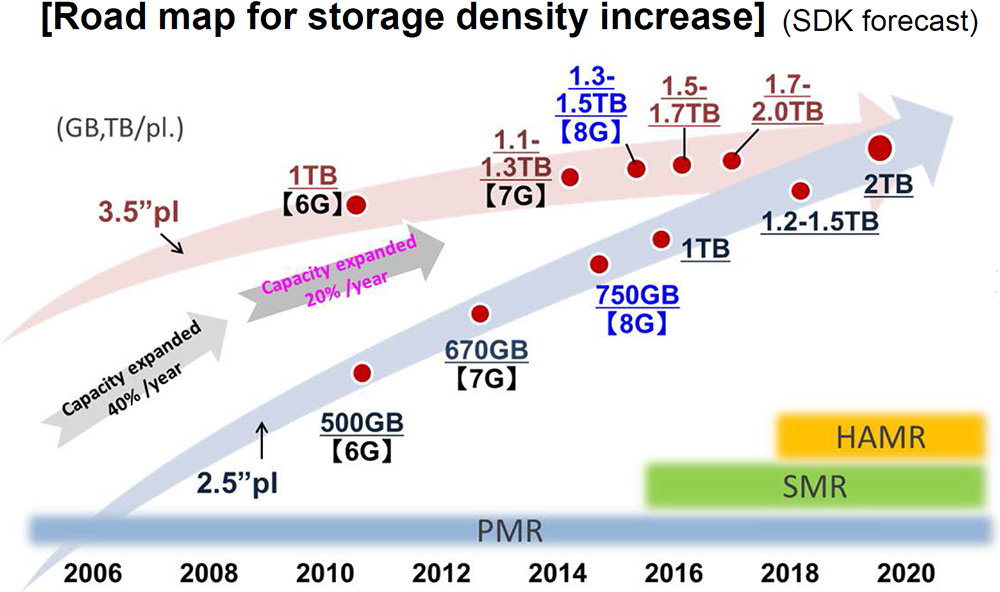
The drive contains seven 1.43 TB platters. Some of Seagate's latest air-filled HDDs contain as many as six platters, including an 8 TB NAS drive [anandtech.com] announced yesterday. The company has not provided detailed specifications of the drive, but if it is anything like HGST's helium drives, it will have lower power consumption, vibrations, and operating temperature than air-filled drives.
Helium sealed drives are just one of the technologies Seagate and WD will be adopting in order to keep hard drives relevant over the next two decades [anandtech.com]. Two dimensional magnetic recording (TDMR) and shingled magnetic recording (SMR) will slightly extend the capacity of perpendicular magnetic recording (PMR) platters. PMR drives may eventually reach 2 TB per platter using these technologies, according to a Showa Denko (SDK) forecast [anandtech.com]. Heat-assisted magnetic recording (HAMR), which has been delayed to at least 2018 [anandtech.com], will pick up from where PMR leaves off. Bit patterned magnetic recording drives could appear sometime in the 2020s and may also be combined with HAMR.