SoylentNews is people
SoylentNews
Site News
Join our Folding@Home team:
Main F@H site
Our team page
Support us: Subscribe Here
and buy SoylentNews Swag
We always have a place for talented people, visit the Get Involved section on the wiki to see how you can make SoylentNews better.
- [c0lo] "The right to listen has been abolished in US" deleted
- [khallow] Retread narratives
- [hubie] Patriots or Seahawks? Who ya got in Super Bowl LX?
- [fliptop] Massive Solar Farm Approved in Middle of NY Amish Country
- [Tork] RubyAI's insta-Casettes.. second vid added!
- [Runaway1956] There are home routers, and there are great home routers
- [Arthur T Knackerbracket] US Pediatricians Give Middle Finger To RFK Jr.
- [turgid] Loony Tunes and Earning a Living
- [Mojibake Tengu] Veterans on Sale
- [mcgrew] Why don’t these exist?
- [janrinok] NATO Allies to Commence a Rotational Presence in Greenland
- [bzipitidoo] battling high blood pressure
- [canopic jug] 39C3: Power Cycles Streaming (Saturday through Tuesday)
- [jasassin] AI real life experience or
- [Gaaark] If everyone around you is a loser or weak or stupid...
Older Stuff
-
November 17- Google to Expand London HQ Despite Brexit (16)
- Insiders at Offshore Call Centres Are Offering the Private Details of Customers of Australian Telcos (18)
- Ending the US Electoral College (252)
- 'Post-Truth' Declared Word of the Year by Oxford Dictionaries (83)
- Debian Has Entered "Transition Freeze" for Squeeze (29)
- Russia Withdraws Rome Statute Signature Following ICC Crimea Report (18)
- China Censors References to Kim Jong Un's Weight (32)
- Linux Close to Finalizing its Top 500 Domination (30)
- Facebook Discloses Additional Advertising Metric Miscalculations (12)
- How I Became a Cyborg and Joined an Underground Medical Movement (52)
- Microsoft Joins Linux Foundation (53)
- The Mechanics of Mechanophilia: Why Men Find Siri Sexy (62)
- "Emotional Support Animals" Riding With Owners Aboard Commercial Airlines Flights (52)
- CRISPR Gene-Editing Tested in a Person for the First Time (11)
- Troubles in Ukraine Parliament Continue (20)
Quick Links

Submitted via IRC for TheMightyBuzzard
Despite loudly, and repeatedly, raised concerns from activists and members of Parliament, the UK's Snooper's Charter (a.k.a., Investigatory Powers bill [PDF]) has been passed by both parliamentary houses and only needs the formality of the royal signature to make it official.
[...] The government, of course, is trying to portray this as nothing more than a fine tuning of pre-existing laws, specifically the Regulation of Investigatory Powers Act (RIPA). Glossed over in its perfunctory "nothing to see here" explanation is the fact that RIPA was also rushed into existence to codify other secret and illegal surveillance programs.
But it's no ordinary update of existing investigatory laws. Jim Killock of the Open Rights Group calls the Snooper's Charter "the most extreme surveillance law ever passed in a democracy." Thanks to the new powers, UK intelligence agencies should be able to put together very extensive dossiers on pretty much anyone they feel like.
Quick, Deucalion, run!
- Read More...
- 27 comments

Biochemists from Trinity College Dublin have solved an old mystery as to the cause of especially smelly camel urine, with implications for the millions of people affected by African parasites called trypanosomes. These parasites frequently cause fatalities via sleeping sickness.
The biochemists have unearthed a metabolic by-product of trypanosome activity known as indolepyruvate, which may offer excellent possibilities for developing anti-trypanosome drugs and therapies because inhibiting its production may be key in fighting the parasite.
Additionally, because this by-product modifies the behaviour of important immune cells and prevents them from becoming fully active, it has potential as an inhibitor of common inflammatory diseases.
...
Professor Nolan said: "Camel herders have long known that the urine of camels infected with trypanosomes has a pungent odour, and is reddish brown in colour. We found that this is directly attributable to parasite breakdown of aromatic amino acids, such as tryptophan, in the host, and to the excretion of the novel by-products into the bloodstream."
"The Riddle of Putrid Camel Urine." There's got to be a joke in there somewhere.
- Read More...
- 11 comments

Submitted via IRC for TheMightyBuzzard
Starting with Chrome 56, planned to be released to the wider public at the end of January 2017, Google will remove support for SHA-1 certificates.
"The SHA-1 cryptographic hash algorithm first showed signs of weakness over eleven years ago and recent research points to the imminent possibility of attacks that could directly impact the integrity of the Web PKI," Chrome Security team member Andrew Whalley explained.
“Website operators are urged to check for the use of SHA-1 certificates and immediately contact their CA for a SHA-256 [i.e. SHA-2] based replacement if any are found,” he advised.
Certificate Authorities stopped issuing SHA-1 signed SSL/TLS certificates on January 1, 2016, but some of them are still valid.
Source: https://www.helpnetsecurity.com/2016/11/17/browsers-stop-sha-1-certificates/
- Read More...
- 8 comments

from the isn't-smoking-indoors-illegal? dept.

A measure that would make Denver the first city in the United States to legalize the use of marijuana in such venues as clubs, bars and restaurants is expected to get enough votes to pass, backers and opponents of the initiative said on Tuesday.
The announcement comes amid a string of victories for proponents of medical and recreational marijuana use, with voters in California and Massachusetts approving ballot initiatives legalizing recreational use of the drug last week.
The Colorado measure will permit private businesses to allow marijuana use by adults in designated areas with certain exceptions. Backers of the initiative said it would make Denver the first city in the country where cannabis enthusiasts can enjoy the drug socially without fear of arrest.
"This is a victory for cannabis consumers who, like alcohol consumers, simply want the option to enjoy cannabis in social settings," Kayvan Khalatbari, a Denver businessman and lead proponent of the so-called I-300 measure, said in a statement on Tuesday.
More:
http://www.reuters.com/article/us-colorado-marijuana-idUSKBN13A2YP?feedType=RSS&feedName=topNews
https://web.archive.org/web/20161117081010/http://www.reuters.com/article/us-colorado-marijuana-idUSKBN13A2YP?feedType=RSS&feedName=topNews
- Read More...
- 89 comments

Bloomberg reports that a settlement has been reached after the U.S. Department of Justice investigated indications that
[...] JPMorgan employees at the bank's Hong Kong subsidiary sought to maximize profits by providing jobs and internships to children of individuals it hoped to do business with.
The settlement provides that the bank will pay around $264 million, and that the investigation will be ended with no prosecution.
"[A]t least five other" undisclosed banks are under investigation for possible violations of the Foreign Corrupt Practices Act.
- Read More...
- 25 comments

Floridians for Solar Choice reports
[November 8,] Florida voters rejected Amendment 1--the utility-backed proposal that sought to limit the growth of customer-owned solar power in the Sunshine State.
In a true David and Goliath battle, a diverse grassroots coalition of more than 200 organizations, solar companies, elected officials, and thousands of concerned citizens worked to defeat the deceptive utility-backed amendment. Amendment 1 opponents feel that a significant percentage of the "yes" voters felt they were tricked once they understood the true nature of the ballot measure. Constitutional amendments in Florida require 60 percent support to pass.
The millions of dollars in slick ad buys and glossy mailers did not win the day as opponents of Amendment 1 successfully harnessed social and earned media to educate Floridians about the true intent of this deceptive proposal while tapping a vast network of organizations, solar businesses and supporters who remain committed to growing--not restricting--Florida's solar industry.
[...] "In all my years of public service, I had never seen such a thinly-veiled attempt to intentionally mislead Florida voters" [...] said Mike Fasano (R), a former state Senator and current tax collector of Pasco County Tax.
Previously, PhilSalkie pointed out how easy it was to be confused by the competing proposals and other Soylentils weighed in on the disgusting state of electric infrastructure in Florida.
Florida Voters [Overwhelmingly] Approve Solar Energy Tax Break Constitutional Amendment
- Read More...
- 41 comments
A third pyramid structure has been discovered within the Temple of Kukulkan at Chichen Itza:
A third structure has been found within the famous Kukulkan pyramid in eastern Mexico, experts say.
The 10m (33t[sic]) tall pyramid was found within two other structures that comprise the 30m pyramid at the Mayan archaeological complex known as Chichen Itza in Yucatan state.
The discovery suggests that the pyramid was built in three phases.
The Mayan civilisation occupied Central America and had its peak around the 6th Century AD.
The recently-discovered smallest pyramid was constructed between the years 550-800, researchers say.
[...] The middle structure was discovered in the 1930s and is estimated to date back to the years 800-1000, while the largest one is believed to have been finished between 1050-1300.
Queue the "Yo dawg..." jokes in 1... 2... 3...
- Read More...
- 18 comments
from the round-round-get-around-I-get-around dept.
Astronomers have measured the roundest known natural object to date using Kepler star oscillation data:
Stars are not perfect spheres. While they rotate, they become flat due to the centrifugal force. A team of researchers around Laurent Gizon from the Max Planck Institute for Solar System Research and the University of Göttingen has now succeeded in measuring the oblateness of a slowly rotating star with unprecedented precision. The researchers have determined stellar oblateness using asteroseismology – the study of the oscillations of stars. The technique is applied to a star 5000 light years away from Earth and revealed that the difference between the equatorial and polar radii of the star is only 3 kilometers – a number that is astonishing small compared to the star's mean radius of 1.5 million kilometers; which means that the gas sphere is astonishingly round.
[...] Gizon and his colleagues selected [Kepler 11145123] to study because it supports purely sinusoidal oscillations. The periodic expansions and contractions of the star can be detected in the fluctuations in brightness of the star. NASA's Kepler mission observed the star's oscillations continuously for more than four years. Different modes of oscillation are sensitive to different stellar latitudes. For their study, the authors compare the frequencies of the modes of oscillation that are more sensitive to the low-latitude regions and the frequencies of the modes that are more sensitive to higher latitudes. This comparison shows that the difference in radius between the equator and the poles is only 3 km with a precision of 1 km. "This makes Kepler 11145123 the roundest natural object ever measured, even more round than the Sun" explains Gizon.
Shape of a slowly rotating star measured by asteroseismology (open, DOI: 10.1126/sciadv.1601777) (DX)
- Read More...
- 18 comments
The nation's top intelligence official on Wednesday evening submitted his letter of resignation, ensuring that President-elect Donald Trump will have the option to build his own network of intel leaders.
"I submitted my letter of resignation last night, which felt pretty good," Director of National Intelligence James Clapper told a House Intelligence Committee hearing on Thursday morning. "I have 64 days left and I would have a hard time with my wife for anything past that."
Clapper has long promised to leave his job at the end of President Obama's term in office, so his resignation was expected.
Still, the formal resignation brings the longtime intelligence official's government career to a close and leaves a key vacancy for Trump to fill.
Edward Snowden for Director of National Intelligence.
- Read More...
- 22 comments
Conventional digital computing uses 'on-off' switches, but quantum computing looks to harness quantum state of matters[sic]—such as entangled photons of light or multiple states of atoms—to encode information. In theory, this can lead to much faster and more powerful computer processing, but the technology to underpin quantum computing is currently difficult to develop at scale.
Researchers at Tyndall have taken a step forward by making quantum dot light-emitting diodes (LEDs) that can produce entangled photons (whose actions are linked), theoretically enabling their use to encode information in quantum computing.
This is not the first time that LEDs have been made that can produce entangled photons, but the methods and materials described in the new paper have important implications for the future of quantum technologies, explains researcher Dr Emanuele Pelucchi, Head of Epitaxy and Physics of Nanostructures and a member of the Science Foundation Ireland-funded Irish Photonic Integration Centre (IPIC) at Tyndall National Institute in Cork.
- Read More...
- 0 comments
from the no-more-profits-from-false-prophets dept.
Google and Facebook finally announced steps to tackle fake news on their respective platforms this week following increasing pressure from critics eager to halt the flow of falsehoods online.
Both companies said they will prohibit fake news websites from advertising on their platforms, thus reducing the exposure of such articles to the public while also starving the companies of an important source of advertising income.
The move comes after the companies received a wave of criticism over its role in propagating misinformation, particularly in this election cycle in which many observed that a bitter partisan war was potentially worsened by polarizing news sources touting untrue assertions. While the technology companies have in the past been hesitant to mediate the flow of news, this change might signal a change in thought as they come to grip with the real-life implications of lackluster surveillance on their platforms.
Wrongthink will not be permitted, citizens.
- Read More...
- 88 comments
from the spinning-rust-still-has-its-place dept.

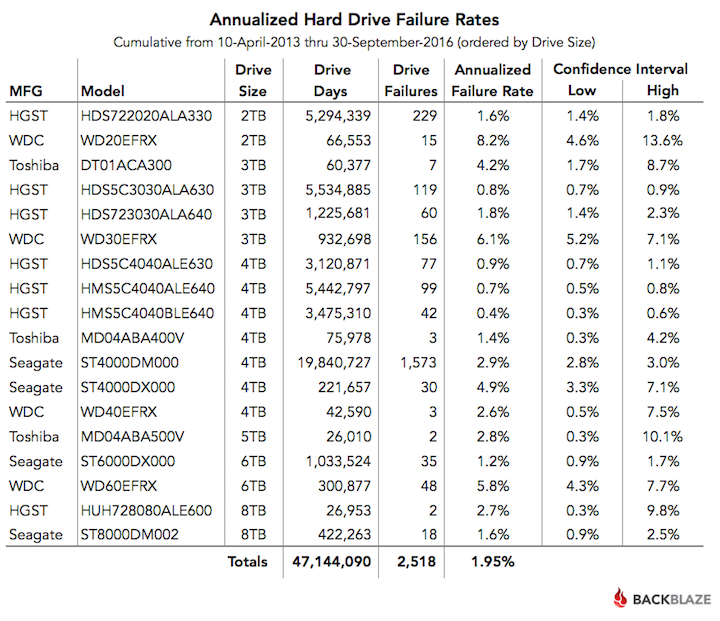
The cloud storage company BACKBLAZE has published another in their series of quarterly articles looking into Disk Drive failure rates.
The company had 68,813 spinning hard drives in operation. For Q3 2016 they have 67,642 drives, which is 1,171 fewer than their last quarterly report. The decline is because they have been migrating from their 2 terabyte (TB) drives to 8 TB models. They currently run a mix of 2, 3, 4, 5, 6 and 8 TB drives in their cloud storage system from a mix of different vendors.
The 8 TB drives are too new to reflect anything other than infant mortality rates, but all of the other sizes have been heavily used for years, such that some brand-specific trends are starting to appear.
The results are summarized in a table with the key metric being Annualized Failure Rate which is computed as follows: ((Failures)/(Drive Days/365)) * 100.
The Seagate 8 TB drives are doing very well. Their annualized failure rate compares favorably to the HGST 2 TB hard drives. With the average age of the HGST drives being 66 months, their failure rate was likely to rise, simply because of normal wear and tear. The average age of the Seagate 8 TB hard drives is just 3 months, but their 1.6% failure rate during the first few months bodes well for a continued low failure rate going forward.
Still, when you look at all the brands and models involved, the HGST brand seem to show the lowest failure rates historically.
With some reporting failure rates over 10% annually, mirrored drives may still be a wise choice for not trusting in the cloud.
- Read More...
- 26 comments
Pluto may have a massive subsurface ocean under its heart-shaped region, Sputnik Planitia, aligned with Pluto's tidally-locked satellite Charon:
Pluto may harbour a slushy water ocean beneath its most prominent surface feature, known as the "heart". This could explain why part of the heart-shaped region - called Sputnik Planitia - is locked in alignment with Pluto's largest moon Charon. A viscous ocean beneath the icy crust could have acted as a heavy, irregular mass that rolled Pluto over, so that Sputnik Planitia was facing the moon.
[...] Sputnik Planitia is a circular region in the heart's left "ventricle" and is aligned almost exactly opposite Charon. In addition, Pluto and Charon are tidally locked, which results in Pluto and Charon always showing the same face to each other.
"If you were to draw a line from the centre of Pluto's moon Charon through Pluto, it would come out on the other side, almost right through Sputnik Planitia. That line is what we call the tidal axis" said James Keane, from the University of Arizona, co-author of one of a pair of papers published on the subject in Nature journal. This is strongly suggestive of a particular evolutionary course for Pluto. The researchers contend that Sputnik Planitia formed somewhere else on Pluto and then dragged the entire dwarf planet over - by as much as 60 degrees - relative to its spin axis.
Also at UCSC.
Reorientation of Sputnik Planitia implies a subsurface ocean on Pluto (DOI: 10.1038/nature20148) (DX)
Previously: New Horizons Finishes Sending 2015 Flyby Data
- Read More...
- 8 comments
You can call it pie in the sky, but pizza delivery is now a real thing -- at least in the Land Down Under.
Domino's Pizza Enterprises said Wednesday it had completed what it called the world's first delivery of a pizza to a customer in New Zealand. Under the watch of a team of drone experts, the unmanned aerial vehicle used GPS navigation to autonomously deliver Peri-Peri Chicken and Chicken and Cranberry pizzas to a backyard in Whangaparaoa, about 20 miles north of Auckland.
Drones have grown in popularity among big retailers such as Amazon and Walmart, which are continually looking for new ways to get a jump on the competition and attract customers. The small, commercial aerial drones could avoid the delays of terrestrial deliveries by flying above traffic and avoiding circuitous roadways.
Manna from heaven?
- Read More...
- 21 comments
Visitors to the upcoming Los Angeles Auto Show will see supercars, hoverboards, self-propelling luggage and all manner of new transportation options.
But they'll be hard pressed to find a clutch pedal or a stick shift. Available in nearly half of new models in the U.S. a decade ago, the manual transmission is going the way of the rumble seat, with stick availability falling to about a quarter this year.
Once standard equipment on all motor vehicles, preferred for its dependability, fuel efficiency and sporty characteristics, the four-on-the-floor is disappearing from major car manufacturers' lineups — and subsequently from the sprawling auto show's floors.
Consider, too, that electric vehicles don't even have a transmission.
- Read More...
- 123 comments
Your weekly Tesla article has arrived, Soylent!
The world's fastest-accelerating car is about to get even faster.
Tesla's high-end Model S will soon be able to go from zero to 60 miles per hour in just 2.4 seconds, following a software enhancement next month that shaves off a 10th of a second. That's a new threshold that distinguishes it from any other production car on the road.
Tesla Motors Inc. Chief Executive Officer Elon Musk teased the update in a tweet on Wednesday—but there's a twist. When the changes are delivered wirelessly next month to all P100D Model S vehicles, the owners will have to figure out how to enable it. It's what's known in the tech industry as an "Easter Egg"—a hidden feature that requires a specific series of gestures to unlock.
From Tesla's blog:
The Model S P100D with Ludicrous mode is the third fastest accelerating production car ever produced, with a 0-60 mph time of 2.5* seconds. However, both the LaFerrari and the Porsche 918 Spyder were limited run, million dollar vehicles and cannot be bought new. While those cars are small two seaters with very little luggage space, the pure electric, all-wheel drive Model S P100D has four doors, seats up to 5 adults plus 2 children and has exceptional cargo capacity.
The 100 kWh battery also increases range substantially to an estimated 315 miles on the EPA cycle and 613 km on the NEDC cycle, making it the first to go beyond 300 miles and the longest range production electric vehicle by far.
The horizontal acceleration is greater than the vertical acceleration of gravity — in other words it can accelerate faster on pavement than it could fall off a cliff.
For comparison, see Wikipedia's list of fastest production cars by acceleration.
[Updated to add quote from Tesla's blog. -Ed.]
- Read More...
- 28 comments