SoylentNews is people
SoylentNews
Site News
Join our Folding@Home team:
Main F@H site
Our team page
Support us: Subscribe Here
and buy SoylentNews Swag
We always have a place for talented people, visit the Get Involved section on the wiki to see how you can make SoylentNews better.
- [c0lo] "The right to listen has been abolished in US" deleted
- [khallow] Retread narratives
- [hubie] Patriots or Seahawks? Who ya got in Super Bowl LX?
- [fliptop] Massive Solar Farm Approved in Middle of NY Amish Country
- [Tork] RubyAI's insta-Casettes.. second vid added!
- [Runaway1956] There are home routers, and there are great home routers
- [Arthur T Knackerbracket] US Pediatricians Give Middle Finger To RFK Jr.
- [turgid] Loony Tunes and Earning a Living
- [Mojibake Tengu] Veterans on Sale
- [mcgrew] Why don’t these exist?
- [janrinok] NATO Allies to Commence a Rotational Presence in Greenland
- [bzipitidoo] battling high blood pressure
- [canopic jug] 39C3: Power Cycles Streaming (Saturday through Tuesday)
- [jasassin] AI real life experience or
- [Gaaark] If everyone around you is a loser or weak or stupid...
Older Stuff
-
August 26- Samsung Electronics Vice Chairman Sentenced to Five Years in Corruption Scandal Ruling (6)
- Seasonal Cycling in Hadza Microbiomes (4)
- Health Insurer Aetna Accidentally Exposes Customers' HIV Statuses With Transparent Envelope Windows (39)
- Babylonian Tablet May Contain Oldest Evidence of Trigonometry (11)
- Next Land War in Asia May Be in Bhutan (25)
- Germans Force Microsoft to Scrap Future Pushy Windows 10 Upgrades (24)
- When Not to Use Docker: Understanding the Limitations of Containers (25)
- Judge Limits DOJ's Search of Anti-Trump Website Data (25)
-
August 25- Samsung to Expand Bixby, Voice Recognition Features to More Smart Home Appliances by 2020 (19)
- Meta: Welcome New Trolls! (241)
- Proof of Concept Released for Dangerous iOS Kernel Exploit (6)
- Apple to Build Iowa Data Center, Get $207.8 Million in Incentives (7)
- Happy Birthday, Linux (24)
- The Myth of the Skills Gap (66)
- A Thorium-Salt Reactor Has Fired Up for the First Time In Four Decades (35)
Quick Links

Arthur T Knackerbracket has found the following story:
A federal judge in Detroit sentenced former engineer James Liang to 40 months in prison on Friday for his role in Volkswagen AG's (VOWG_p.DE) multiyear scheme to sell diesel cars that generated more pollution than U.S. clean air rules allowed.
U.S. District Court Judge Sean Cox also ordered Liang to pay a $200,000 fine, 10 times the amount sought by federal prosecutors. Cox said he hoped the prison sentence and fine would deter other auto industry engineers and executives from similar schemes to deceive regulators and consumers.
Liang was part of a long-term conspiracy that perpetrated a "stunning fraud on the American consumer," Cox said, as the defendant's family looked on in the courtroom. "This is a very serious and troubling crime against our economic system."
Liang pleaded guilty earlier this year to misleading regulators, and had cooperated with U.S. law enforcement officials investigating Volkswagen.
Prosecutors last week recommended that Liang, 63, receive a three-year prison sentence, reflecting credit for his months of cooperation with the U.S. investigation of Volkswagen's diesel emissions fraud. Liang could have received a five-year prison term under federal sentencing guidelines. Liang's lawyers had asked for a sentence of home detention and community service.
Liang can appeal the sentence, Cox said.
Volkswagen pleaded guilty in March to three felony charges under an agreement with prosecutors to resolve the U.S. criminal probe of the company itself. It agreed to spend as much as $25 billion in the United States to resolve claims from owners and regulators and offered to buy back about 500,000 vehicles.
Volkswagen has admitted that it used software to deceive regulators in the United States and Europe from 2006 to 2015.
-- submitted from IRC
- Read More...
- 26 comments

Congress just passed, and Trump signed, a law that makes all properties adjacent to the rail system operated by the Washington Metropolitan Area Transit Authority, Constitution free zones.
From TFA on zerohedge.com:
"In performing its duties, the Commission, through its Board or designated employees or agents, may: Enter upon the WMATA Rail System and, upon reasonable notice and a finding by the chief executive officer that a need exists, upon any lands, waters, and premises adjacent to the WMATA Rail System, including, without limitation, property owned or occupied by the federal government, for the purpose of making inspections, investigations, examinations, and testing as the Commission may deem necessary to carry out the purposes of this MSC Compact, and such entry shall not be deemed a trespass."
As we all know, the standard in the 4th Amendment is a particularized warrant based on probable cause, "reasonable notice and need" as determined by the cops (i.e. agency chief), is not the same thing at all.
We already have constitution free zones within 100 100 miles of any border, and this provides a convenient framework to do a similar thing along any rail line (or road) so the Feds can liberate the center of the country from any form of Constitutional protection. Anyway ... the 4th Amendment is already dead at this point, but its piecemeal demise should provide a useful education for those clamoring for the demise of the 1st.
- Read More...
- 100 comments

Over at phys.org is an article on new technology being rolled out at Singapore's Changi airport, and trialled in several other locations.
Facial scanning in particular is generating a lot of buzz. Changi in the affluent city-state of Singapore, regarded as among the world's best airports, is set to roll out this biometric technology at a new terminal to open later this year.
Passengers will have their faces scanned when they first check in and at subsequent stages, theoretically allowing them to go through the whole boarding process quickly without encountering another human.
Australia announced in July an investment of Aus$22.5 million ($17.5 million) to introduce face recognition technology at all the country's international airports, while Dubai Airport is also trialling it.
[...] Robots are appearing at some major hubs, including at Seoul's Incheon airport, where they carry out tasks including cleaning and carrying luggage, while Changi's new terminal will have robotic cleaners complete with butlers' uniforms.
The article is a widely reprinted AFP story, but Business Traveller also has it's own walk through of the new terminal, which focuses on the overall experience of the traveller rather than the technology, but also includes some additional details on the system:
[...] the machine measures key facial features and structure rather than details such as haircuts and facial hair, so barring reconstructive surgery passengers can rest assured that the scanning will work even if they look slightly different to their passport photo. The scanning works by filming a short video and selecting the optimal “frame” that best meets the necessary criteria, making absolute stillness while the photo is being taken not necessary. Glasses do need to be removed during this process, however.
- Read More...
- 13 comments

from the deadwood-'deadweight'-delights-dollar-delinquents dept.
Submitted via IRC for TheMightyBuzzard
Acid Wizard Studio, the creators of the popular Darkwood game, have shared a copy on The Pirate Bay. The developers want to help out people who don't have the financial means to buy a legal copy of the game and also prevent them from going to unauthorized key sharing sites.
Online piracy is an issue that affects many industries, and indie game development is certainly no exception.
While some developers see piracy as an evil that needs to be rooted out as soon as possible, others are more open to the motivations behind it.
The average game fan may not have the financial means to try out all the new titles that come out every month, for example. While these people are not by any means entitled to a free copy, sometimes the human element resonates with developers.
Acid Wizard Studio, the three college friends from Poland behind the horror game Darkwood, started thinking about this when they recently received an email from a desperate young fan.
They recount how a fan, who loved the game, asked for a refund because he was worried about his parent's reaction to the cost. They realized this was not an isolated occurrence and decided to do something very unusual in the videogame industry: make a free copy available on a torrent! The story concludes:
"We have just one request: if you like Darkwood and want us to continue making games, consider buying it in the future, maybe on a sale, through Steam, GOG or Humble Store. But please, please, don't buy it through any key reselling site. By doing that, you're just feeding the cancer that is leeching off this industry."
People who are into horror games can download a copy of the game here, or buy it here. The Imgur post with the full story of the developers, spotted via PC Gamer, is well worth a read too.
- Read More...
- 333 words in story
- 13 comments
Fox News is reporting that LG will be opening a new plant in Detroit:
LG Electronics said Tuesday it will spend $25 million to open a U.S. plant for manufacturing electric vehicle components.
The 250,000-square-foot building is located in Hazel Park, Michigan, a suburb of Detroit. When it opens next year, the plant will create at least 292 jobs in Hazel Park and an expanded research and development center in nearby Troy.
The Michigan government is providing a four-year, $2.9 million capital grant for the project.
[...] LG said vehicle components are the company's fastest-growing business. Auto-related revenue jumped 43% year-over-year to $1.5 billion during the first half of 2017, driven by LG's supplier agreement with General Motors (GM) for the new Chevrolet Bolt electric vehicle.
[...] In addition to the Michigan facility, LG expects to begin construction soon on a $250 million factory for washing machines in Clarksville, Tennessee. The production plant will create 600 new jobs by 2019, according to LG. The company is also building a new North American headquarters down the road from its current offices in Englewood Cliffs, N.J. The project will cost $300 million.
- Read More...
- 29 comments

http://www.hku.hk/press/news_detail_16681.html
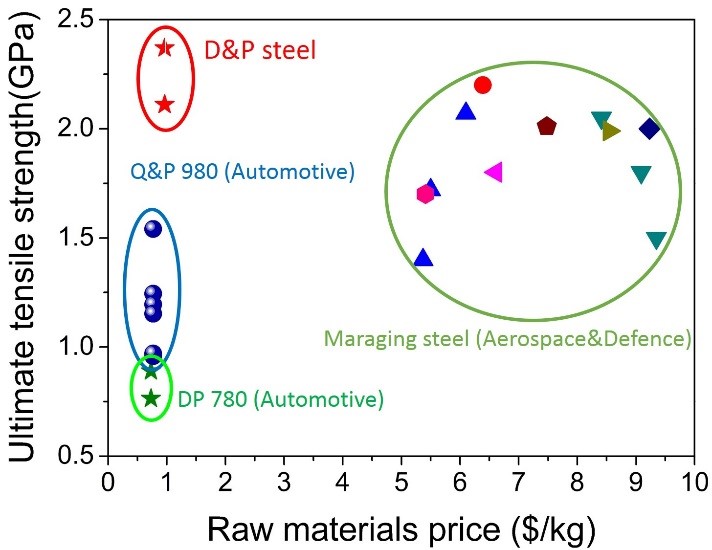
A Hong Kong-Beijing-Taiwan mechanical engineering team led by Dr Huang Mingxin from the University of Hong Kong (HKU) has recently developed a Super Steel (also called D&P Steel as it adopted a new deformed and partitioned (D&P) strategy) which addressed the strength-ductility trade-off. Its material cost is just one-fifth of that of the steel used in the current aerospace and defence applications. This research breakthrough is recently published in the prestigious academic journal Science.
[...] In addition to the substantial improvement of tensile properties, this breakthrough steel has achieved the unprecedented yield strength of 2.2 GPa and uniform elongation of 16%. Additionally, this breakthrough steel has two advantages:
(1). Low raw-materials cost.
The raw materials cost of the D&P steel is only 20% of the maraging steel used in aerospace and defence applications. The chemical composition of this breakthrough steel belongs to the system of medium manganese (Mn) steel, containing 10% manganese, 0.47% carbon, 2% aluminium, 0.7% vanadium (mass percent), and the balance is iron. No expensive alloying elements have been used exhaustively but just some common alloying compositions that can be widely seen in the commercialized steels. Figure 1[1] compares the raw materials cost between the present D&P steel with other high-strength steels.
(2). Simple industrial processing
The second advantage is that this breakthrough steel can be developed using conventional industrial processing routes, including warm rolling, cold rolling and annealing. This is different from the development of other metallic materials where the fabrication processes involve complex routes and special equipment, which are difficult to scale-up. Therefore, it is expected that the present breakthrough steel has a great potential for industrial mass production.
[1] Figure 1.
High dislocation density–induced large ductility in deformed and partitioned steels (open, DOI: 10.1126/science.aan0177) (DX)
- Read More...
- 20 comments
Arthur T Knackerbracket has found the following story:
You may've heard that astronauts on the International Space Station recycle their own pee into drinking water, but space travelers could also one day upcycle their own urine into tools and other useful items.
Researchers from Clemson University are exploring ways that strains of yeast can be used to convert nitrogen from urine and carbon dioxide from astronauts' breath (or perhaps the atmosphere of Mars) into useful substances like nutrients or polymers. One strain of engineered yeast creates polyester polymers that could be used in 3D printers to create needed tools or parts for a long space mission.
The researchers presented their work Tuesday at the 254th National Meeting & Exposition of the American Chemical Society (ACS) in Washington.
[...] Having "a biological system that astronauts can awaken from a dormant state" and start using to produce what they need, when they need it, is the project's motivation, Blenner said.
See also: EurekAlert.
-- submitted from IRC
- Read More...
- 19 comments
from the How-About-Colour-Changing...People? dept.

Recently on Last Week Tonight John Oliver discussed the problem of nuclear waste storage, which despite a number of attempts to designate a central storage site is still stored in "temporary" sites throughout the US.
The idea of a central nuclear waste repository at Yucca Mountain was raised again. However one additional problem, highlighted by a consultation in 1981 by the US Department of Energy, was how to design radiation warnings which could be understood tens of thousands of years into the future even though language, culture, and iconography may undergo significant changes.
And on that note, here's an old guardian article on how colour-changing cats might be the solution.
In 1984, writer Françoise Bastide and semiotician Paolo Fabbri suggested the answer could lie in breeding animals that "react with discoloration of the skin when exposed" to radiation. "[Their] role as a detector of radiation should be anchored in cultural tradition by introducing a suitable name (eg, 'ray cat')."
And following up on that is the project The Ray Cat Solution, in conjunction with Bricobio, the Montréal biology maker community:
New Hampshire Institute of Art's Type 1 class has joined forces with Bricobio and The Raycat Solution to help insert Raycats into the cultural vocabulary.
While Bricobio works towards genetically altering cats so they change color when in the presence of radioactive material, the NHIA Type 1 class is working to insert the idea that if a cat changes color, that space might be dangerous to others.
There is an associated film on the subject on Vimeo.
Originally spotted through the 99% Invisible Episode "Ten Thousand Years"
- Read More...
- 36 comments
Uber is adding trip type preferences, more driver destinations, and long trip notifications for drivers. The changes come as tips to Uber drivers have hit $50 million:
"This week, we're going to hit $50 million dollars in tips for drivers," explained Uber's U.S. and Canada manager Rachel Holt. "We launched the tipping effort in three cities two months ago, but we didn't roll it out all over the U.S. until the middle of July. So we're really, really excited just to see how well that feature has done in just a short period of time."
That $50 million is a lot in context: Lyft has had the feature for years, and hit just $250 million in tips in July. Drivers have made around 200,000 phone calls to support, Holt says, since Uber introduced 24/7 phone service, and on average they reach an agent in less than 30 seconds. Eighty-five percent of drivers have said they're satisfied with the experience.
The new changes today are focused on adding more flexibility to the experience. If you're not super familiar with the driver experience, these might sound mysterious, but they're actually pretty straightforward, and each emphasizes greater freedom in how drivers manage their day.
Pay your Uber driver well, because Uber won't.
- Read More...
- 17 comments
Researchers from The University of Manchester are using polystyrene particles rather than expensive polymers to make the next generation of solar cells, which are used to make solar panels, more stable and even cheaper.
The move could significantly reduce the cost of production and manufacturing of the solar cells, making electricity cheaper in the future for the public at a time when energy prices are increasing.
The research, published by The Royal Society of Chemistry in the journal Nanoscale [DOI: 10.1039/C7NR02650A] [DX], shows how University of Manchester scientists are using insulating polystyrene microgel particles to reduce the costs and improve the stability of Perovskite Solar Cells or PSCs.
PSCs are a new kind of solar panel and deemed one of the top ten emerging technologies by the World Economic Forum. This is because they have unprecedented increases in their rate of power conversion efficiency and potentially have relative low cost per watt.
[...] "The perovskite layer in solar cells is not inherently unstable, but the required [hole-transport material (HTM)] layer is. HTM layers made of congregated polymers are thin but they are also relatively expensive and contribute a significant portion of the total cost of the solar cell. In this study we used polystyrene, which is 1 ten thousandth of the cost of polymers to produce, and is also hydrophobic which helps improve the stability of PSCs. Overall the enhanced stability and lower costs of production hugely outweigh any of the decreased efficiency."
- Read More...
- 3 comments

"This is the first case in California as to how the gig economy works," US Magistrate Judge Jacqueline Corley said during the Thursday hearing, likely the last hearing before the September 5 bench trial, which is expected to last about a week. Most of the hearing was taken up establishing procedural ground rules and wrapping up loose threads about witness availability, among other items.
This lawsuit just might provide an answer. If Grubhub must treat its drivers as employees, the employees would be entitled to all kinds of benefits, including unemployment, insurance, and reimbursement for various expenses, like gas and employee phone bills. In short, treating workers as employees could cost companies like Grubhub millions of dollars.
The case, known as Lawson v. Grubhub, which was first filed back in 2015, is one of a slew of ongoing cases filed against so-called "gig economy" firms. During the Thursday hearing, the judge said that she had only recently understood that, in this context, "gig" simply was slang for "job" or work. She seemingly was under the impression that it was related to the tech prefix "giga."
[...] "This trial is a milestone because similar cases have settled or been dismissed," Michael LeRoy, a labor law professor at the University of Illinois, e-mailed Ars. "When cases settle, the wage-and-hour laws are not applied and interpreted by courts—and therefore, it's hard to say for sure how the law is adapting to the rapid changes in gig work."
-- submitted from IRC
- Read More...
- 13 comments
Submitted via IRC for TheMightyBuzzard
You may recall that in 2014 we wrote about a strange occurrence having to do with Chase Bank refusing to provide its banking services to Teagan Presley, a rather well known adult film actress. When it became clear that Presley wasn't the only performer to whom this was happening, it initially looked as though banks were engaging in a form of slut-shaming of adult film actors. It turned out, however, that it was the federal government doing the slut-shaming, with the emergence of the Department of Justice's Operation Choke Point. This DOJ policy that was developed to combat financial fraud somehow bled over the stencil lines and became a sort of banking morality police, encouraging banks to cut off services to industries like adult film, fireworks retail stores, and sellers engaged in what the DOJ deemed to be "racist materials." It's worth highlighting that all of these industries and actions, whether you like them or not, are legal, yet the DOJ was essentially attempting to extra-judiciously scuttle them through secretive federal policy. That should have terrified everyone, but didn't, and so the program went on.
Until recently. The justice department recently announced that Operation Choke Point will be ended.
The move hands a big victory to Republican lawmakers who charged that the initiative — dubbed "Operation Choke Point" — was hurting legitimate businesses. In a letter to House Judiciary Chairman Bob Goodlatte (R-Va.), Assistant Attorney General Stephen Boyd referred to the program as "a misguided initiative."
"We share your view that law abiding businesses should not be targeted simply for operating in an industry that a particular administration might disfavor," says the letter, obtained by progressive activist group Allied Progress and later provided to POLITICO by Goodlatte's office. "Enforcement decisions should always be made based on facts and the applicable law. We reiterate that the Department will not discourage the provision of financial services to lawful industries, including businesses engaged in short-term lending and firearms-related activities," it adds. A nearly identical letter was sent to Sens. Thom Tillis (R-N.C.) and Mike Crapo (R-Idaho).
I was more annoyed by their use of it against gun stores but good riddance regardless.
Previously:
Adult Film Stars' Bank Accounts Closed
- Read More...
- 53 comments

Submitted via IRC for TheMightyBuzzard
The whole New Zealand-based spying operation against Kim Dotcom and his Megaupload co-defendants was illegal, the High Court has ruled. The revelation appears in a newly released decision, which shows the GCSB spy agency refusing to respond to questions about its activities on the basis that could jeopardize national security.
In the months that preceded the January 2012 raid on file-storage site Megaupload, authorities in New Zealand used the Government Communications Security Bureau (GCSB) spy agency to monitor Kim and Mona Dotcom, plus Megaupload co-defendant Bram van der Kolk. When this fact was revealed it developed into a crisis. The GCSB was forbidden by law from conducting surveillance on its own citizens or permanent residents in the country, which led to former Prime Minister John Key later apologizing for the error.
With Dotcom determined to uncover the truth, the entrepreneur launched legal action in pursuit of the information illegally obtained by GCSB and to obtain compensation. In July, the High Court determined that Dotcom wouldn't get access to the information but it also revealed that the scope of the spying went on much longer than previously admitted, a fact later confirmed by the police. This raised the specter that not only did the GCSB continue to spy on Dotcom after it knew it was acting illegally, but that an earlier affidavit from a GCSB staff member was suspect.
With the saga continuing to drag on, revelations published in New Zealand this morning indicate that not only was the spying on Dotcom illegal, the entire spying operation – which included his Megaupload co-defendants – was too.
Oopsie...
Source: https://torrentfreak.com/entire-kim-dotcom-spying-operation-was-illegal-high-court-rules-170825/ (archive)
- Read More...
- 33 comments
It's not an acid bath. It's an alkaline bath:
When it comes to putting loved ones in their final resting places, our choice has long been whether to bury a body or cremate it. But a third option has been gaining attention recently: Alkaline hydrolysis, which involves dissolving a body in a liquid solution. The process leaves behind bones that can be ground into ash using much less energy than cremation. Though it sounds a bit gruesome, the approach offers many benefits. "This by far is the most environmentally friendly choice" Dean Fisher, director of the Donated Body Program at UCLA told Wired.
[...] Having a body cremated may seem like a sustainable burial, but in most cases it's not great for the environment. In cremation, everything is burned into ash, including bone and medical implants. That can lead to the release of harmful pollutants. In the UK, for instance, cremation contributes to 16% of all mercury pollution. And as The Atlantic has reported, cremation takes about two SUV-tanks worth of gas to cremate a single body. Alkaline hydrolysis, on the other hand, requires only an eighth of that energy, Gizmodo reports.
Also at Here & Now (4:45 audio).
California: AB-967 Human remains disposal: alkaline hydrolysis: licensure and regulation.
- Read More...
- 37 comments
The "Daily Stormer", a neo-Nazi website that has been having trouble staying online since Charlottesville, has once again been shutdown.
According to The Verge:
The neo-Nazi site Daily Stormer briefly returned to the web today, using a new URL and a string of new hosts to dodge the bans that took it off the internet last week. The site reappeared this morning at the address Punished-stormer.com, apparently using Dreamhost as both a host and DNS provider.
[note: url modified]
Shortly after the new site became public, Anonymous groups began a denial-of-service attack against it, targeting the Dreamhost DNS infrastructure that makes the site accessible to the rest of the web. The result was nearly two hours of intermittent downtime for the countless sites using Dreamhost's DNS infrastructure.
In WWII, things like this were called "collateral damage", where innocent casualties were necessary in order to get at the Nazis themselves. But is this sort of action legitimate on the internet? Especially by non-governmental organizations?
Also reported at https://www.wordfence.com/blog/2017/08/dreamhost-ddos-attack/
Related story: https://www.theverge.com/2017/8/21/16180614/charlottesville-daily-stormer-alt-right-internet-domain
- Read More...
- 93 comments
- Politics