SoylentNews is people
SoylentNews
Site News
Join our Folding@Home team:
Main F@H site
Our team page
Support us: Subscribe Here
and buy SoylentNews Swag
We always have a place for talented people, visit the Get Involved section on the wiki to see how you can make SoylentNews better.
- [mcgrew] The Weather
- [Tork] Creating Web Funnies
- [turgid] AI Crash
- [janrinok] US/Israeli Attacks on Iran - Discussion
- [khallow] Lessons from evolution?
- [Rich] Zero Local Trust?
- [c0lo] Living on minimal wage
- [Gaaark] It's AI all the way down!
- [Runaway1956] geopricing
- [hubie] GOG Galaxy is Apparently to be Ported to Linux
- [fliptop] Massive Solar Farm Approved in Middle of NY Amish Country
- [Arthur T Knackerbracket] US Pediatricians Give Middle Finger To RFK Jr.
- [Mojibake Tengu] Veterans on Sale
- [bzipitidoo] battling high blood pressure
- [canopic jug] 39C3: Power Cycles Streaming (Saturday through Tuesday)
Older Stuff
-
June 15- Russia, China Alledgedly Crack Snowden Files (25)
- FBI-Seized MegaUpload Domain Still in Limbo after DNS Hijacking (6)
- Researchers Design Sonar-Based Contactless Sleep Monitoring (9)
- Encrypted Messaging Service Stops Answering 'Warrant Canary' Questions (56)
- US Congress Attempts to Close Loopholes and Block Funding for NSA Surveillance (31)
- How Microsoft Squashed FOSS in Voting Systems in the USA (50)
- 90 Year Old Sailing Ship Puts Half of Iceland's Coast Guard Out of Action (25)
- Geeksphone Stops Support for FirefoxOS with No Warning (25)
- 68 Katy – 68000 Linux on a Solderless Breadboard (13)
- Krita's Kickstarter Was a Success; Prepare to be Second-Fastest, Photoshop (20)
- Hacking of Federal Security Forms Much Worse than Originally Thought (55)
- Medical Device Hijacking as Vector into Hospital Networks (7)
-
June 14
Quick Links

ArsTechnica has a story about the abandoned Soviet era Space Shuttle project.
When the project was cancelled, (along with the USSR), like so many other things in the Soviet Union at that time, the workers were sent home, the doors locked, and the entire project lies abandoned.
No attempt seems to have been made to fill museums, or salvage any of the shuttles for historical purposes.
The photos are from Ralph Mirebs from the Baikonur Cosmodrome who's page has many more. The Page is in Russian but the Google Translate version renders the descriptions to passable English.
Similar photo essays for other abandoned Soviet era projects Ekranoplan, a missile carrying ground effect vehicle designed for dash attack on naval targets or shore installations. (don't miss paging arrows at side of images).
Original Submission
- Read More...
- 13 comments

We just deployed a new point upgrade to rehash today to fix a bunch of small bugs that have been with us since the rehash upgrade and a few that were around longer than that. Here are the highlights:
- Fixes for various XSS isues by adding strip_title where appropriate in output templates.
- Fix PollBooth for Nexus support (found the bugs when cleaning up XSS issues).
- Fix broken daily mails by removing a utf decode that was unneeded since mod_perl 2 is better with utf8.
- Comment links now link to the the commentwrap div just above the comment.
- Commentwrap div's 'Reply' button now has verbage based on if we are on the story or on a specific comment.
- Add cert store location to Subscribe code to get rid of LWP errors and allow PayPal subscriptions to complete.
- Fix missing hit counts by adding accesslog back in (for editors and admins).
- Fix for unordered singoffs in story edit page (for editors and admins).
- Fix broken block save in admin.pl by setting defaults for not null table update (for admins).
We were able to kill off about 10 high priority bugs with this mini release. Current issues and feature requests can be found on GitHub and you can submit new issues or feature requests here if you have a GitHub account. We also welcome bugs and requests sent via email to admin@soylentnews.org or left in the comments below.
Our goals for the next major update is more of the same bug hunting and killing with a few features added here and there. Again I would like to thank you for your patience with the growing pains we have had with the 15_05 rehash upgrade. This update should bring us mostly back to where we were before in terms of broken features.
- Read More...
- 27 comments
- Meta

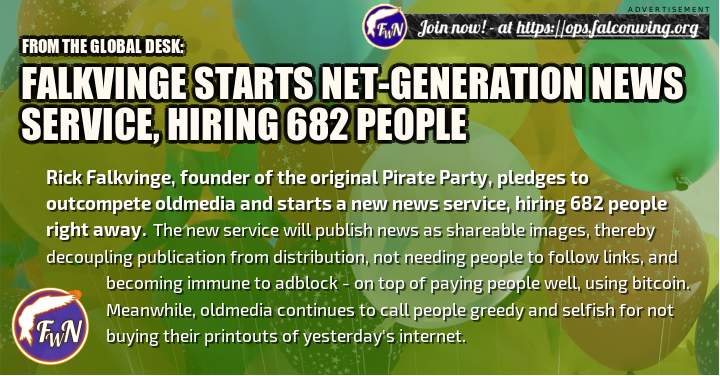
Former Swedish Pirate Party leader and Internet activist Rick Falkvinge launched a new venture yesterday. Intended to rival established media, Falconwings provisions quality news bulletins that are easily shared via the project's automated image creation process. A total of 600 writers are being recruited, with the sole criteria being the ability to consistently author summaries of 450 characters, split into three principle sentences: Fact, Background and Satire.
Initial signs have been promising, with the various tweets from candidates exceeding expectations in terms of quality and audience.
Are there any budding Soylentils interested in giving this a try?
Original Submission
- Read More...
- 16 comments
Mike Hale writes in the NYT that after Sunday night's Season 5 finale the wildly popular show seems to have lost its way, and to be losing faith with a growing number of its viewers. After two or three seasons of coherent and satisfying action, the show is spinning in place, stalling for time as it crawls toward an ending that will be more disappointing the longer it's delayed. Sound familiar? As with "Lost," there may be a blueprint, but it's not looking very sound. According to Hale, the escalating series of shocks in the season finale was a prime example of substituting sensation for imagination, busyness for drama. "Not content to kill off a mid-major character, the episode moved on to whipping girls, putting a major female character through an excruciatingly long, nude walk of shame and, in its closing seconds, assassinating a fan favorite who was one of the few wholly sympathetic figures in the show."
Amy Sullivan says that the problem is that it's incredibly hard to craft a epic series without getting necessarily bogged down in the middle installments. "Your protagonists are usually in some long-term predicament or up against an enemy who will keep winning until some resolution is reached in the finale," says Sullivan. "So the need to throw in a few shocking moments for the sake of surprise and to keep readers/audiences off-balance is understandable." According to Hale when you look at the overall framework, nearly all the characters are where they were when the season began. "The usurping Boltons are still in Winterfell; Sansa is still on the run; Arya is still hiding in Braavos; the dragon queen Daenerys Targaryen and the sly dwarf, Tyrion, are still marooned in Essos; the Lannisters still occupy the castle in King's Landing," concludes Hale. "This can be blamed on the show's semidependent relationship with Mr. Martin's novels, but viewers (like me) who haven't read the books don't care about that. The question is how much longer we'll care at all."
- Read More...
- 81 comments

Bild claims [paywall and in German] that Chancellor Angela Merkel's personal computer was one of the first to be compromised in a cyberattack linked to Russia. Merkel's computer was reportedly used to spread malware to other targets within the German government.
Germany's top prosecutor has dropped an investigation into the National Security Agency's surveillance of Chancellor Merkel's cell phone.
V3.co.uk is claiming that German defense minister Ursula von der Leyen is under attack by hackers, but this has yet to be corroborated in any source the author can find.
Original Submission
- Read More...
- 11 comments

from the do-not-welcome-your-communist-overlords dept.
Susan Crawford reports on "El Paquete" (the package), Cuba's answer to the internet, an informal but extraordinarily lucrative distribution chain where anyone in Cuba who can pay can watch telenovelas, first-run Hollywood movies, brand-new episodes of Game of Thrones, and even search for a romantic partner. The so-called "weekly package," which is normally distributed from house to house contains the latest foreign films a week, shows, TV series, documentaries, games, information, music, and more. The thumb drives make their way across the island from hand to hand, by bus, and by 1957 Chevy, their contents copied and the drive handed on. "El Paquete plays to Cuban strengths and needs," writes Crawford because Cubans are great at sharing. "And being paid to be part of the thumb-drive supply chain is a respectable job in an economy that is desperately short on employment opportunities." Sunday the "weekly package" of 1 terabyte is priced at $ 10, then $2 on Monday or Tuesday and $1 for the rest of the week.
The sneakernet is still in use today in other parts of the world including Bhutan where a sneakernet distributes offline educational resources, including Kiwix and Khan Academy on a Stick to hundreds of schools and other educational institutions. Google once used a sneakernet to transport 120 TB of data from the Hubble Space Telescope.
"Never underestimate the bandwidth of a station wagon full of magnetic tapes hurtling down the highway".
Original Submission
- Read More...
- 16 comments
from the what-are-these-girls-you-speak-of? dept.

RealDoll, after almost 20 years of selling "the world's finest love doll," is developing an animated, robotic, artificially intelligent head that can be switched onto existing RealDoll bodies. The purpose, according to RealDoll's founder and CEO Matt McMullen, is to "arouse someone on an emotional, intellectual level, beyond the physical."
If you haven't heard of RealDoll before, the company makes expensive ($5,000-$10,000, £3,200-£6,400) but very realistic sex dolls. The dolls (which come in male and female varieties) have fully poseable skeletons, silicone skin, and are roughly the same weight and size as a real human. The dolls have interchangeable faces and orifices.
The reality that Westworld and AI imagined decades ago has arrived. What are the ethical implications? Would you be willing to use one?
Original Submission
- Read More...
- 75 comments
We knew in advance that we’d be hearing more about Fallout 4 and Doom from Bethesda at their “E3 showcase” Sunday evening, but the best laid plans of mice and mutants gang aft agley—a brief technical mix-up the day before also told us that we’d be getting a look at Dishonored 2 as well. But there didn’t need to be any surprises—those three AAA games themselves were enough to warm any gamer’s heart. Especially if you like Fallout.
[...] First up was a new Doom game, titled simply Doom. The latest entry in the long-running franchise is built on id Software’s latest engine, id Tech 6, and id Software Executive Producer Marty Stratton described the game as being about “badass demons, big effing guns, and moving really, really fast.”The audience was then shown a long video consisting entirely of in-engine gameplay, with a space-suited marine running through a Union Aerospace Corporation mining facility, blowing up hell-spawn in fine form. Doom games have always looked great, thanks to the engine wizardry of John Carmack and friends; though Carmack is no longer at id, the new Doom game carries on that trend. Where id Tech 6 makes Doom look great is in the lighting and shadowing—we’re long past the point where realistic gaming environments are amazing, but id Tech 6’s shadowing and lighting really did make a noticeable difference. We also got a glimpse at a hell level, which, in contrast to Doom 3’s portrayal of the netherworld, was relatively well-lit and moody—though the standard “id palette” of grays, blacks, and reds still dominated.
[...] The Dishonored 2 glimpse we got appeared to be all pre-rendered footage, and much like the last go-round, it oozed faux-Victorian steampunk atmosphere and style. The trailer starred a masked assassin (revealed to be an adult princess Emily Kaldwin), and she was seen infiltrating a stronghold, fighting off clockwork bad guys and overcoming obstacles using a variety of Dishonored-style tricks, gadgets, and sorcery.Players will be offered a choice between playing as the first game’s Corvo Attano or as Emily Kaldwin, as shown in the demo. The first game’s stealth-based, no-kill gameplay is still an option (and, given how the plot in the first game wound it, is likely the preferred option).
[...] “One of the great things about Fallout is the world that existed before the bombs fell,” Bethesda Studios Game Director Todd Howard said after he took the stage, referring to the retro-futuristic 1950s pastiche that is the pre-war Fallout world—where the men wore hats and the cars all had fins. The new game starts in that kitschy world of plastic-covered furniture and robo-servants. The familiar Fallout procedure of character generation and S.P.E.C.I.A.L. attribute assignments plays out in the Technicolor past, with players able to pick a male or female character to play (with the family robot actually saying the name the player typed in—Howard interjected that Bethesda had recorded about a thousand popular names for use in in-game dialogue).[...]Howard confirmed again that the game will include “the massive ruins of downtown Boston” as its showpiece location, though much of the demo footage took place in wastelands outside of the city.
Fallout wouldn’t be Fallout without the Pip-Boy, and Howard showed off how the wrist-mounted computer had been updated for the new game, with subtle animations and a new layered armor system (and playable Pip-Boy games, too). In fact, players who purchase the game’s collector’s edition (price unannounced) will receive an actual, for-real physical Pip-Boy prop—which can house a smartphone running Bethesda’s Pip-Boy app. This works as a second screen to your actual game, letting you control your character’s in-game Pip-Boy from your physical wrist.
It's a big announcement for gamer fans. Let's hope Fallout 4 is less buggy than New Vegas.
Original Submission
- Read More...
- 20 comments
Another story from Ars Technica:
By now, any sentient IT person knows the perils of open Wi-Fi. Those free connections in cafes and hotels don't encrypt network traffic, so others on the network can read your traffic and possibly hijack your sessions. But one of the main solutions to this problem has a hole in it that isn't widely appreciated.
Large sites like Twitter and Google have adopted SSL broadly in order to protect users on such networks. But for broader protection, many people use a virtual private network (VPN). Most people, if they use a VPN at all, use a corporate one. But there are public services as well, such as F-Secure's Freedome and Privax's HideMyAss. Your device connects with the VPN service's servers and establishes an encrypted tunnel for all your Internet traffic from the device to their servers. The service then proxies all your traffic to and from its destination.
It's a better solution than relying on SSL from websites for a number of reasons: with a VPN, all of the traffic from your device is encrypted, whether the site you are visiting has SSL or not. Even if the Wi-Fi access point to which you are connected is malicious, it can't see the traffic. Any party that is in a position to monitor your traffic can't even see the addresses and URLs of the sites with which you are communicating, something they can do with SSL over open Wi-Fi.
But there is a hole in this protection, and it happens at connect time. The VPN cannot connect until you connect to the Internet, but the VPN connection is not instantaneous. In many, perhaps most public Wi-Fi sites, your Wi-Fi hardware may connect automatically to the network, but you must open a browser to a "captive portal," which comes from the local router, and attempt to gain access to the Internet beyond. You may have to manually accept a TOS (Terms of Service) agreement first.
In this period before your VPN takes over, what might be exposed depends on what software you run. Do you use a POP3 or IMAP e-mail client? If they check automatically, that traffic is out in the clear for all to see, including potentially the login credentials. Other programs, like instant messaging client, may try to log on.
- Read More...
- 22 comments
Techdirt has already written about the massive problems with the Sunday Times' big report claiming that the Russians and Chinese had "cracked" the encryption on the Snowden files (or possibly just been handed those files by Snowden) and that he had "blood on his hands" even though no one has come to any harm. It also argued that David Miranda was detained after he got documents from Snowden in Moscow, despite the fact that he was neither in Moscow, nor had met Snowden (a claim the article quietly deleted). That same report also claimed that UK intelligence agency MI6 had to remove "agents" from Moscow because of this leak, despite the fact that they're not called "agents" and there's no evidence of any actual risk. So far, the only official response from News Corp. the publisher of The Sunday Times (through a variety of subsidiaries) was to try to censor the criticism of the story with a DMCA takedown request.
Either way, one of the journalists who wrote the story, Tom Harper, gave an interview to CNN which is quite incredible to watch. Harper just keeps repeating that he doesn't know what's actually true, and that he was just saying what the government told him -- more or less admitting that his role here was not as a reporter, but as a propagandist or a stenographer.
[Also Covered By]: The Intercept
Original Submission
- Read More...
- 35 comments
Liliputing reports:
Chinese chip maker Allwinner has joined the Linux Foundation as part of an effort to improve its relationship with the open source community.
While you can run Ubuntu and other Linux-based software on many tablets and TV boxes with Allwinner chips, the company has a history of violating GPL by failing to make source code available.
The company's involvement with the Linux Foundation could help change that. Maybe.
A few years ago developers discovered they could get Ubuntu and other Linux-based software to run on devices like the Mele A1000 and Rikomagic MK802, which helped make these mini PCs popular with folks looking for more than a simple TV box.
There's even a Sunxi Linux community dedicated to developing open source software for products with Allwinner processors. But the community has called out Allwinner for numerous GPL violations.
Original Submission
- Read More...
- 18 comments
from the not-what-we-expected-but-is-it-bad? dept.

http://arstechnica.com/information-technology/2015/06/is-the-internet-a-failed-utopia/
LONDON—At Shoreditch Town Hall on Thursday, at an event hosted by Intelligence Squared and Vanity Fair, the longevous British broadcaster Jeremy Paxman of University Challenge fame asked the audience of few hundred: "Is the Internet a failed utopia?" He asked us to vote on the matter by raising our hands. About two-thirds of the audience disagreed with the statement, a fair few (including myself) were undecided, and only a smattering of people actually thought the Internet was a failed utopia.
It was then the turn of four panellists, in the style of an electoral hustings or stump speech, to change our minds. In the failed-utopia camp were Andrew Keen and Frank Pasquale; in the not-a-failed-utopia faction were Peter Barron and Beth Noveck. They took it in turns to deliver quite rousing speeches.
The naysayers obviously had the harder job from the outset—we were at an event that was specifically tailored for fans of the Internet, after all—but they did a good job of reminding us that the Internet, as it stands, is not the elysium that we were all promised at its inception. Keen warned us that, while we think the Internet is an idyllic plateau where everyone is on an even footing, where two guys in a garage can compete with the monolithic, infrastructure-owning giants, we're all deluding ourselves: just like the real world, the Internet is now ruled by big corporations.
The utopian speakers, Barron and Noveck, mostly focused on all of the cool things that wouldn't have been possible before the Internet and World Wide Web were created. Noveck, who was a driving force behind President Obama's Open Government Initiative, reminded us that, with a smartphone in your pocket, you have access to more information than the president of the United States did 25 years ago. Barron, who is a public affairs bod at Google, spoke about the equality of opportunity on the Internet—and of course, about all the free services that we get to enjoy.
What does SN think?
Original Submission
- Read More...
- 50 comments
Russia's Rostech Corporation is to unveil a super-high frequency weapon capable of taking down all kinds of drones, missiles and other high precision weapons. The presentation will be made at the Army-2015 military expo. The Mosow Radio Engineering Institute has developed a super-high frequency (SHF) "cannon." It's designed to knock out aircraft, drones, guided missiles and any airborne high precision weapons using electronics. The cannon creates an air-exclusion zone within a reported radius of over 10 kilometers around the defended object or installation, though the system's exact characteristics are classified.
"This mobile microwave irradiation complex performs off-frequency rejection of electronics aboard low-altitude aerial targets and warheads of high precision weapons," a source in Rostech Corporation told TASS, adding this system puts close range air defenses on a whole new level. "In terms of performance capabilities, the complex has no competitors in the world," the source said. All the equipment is mounted on a tracked Buk missile air defense transportation platform.
http://rt.com/news/267187-shf-cannon-russia-drones/?utm_source=rss&utm_medium=rss&utm_campaign=RSS
NOTE: I wandered around the net for several minutes, looking for alternative news sources on this cannon. I found exactly three other sources, all of which quote RT. Propaganda? Vaporware? You'll have to decide for yourself.
Original Submission
- Read More...
- 31 comments
LastPass, a password management service has informed its customers that its network was successfully targeted by hackers.
We want to notify our community that on Friday, our team discovered and blocked suspicious activity on our network. In our investigation, we have found no evidence that encrypted user vault data was taken, nor that LastPass user accounts were accessed. The investigation has shown, however, that LastPass account email addresses, password reminders, server per user salts, and authentication hashes were compromised.
We are confident that our encryption measures are sufficient to protect the vast majority of users. LastPass strengthens the authentication hash with a random salt and 100,000 rounds of server-side PBKDF2-SHA256, in addition to the rounds performed client-side. This additional strengthening makes it difficult to attack the stolen hashes with any significant speed.
Nonetheless, we are taking additional measures to ensure that your data remains secure. We are requiring that all users who are logging in from a new device or IP address first verify their account by email, unless you have multifactor authentication enabled. As an added precaution, we will also be prompting users to update their master password.
SecurityWeek reports:
Rapid7 Security Engineering Manager Tod Beardsley said that he was pleased to see that LastPass disclosed the breach in a weekend's time. He added however that the attackers apparently have all they need to start brute-forcing master passwords.
"The fact that the attackers are now armed with a list of LastPass users by e-mail means that we may see some targeted phishing campaigns, presenting users with fake “Update your LastPass master password” links," said Beardsley. "So, while further direct communication from LastPass to their users about this breach should be welcome, it should be treated with suspicion if there are any embedded links and calls to action."
Additional reporting at The Register notes:
Some LastPass users weren't pleased with how they found out about the breach, either. In comments posted to the company's website on Monday, many expressed dismay that they learned of the incident via online reports on LifeHacker, Reddit, Twitter, and elsewhere, rather than via direct email from LastPass.
"What the hell guys?" one user who identified himself as "Ian" wrote. "I'm not annoyed that you got breached, I'm annoyed that as a paying customer, I found out about it via facebook."
Others complained of problems when trying to change their master passwords, or being locked out of their accounts after making the change.
Also, IT World reported:
The master password change is especially important for users with weak passwords, such as single dictionary words, who will be most at risk of having their passwords cracked. People who use their master password for other accounts should change the password for those other sites as well.
It’s not the first time that LastPass has been hacked. In 2011, the company also suffered a breach, though this attack is different because LastPass knew right away what was taken and has fortified the way it stores passwords in order to better protect against attackers cracking them.
Original Submission 1 Original Submission 2
- Read More...
- 516 words in story
- 10 comments

Softpedia reports
The Linux kernel 2.6.32.67 LTS maintenance release has been made available [June 4] for all users of the 2.6 kernel series, and it promises to fix two regressions that have been introduced in the previous point release of the branch, Linux kernel 2.6.32.66 LTS.
[...] The 2.6.32 kernel series [...] will reach end of life in a couple of months, which means that [all users of 2.6.x] will have to move to a different LTS (Long Term Supported) kernel branch, such as Linux kernel 3.2 or Linux kernel 3.4.
For the record, Kernel 2.6.0 was released 2003/12/17, and Kernel 2.6.32 was released 2009/12/03.
In other kernel news, Greg Kroah-Hartman tweeted that Kernel 4.1 will be an LTS version.
Original Submission
- Read More...
- 6 comments