SoylentNews is people
SoylentNews
Site News
Join our Folding@Home team:
Main F@H site
Our team page
Support us: Subscribe Here
and buy SoylentNews Swag
We always have a place for talented people, visit the Get Involved section on the wiki to see how you can make SoylentNews better.
- [mcgrew] The Weather
- [Tork] Creating Web Funnies
- [turgid] AI Crash
- [janrinok] US/Israeli Attacks on Iran - Discussion
- [khallow] Lessons from evolution?
- [Rich] Zero Local Trust?
- [c0lo] Living on minimal wage
- [Gaaark] It's AI all the way down!
- [Runaway1956] geopricing
- [hubie] GOG Galaxy is Apparently to be Ported to Linux
- [fliptop] Massive Solar Farm Approved in Middle of NY Amish Country
- [Arthur T Knackerbracket] US Pediatricians Give Middle Finger To RFK Jr.
- [Mojibake Tengu] Veterans on Sale
- [bzipitidoo] battling high blood pressure
- [canopic jug] 39C3: Power Cycles Streaming (Saturday through Tuesday)
Older Stuff
-
May 29- Construction Starts on the World's Largest Optical Telescope (25)
- U.S. Homeland Security Chief Mulls Broader Laptop Ban (78)
- Researchers Find Natural Contraceptive (22)
- Free TV Will Have 4K Content in a Couple Years (59)
- June 1 Deadline for Providing Lobbyist Waiver Documents Looms (19)
- The Tentacles of Facebook (35)
- MailTask: an Email Client and Manager (42)
- FIN7 'Cyber-Mafia' Group Giving Heartburn to the U.S. Restaurant Industry (7)
- Smartphone Use May Impact Utilitarian Moral Judgments (45)
- Commerce Secretary Praises Lack of Protesters During Trump's Saudi Visit (24)
- Our Tech is Shit: A Dissent on the Claim Technology is Currently Rapidly Improving (86)
- Early Science Results from the Juno Mission to Jupiter (3)
- Saudi Arabia, UAE to Donate to Women Entrepreneurs Fund (10)
-
May 28
Quick Links

The U.S. restaurant industry is in a funk. Blame it on lunch.
Americans made 433 million fewer trips to restaurants at lunchtime last year, resulting in roughly $3.2 billion in lost business for restaurants, according to market-research firm NPD Group Inc. It was the lowest level of lunch traffic in at least four decades.
While that loss in traffic is a 2% decline from 2015, it is a significant one-year drop for an industry that has traditionally relied on lunch and has had little or no growth for a decade.
"I put [restaurant] lunch right up there with fax machines and pay phones," said Jim Parks, a 55-year-old sales director who used to dine out for lunch nearly every day but found in recent years that he no longer had room for it in his schedule.
Like Mr. Parks, many U.S. workers now see stealing away for an hour at the neighborhood diner in the middle of the day as a luxury. Even the classic "power lunch" is falling out of favor among power brokers.
Re-heating leftovers in the break room microwave takes two minutes and is guaranteed to be on your diet?
- Read More...
- 88 comments

from the think-of-the-poor-rent-seeking-monopolists dept.

Score one for the little guys. In a precedent-setting decision handed down this morning, the U.S. Supreme Court ruled that a company's patent rights are forfeited once they sell an item to a consumer under the "first sale" doctrine. This idea was central to Impression Products, Inc. v Lexmark Int'l, Inc. and is a major blow to companies that sell their printers for (relatively) low prices and then recoup any losses on the sale of expensive ink and toner cartridges. [...]
"Extending the patent rights beyond the first sale would clog the channels of commerce, with little benefit from the extra control that the patentees retain," wrote Chief Justice John Roberts. In his opinion, Chief Justice Roberts contended that Lexmark's heavy-handed approach to discouraging cartridge remanufacturers only emboldened them to find new and innovative ways to circumvent the company's defenses.
A patent holder that restricts the reuse or resale of its printer ink cartridges can't invoke patent law against a remanufacturing company that violates the restriction, the U.S. Supreme Court ruled on Tuesday.
The court ruled that Lexmark International's patent rights are exhausted with its first sale of the cartridges, despite restrictions it tried to impose.
Chief Justice John G. Roberts Jr. wrote the opinion (PDF), joined in full by six justices. Justice Neil M. Gorsuch didn't participate in the case.
Additional coverage by Consumerist.
Doesn't the Supreme Court care how many lawyers this will put out of work? Think of the Lawyers! And the effect on commerce for those selling ink at $8,000 a gallon.
- Read More...
- 75 comments

TReg and Jagged 1 -- together they seem to be a key to overcoming hair loss:
In experiments in mice, UC San Francisco researchers have discovered that regulatory T cells (Tregs; pronounced "tee-regs"), a type of immune cell generally associated with controlling inflammation, directly trigger stem cells in the skin to promote healthy hair growth. Without these immune cells as partners, the researchers found, the stem cells cannot regenerate hair follicles, leading to baldness.
"Our hair follicles are constantly recycling: when a hair falls out, a portion of the hair follicle has to grow back," said Michael Rosenblum, MD, PhD, an assistant professor of dermatology at UCSF and senior author on the new paper. "This has been thought to be an entirely stem cell-dependent process, but it turns out Tregs are essential. If you knock out this one immune cell type, hair just doesn't grow."
The new study – published online May 26 in Cell – suggests that defects in Tregs could be responsible for alopecia areata, a common autoimmune disorder that causes hair loss, and could potentially play a role in other forms of baldness, including male pattern baldness, Rosenblum said. Since the same stem cells are responsible for helping heal the skin after injury, the study raises the possibility that Tregs may play a key role in wound repair as well.
More..
[...] Tregs' role in triggering hair growth did not appear related to their normal ability to tamp down tissue inflammation, the researchers found. Instead, they discovered that Tregs trigger stem cell activation directly through a common cell-cell communication system known as the Notch pathway. First, the team demonstrated that Tregs in the skin express unusually high levels of a Notch signaling protein called Jagged 1 (Jag1), compared to Tregs elsewhere in the body. They then showed that removing Tregs from the skin significantly reduced Notch signaling in follicle stem cells, and that replacing Tregs with microscopic beads covered in Jag1 protein restored Notch signaling in the stem cells and successfully activated follicle regeneration.
"It's as if the skin stem cells and Tregs have co-evolved, so that the Tregs not only guard the stem cells against inflammation but also take part in their regenerative work," Rosenblum said. "Now the stem cells rely on the Tregs completely to know when it's time to start regenerating."
[...] the findings may have implications for alopecia areata, an autoimmune disease that interferes with hair follicle regeneration and causes patients to lose hair in patches from their scalp, eyebrows, and faces. Alopecia is among the most common human autoimmune diseases – it's as common as rheumatoid arthritis, and more common than type 1 diabetes – but scientists have little idea what causes it.
An abstract is available: Regulatory T Cells in Skin Facilitate Epithelial Stem Cell Differentiation ( DOI: http://dx.doi.org/10.1016/j.cell.2017.05.002 ); full article is paywalled.
Finally, new hope for balding neckbeards?
- Read More...
- 474 words in story
- 10 comments
from the we-don't-breed-with-dogs-in-this-dept dept.

http://www.sciencemag.org/news/2017/05/earliest-evidence-dog-breeding-found-remote-siberian-island
The hunter-gatherers of Zhokhov Island were a hardy folk. Nine thousand years ago, they survived frigid year-round temperatures in animal-skin tents some 500 kilometers north of what is now the Russian mainland, and they were the only people ever known to hunt large numbers of polar bears without firearms. Now it appears these ancient Arctic dwellers did something even more remarkable: They may have been among the first humans to breed dogs for a particular purpose. An analysis of canine bones from Zhokhov suggests the dogs there were bred to pull sleds, making this the first evidence—by thousands of years—for dog breeding in the archaeological record.
Archaeological dogs from the Early Holocene Zhokhov site in the Eastern Siberian Arctic
Previously: Dogs may have been Domesticated More Than Once (DOI: 10.1016/j.jasrep.2017.04.003) (DX)
- Read More...
- 8 comments

Submitted via IRC for Bytram
From Inverse.com:
Schizophrenia strikes hard, vicious, and late. A person with the disorder can get all the way through childhood and their teen years without any hallucinations or major disconnects from reality. Then, right on the cusp of adulthood, symptoms of the severe mental disorder can emerge with powerful debilitating effects. Until now, doctors have had no useful, consistent way to see it coming.
But that could change, according to a massive JAMA Psychiatry study published on Wednesday. The research details the first major results from a new branch of personality research that might lead scientists to catch schizophrenia and other severe mental illnesses early –- and perhaps even treat them before they emerge.
The researchers, led by University College London psychiatrist Joseph F. Hayes, Ph.D., found a significant link between a range of teenage personality traits and schizophrenia, schizoaffective disorder (an illness that includes symptoms of schizophrenia and certain mood disorders), bipolar disorder, and a group of other illnesses lumped together as "nonaffective psychotic illnesses" (meaning they include psychotic symptoms but not mood disorders).
- Read More...
- 72 comments

Recently, Intel was rumored to be releasing 10 and 12 core "Core i9" CPUs to compete with AMD's 10-16 core "Threadripper" CPUs. Now, Intel has confirmed these as well as 14, 16, and 18 core Skylake-X CPUs. Every CPU with 6 or more cores appears to support quad-channel DDR4:
| Intel Core | Cores/Threads | Price | $/core |
|---|---|---|---|
| i9-7980XE | 18/36 | $1,999 | $111 |
| i9-7960X | 16/32 | $1,699 | $106 |
| i9-7940X | 14/28 | $1,399 | $100 |
| i9-7920X | 12/24 | $1,199 | $100 |
| i9-7900X | 10/20 | $999 | $100 |
| i7-7820X | 8/16 | $599 | $75 |
| i7-7800X | 6/12 | $389 | $65 |
| i7-7740X | 4/8 | $339 | $85 |
| i7-7640X | 4/4 | $242 | $61 (less threads) |
Last year at Computex, the flagship Broadwell-E enthusiast chip was launched: the 10-core i7-6950X at $1,723. Today at Computex, the 10-core i9-7900X costs $999, and the 16-core i9-7960X costs $1,699. Clearly, AMD's Ryzen CPUs have forced Intel to become competitive.
Although the pricing of AMD's 10-16 core Threadripper CPUs is not known yet, the 8-core Ryzen R7 launched at $500 (available now for about $460). The Intel i7-7820X has 8 cores for $599, and will likely have better single-threaded performance than the AMD equivalent. So while Intel's CPUs are still more expensive than AMD's, they may have similar price/performance.
For what it's worth, Intel also announced quad-core Kaby Lake-X processors.
Welcome to the post-quad-core era. Will you be getting any of these chips?
- Read More...
- 31 comments
Did you see Sony's second-generation Digital Paper and realize you found your dream e-reader? If so, you'll get to do something about it very soon. Sony has announced that its latest 13.3-inch E Ink tablet (the DPT-RP1) will reach the US sometime in June, when it will sell for the previously announced $700. As mentioned in April, it's really about a lot of incremental improvements: you're most likely to notice the higher resolution (1,650 x 2,200), but the thinner, lighter design and NFC unlocking will also be helpful. The centerpiece remains the ability to read and annotate documents in exceptional detail -- this is aimed at pros and students who need to plow through complex documents like research papers.
It's doubtful that you'll see the new Digital Paper sitting at your local big-box store. You'll likely have to go straight to the source or find a specialized reseller. We've asked Sony if it has plans for mainstream sales and will let you know if it has something to add.
Source: ArsTechnica
- Read More...
- 33 comments
from the there's-supposed-to-be-an-earth-shattering-kaboom dept.
There are a few known ways that black holes could be created. First way: start with a very massive star, watch it burn through all its nuclear fuel, and wait for the core to collapse in a violent supernova explosion, leaving a black hole behind. Second way: start with a neutron star, and let it accumulate enough mass to push it over the edge, either by accretion or by colliding with something like another neutron star. There was long theorised to be a third way: for a star to collapse directly into a black hole with no supernova. Astronomers using the Large Binocular Telescope, and the Hubble and Spitzer Space Telescopes have observed just such a thing happening to a star in the nearby galaxy NGC 6946, 22 million light years away. They saw a star of 25 solar masses, given the designation N6946-BH1, quietly wink out into a black hole.
Astronomers have watched as a massive, dying star was likely reborn as a black hole. It took the combined power of the Large Binocular Telescope (LBT), and NASA's Hubble and Spitzer space telescopes to go looking for remnants of the vanquished star, only to find that it disappeared out of sight.
It went out with a whimper instead of a bang.
The star, which was 25 times as massive as our sun, should have exploded in a very bright supernova. Instead, it fizzled out — and then left behind a black hole.
"Massive fails" like this one in a nearby galaxy could explain why astronomers rarely see supernovae from the most massive stars, said Christopher Kochanek, professor of astronomy at The Ohio State University and the Ohio Eminent Scholar in Observational Cosmology.
As many as 30 percent of such stars, it seems, may quietly collapse into black holes —no supernova required.
"The typical view is that a star can form a black hole only after it goes supernova," Kochanek explained. "If a star can fall short of a supernova and still make a black hole, that would help to explain why we don't see supernovae from the most massive stars."
He leads a team of astronomers who published their latest results in the Monthly Notices of the Royal Astronomical Society.
The original paper (paywalled) appears to be "The search for failed supernovae with the Large Binocular Telescope: confirmation of a disappearing star" (DOI: 10.1093/mnras/stx816) but it is not linked in the JPL press release. Also available as arXiv:1609.01283.
- Read More...
- 54 comments

http://www.reuters.com/article/us-samsung-elec-chips-idUSKBN18P04K
Tech giant Samsung Electronics Co Ltd said on Monday it is considering adding NAND memory chip production capacity at its manufacturing base in China amid an industry-wide boom that will likely fuel record sales for memory suppliers.
Samsung, the world's biggest memory chip maker by sales, has already invested $7 billion in the Xi'an facility to make 3D NAND memory chips. The chips are used for high-end data storage products on electronic devices such as smartphones, personal computers and data servers, and their prices have surged in recent months as suppliers struggle to keep up with demand.
[...] Researcher IHS expects this year's memory industry revenue to jump 32 percent to a record $104 billion.
Recently, Western Digital sought to intervene in the sale of Toshiba's memory business, rather than purchase the division itself. Originally valued at $18 billion, Foxconn has bid $27 billion and Broadcom bid $28 billion.
Western Digital, through its SanDisk subsidiary, is seeking arbitration to prevent Toshiba from selling off its stake in their flash memory joint venture without the consent of Western Digital. [...] Western Digital does have leverage in their preexisting relationship with Toshiba as co-owner of their flash memory joint venture. Western Digital is alleging that Toshiba is required to obtain Western Digital's consent before spinning off or selling Toshiba Memory, and that Toshiba's actions so far have violated their agreements with Western Digital. Western Digital has initiated arbitration proceedings against Toshiba, seeking to block further action without Western Digital's consent and to reverse the Toshiba Memory spin-off.
- Read More...
- 3 comments
The conch shell is made of the same material as chalk, but unlike the crumbly rock, it's one of the toughest materials out there. If we can understand why it's so tough, we can mimic it to create nearly unbreakable materials that can be used for safety gear, and in construction, aerospace and other industries. Now, a team of researchers from MIT have developed a 3D printing technology that allowed them to duplicate the conch shell's structure and to test it more closely in the lab.
Conch shells have a complex, three-tiered structure with a zigzag matrix that makes them resistant to breakage. Small cracks don't typically lead to big ones, since they have to go through a maze to become bigger. However, to be able to replicate that quality, scientists need more data on how exactly cracks appear and spread.
That's why the team used the samples they printed to perform a series of drop tests. Since these samples are identical, unlike conch shells that have variations in quality, they gave the scientists a way to collect more accurate data. By the end of the testing period, the researchers were able to conclude that the shell's structure is 85 percent better at preventing cracks than the strongest base material and 70 percent better than a traditional fiber composite arrangement.
Source: ArsTechnica
- Read More...
- 20 comments
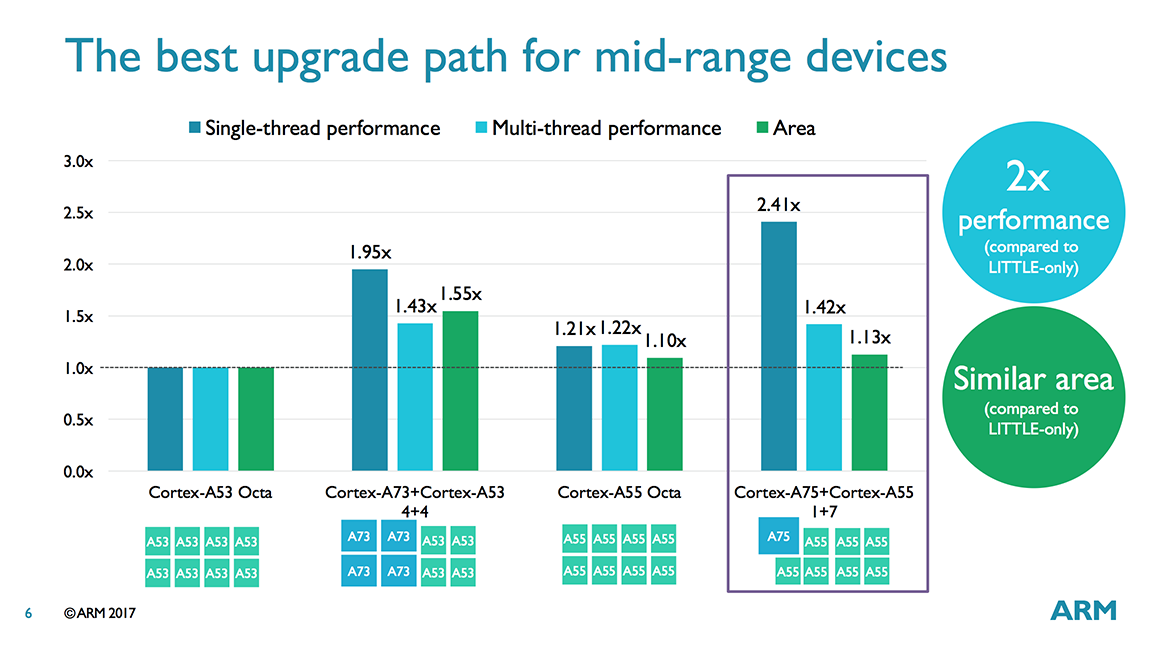
ARM has announced two new CPU cores, the Cortex-A75 and Cortex-A55. According to ARM, the A75 increases performance by around 22% over the A73 at the same level of power consumption. It can also scale to use more power per core (1-2 W rather than 0.75 W) which could slightly improve the performance of ARM laptops and tablets.
The smaller core, the Cortex-A55, increases performance by around 18% compared to the Cortex-A53, but also increases power consumption by 3%. Thus, power efficiency is about 14-15% better than the A53.
ARM's successor to big.LITTLE, DynamIQ, allows for up to 8 cores of any size (which for now means either the A75 or A55) inside of a single cluster. This means that a configuration including 1x Cortex-A75 and 7x Cortex-A55 cores would be possible, or even optimal according to ARM.
ARM also announced its Mali-G72 GPU, an incremental upgrade to the Mali-G71:
ARM says that the Mali-G72 will see a 25 percent boost to energy efficiency compared with the G71, meaning that SoC designers will have more power to play with to boost performance or increase battery life.
Similarly, the G72 offers 20 percent better performance density, meaning that manufacturers can pack more GPU cores into the same die area as before, giving further potential for a performance boost without an increase in cost. Previously ARM was targeting 16 to 20 Mali-G71 cores as the optimum for mobile, and expects to see the number push closer to the 32 shader core maximum supported by the G72 this time around.
- Read More...
- 16 comments
An Army veteran, a recent college graduate and a student who once won a poetry contest by condemning prejudice stirred up by the Sept. 11 attacks intervened as a man screamed anti-Muslim insults at two women in Portland, Ore., on Friday.
[...] Two of the men — Taliesin Myrddin Namkai Meche, 23, and Rick Best, 53 — died in the attack, which occurred on a commuter train. The third, Micah David-Cole Fletcher, 21, was treated on Saturday for injuries that the police said were serious but not life-threatening.
Jeremy Christian, 35, of North Portland, Ore., was charged with two counts of aggravated murder in the attack and could face additional charges when he is arraigned on Tuesday. Mr. Christian, who the authorities said had a history of making extremist statements on social media, was ranting at, and talking disparagingly about, the two women, one of whom was wearing a hijab.
Source: The New York Times
President Donald Trump has released his first official statement on the attack in Portland, Oregon, more than 48 hours after the two victims died.
"The violent attacks in Portland on Friday are unacceptable," Mr Trump tweeted. "The victims were standing up to hate and intolerance. Our prayers are w/ them."
Source: The Independent
Portland law enforcement leaders were tightlipped Saturday about the investigation into Friday's attacks that killed two men on a light rail train but a federal official did say it was too early to label the incident a hate crime.
[...] Loren Cannon, special agent in charge of the Portland FBI office, [...]
"It's too early to say whether last night's violence was an act of domestic terrorism or a federal hate crime," he said. "However, in the coming days, the FBI, PPB and the prosecutors will work together to share information, leverage resources and make determinations about future criminal charges."
[...] Leaders of the Muslim community said they were thankful for the men who gave their lives to save the girls from harm. They have raised $50,000 toward a goal of $60,000 to help support the victims and their families.
Source: The Oregonian
- Read More...
- 191 comments

Hackers used malware to steal customer payment data from most of Chipotle Mexican Grill Inc's (CMG.N) restaurants over a span of three weeks, the company said on Friday, adding to woes at the chain whose sales had just started recovering from a string of food safety lapses in 2015.
Chipotle said it did not know how many payment cards or customers were affected by the breach that struck most of its roughly 2,250 restaurants for varying amounts of time between March 24 and April 18, spokesman Chris Arnold said via email.
A handful of Canadian restaurants were also hit in the breach, which the company first disclosed on April 25.
Source: Reuters
- Read More...
- 9 comments
from the we've-built-up-an-immunity-to-ibogaine-powder dept.
Submitted via IRC for Bytram
Source: https://www.inverse.com/article/31461-ibogaine-cure-addiction
In West Africa, the roots of a native shrub contain a psychoactive substance called ibogaine. In small doses, ibogaine produces a mild euphoric effect somewhat comparable to other stimulant plants, like khat in the Horn of Africa or piri piri in the Amazon. But in large doses, its psychedelic effects are extraordinary.
[...] In Brazil, which has no such crisis, Gomes and his colleagues work with patients addicted to (predominately) crack cocaine. Though they'll meet with their patients a number of times, they'll administer ibogaine to each person only once. Speaking at the MAPS Psychedelic Science Conference in California late last month, Gomes said most people he sees are addicts for whom traditional therapy and the various Anonymous programs have failed. They tend to be impatient with the precursor meetings and adherence to controlled settings, wanting mostly to get the drug, take it, and leave cured.
- Read More...
- 25 comments
Game studios that use digital rights management (DRM) tools tend to defend it to the death, even after it's been cracked. It prevents 'casual' piracy and cheating, they sometimes argue. However, Rime developer Tequila Works is taking a decidedly different approach. It claims that it'll remove Denuvo, the anti-tampering/DRM system on the Windows version of Rime, if someone cracks its island puzzle title. This is an odd promise to make, especially since it amounts to an inadvertent dare -- find a way to break in and the developers will eliminate the need for that crack.
This wouldn't be so unusual a statement if there weren't a history of Denuvo cracks. While it's harder to defeat this code than earlier schemes, it's definitely not impossible. Recent games like Resident Evil 7 and Prey had their Denuvo implementations broken within days of release, while developers have patched it out on titles like Doom and Inside. Tequila Works is aware that cracking is likely more a question of "when" than "if," but it appears to be optimistic about the challenge involved.
Source: ArsTechnica
- Read More...
- 22 comments