SoylentNews is people
SoylentNews
Site News
Join our Folding@Home team:
Main F@H site
Our team page
Support us: Subscribe Here
and buy SoylentNews Swag
We always have a place for talented people, visit the Get Involved section on the wiki to see how you can make SoylentNews better.
- [janrinok] Supreme Court strikes down Trump's sweeping tariffs
- [c0lo] Living on minimal wage
- [Gaaark] It's AI all the way down!
- [mcgrew] EV Myths
- [Runaway1956] geopricing
- [turgid] 4G Internet
- [hubie] GOG Galaxy is Apparently to be Ported to Linux
- [khallow] Retread narratives
- [fliptop] Massive Solar Farm Approved in Middle of NY Amish Country
- [Tork] RubyAI's insta-Casettes.. second vid added!
- [Arthur T Knackerbracket] US Pediatricians Give Middle Finger To RFK Jr.
- [Mojibake Tengu] Veterans on Sale
- [bzipitidoo] battling high blood pressure
- [canopic jug] 39C3: Power Cycles Streaming (Saturday through Tuesday)
- [jasassin] AI real life experience or
Older Stuff
-
May 25- Libreboot Sees First New Release In Nearly 5 Years, Supports More Old Motherboards (33)
- Teardown of an ATX PC Power Supply (65)
- Tesla is Found Guilty of Throttling Charging Speed, Asked to Pay $16,000 to Thousands of Owners (72)
- Crypto Payments above $10,000 would be Reported to IRS Under Treasury Plan (30)
-
May 24- A Zombie-Fire Outbreak may be Growing in the North (15)
- Raspberry Pi Foundation Announces a New Power Over Ethernet HAT (19)
- Huawei Launching HarmonyOS, Developing RISC-V Board, Hoping to Build "3nm" SoC (12)
- Mars Curiosity Rover Detects Potential Organic Salts (13)
- Incredible Microscope Sees Atoms at Record Resolution (20)
- Washington State Removes All Barriers to Municipal Broadband (72)
- The Glow of Fireflies is Helping Scientists Find Treatments for Cancer (4)
- Coherent Storage of Light Over One-Hour Achieved (15)
- Global Cactus Traffickers are Cleaning Out the Deserts (16)
-
May 23
Quick Links

Nearly the Speed of Light in One Millimeter: Presenting a New Type of Particle Accelerator:
In conventional particle accelerators, strong radio waves are guided into specially shaped metal tubes called resonators. The particles to be accelerated — which are often electrons — can ride these radio waves like surfers ride an ocean wave. But the potential of the technology is limited: Feeding too much radio wave power into the resonators creates a risk of electrical charges that can damage the component. This means that in order to bring particles to high energy levels, many resonators have to be connected in series, which makes today's accelerators in many cases kilometers long.
That is why experts are eagerly working on an alternative: plasma acceleration. In principle, short and extremely powerful laser flashes fire into a plasma — an ionized state of matter consisting of negatively charged electrons and positively charged atomic cores. In this plasma, the laser pulse generates a strong alternating electric field, similar to the wake of a ship, which can accelerate electrons enormously over a very short distance. In theory, this means facilities can be built far more compact, shrinking an accelerator that is a hundred meters long today down to just a few meters. "This miniaturization is what makes the concept so attractive," explains Arie Irman, a researcher at the HZDR Institute of Radiation Physics. "And we hope it will allow even small university laboratories to afford a powerful accelerator in the future."
But there is yet another variant of plasma acceleration where the plasma is driven by near-light-speed electron bunches instead of powerful laser flashes. This method offers two advantages over laser-driven plasma acceleration: "In principle, it should be possible to achieve higher particle energies, and the accelerated electron beams should be easier to control," explains HZDR physicist and primary author Thomas Kurz. "The drawback is that at the moment, we rely on large conventional accelerators to produce the electron bunches that are needed to drive the plasma." FLASH at DESY in Hamburg, for instance, where such experiments take place, measures a good one hundred meters.
This is precisely where the new project comes in. "We asked ourselves whether we could build a far more compact accelerator to drive the plasma wave," says Thomas Heinemann of the University of Strathclyde in Scotland, who is also a primary author of the study. "Our idea was to replace this conventional facility with a laser-driven plasma accelerator." To test the concept, the team designed a sophisticated experimental setup in which strong light flashes from HZDR's laser facility DRACO hit a gas jet of helium and nitrogen, generating a bundled, fast electron beam via a plasma wave. This electron beam passes through a metal foil into the next segment, with the foil reflecting back the laser flashes.
In this next segment, the incoming electron beam encounters another gas, this time a mixture of hydrogen and helium, in which it can generate a new, second plasma wave, setting other electrons into turbo mode over a span of just a few millimeters — out shoots a high-energy particle beam. "In the process, we pre-ionize the plasma with an additional, weaker laser pulse," Heinemann explains. "This makes the plasma acceleration with the driver beam far more effective."
Journal Reference:
T. Kurz, T. Heinemann, M. F. Gilljohann, et al. Demonstration of a compact plasma accelerator powered by laser-accelerated electron beams [open], Nature Communications (DOI: 10.1038/s41467-021-23000-7)
- Read More...
- 581 words in story
- 18 comments
Not Graphene: New Type of Atomically Thin Carbon Material Discovered:
Carbon exists in various forms. In addition to diamond and graphite, there are recently discovered forms with astonishing properties. For example graphene, with a thickness of just one atomic layer, is the thinnest known material, and its unusual properties make it an extremely exciting candidate for applications like future electronics and high-tech engineering. In graphene, each carbon atom is linked to three neighbors, forming hexagons arranged in a honeycomb network. Theoretical studies have shown that carbon atoms can also arrange in other flat network patterns, while still binding to three neighbors, but none of these predicted networks had been realized until now.
Researchers at the University of Marburg in Germany and Aalto University in Finland have now discovered a new carbon network, which is atomically thin like graphene, but is made up of squares, hexagons, and octagons forming an ordered lattice. They confirmed the unique structure of the network using high-resolution scanning probe microscopy and interestingly found that its electronic properties are very different from those of graphene.
In contrast to graphene and other forms of carbon, the new Biphenylene network — as the new material is named — has metallic properties. Narrow stripes of the network, only 21 atoms wide, already behave like a metal, while graphene is a semiconductor at this size. "These stripes could be used as conducting wires in future carbon-based electronic devices." said professor Michael Gottfried, at University of Marburg, who leads the team who developed the idea. The lead author of the study, Qitang Fan from Marburg continues, "This novel carbon network may also serve as a superior anode material in lithium-ion batteries, with a larger lithium storage capacity compared to that of the current graphene-based materials."
Journal Reference:
Qitang Fan, Linghao Yan, Matthias W. Tripp, et al. Biphenylene network: A nonbenzenoid carbon allotrope [$], Science (DOI: 10.1126/science.abg4509)
- Read More...
- 6 comments

from the when-you-want-to-take-it-with-you dept.

Exclusive: Valve is making a Switch-like portable gaming PC
Video game and hardware studio Valve has been secretly building a Switch-like portable PC designed to run a large number of games on the Steam PC platform via Linux—and it could launch, supply chain willing, by year's end.
Multiple sources familiar with the matter have confirmed that the hardware has been in development for some time, and this week, Valve itself pointed to the device by slipping new hardware-related code into the latest version of Steam, the company's popular PC gaming storefront and ecosystem.
[...] In recent years, the "Switch-like PC" category has exploded. In early 2020, Alienware revealed its first Switch-like gaming PC, but the "concept" device has not yet turned into a commercial product. If you want to buy a similar device today, you're largely looking at products from Chinese OEMs like GPD, One-Netbook, and Aya, who have slapped ultramobile PC processors and parts into a Switch-like chassis.
Rumors point to an AMD "Van Gogh" APU (Zen 2 quad-core with RDNA 2 graphics and support for LPDDR5 RAM), 7/8-inch screen, at a $400 price point for a Q4 2021 release.
Also at Wccftech.
- Read More...
- 30 comments

New 12.9-inch iPad Pro already has a display problem:
Apple has begun shipping its 2021 M1-equipped iPad Pro tablets, and the larger 12.9-inch version has earned special acclaim for its beautiful mini-LED display. We praised its brightness and stellar picture quality in our own iPad Pro 2021 (12.9-inch) review, but now some owners are reporting some distracting bloom effects appearing on the screen while viewing their tablet in a dark room.
Notably, 2021 iPad Pro users like Josh Teder and Teoh Yi Chie have taken to Twitter to post images showcasing a slight bloom effect that can be seen around bright areas of the 12.9-inch iPad Pro's screen when using it in total darkness.
[...] This is significant because, as MacRumors points out, Apple's for the new iPad Pro specifically spell out how the larger iPad Pro's Liquid Retina XDR display is designed to minimize bloom by handling local dimming better than typical LED LCD displays.
[...] Some users are now posting images which show a noticeable light bloom around bright areas of the 12.9-inch iPad Pro's screen in total darkness, even when they aren't scrolling. Many are quick to point out that this is a very subtle effect that's barely noticeable unless you're using the iPad in a dark room, but it's still a notable example of how Apple's new mini-LED display falls short of what can be achieved with a high-quality OLED screen like that found on the Samsung Galaxy Tab S7 Plus.
- Read More...
- 10 comments

There are still a few months to fix this, but for now the US Patent and Trademark Office's (USPTO) Acting Commissioner for Patents, Andrew Faile, and Chief Information Officer, Jamie Holcombe, have announced that starting January 1st, 2022, the USPTO will institute a surcharge for applicants that are not locked into Microsoft products via the proprietary DOCX format. From that date onwards, the USPTO will move away from PDF and require all filers to use that proprietary format or face an arbitrary surcharge when filing.
First, we delayed the effective date for the non-DOCX surcharge fee to January 1, 2022, to provide more time for applicants to transition to this new process, and for the USPTO to continue our outreach efforts and address customer concerns. We've also made office actions available in DOCX and XML formats and further enhanced DOCX features, including accepting DOCX for drawings in addition to the specification, claims, and abstract for certain applications.
One out of several major problems with the plans is that DOCX is a proprietary format. There are several variants of DOCX and each of them are really only supported by a single company's products. Some other products have had progress in beginning to reverse engineering it, but are hindered by the lack of documentation. DOCX is a competitor to the fully-documented, open standard OpenDocument Format, also known as ISO/IEC 26300.
DOCX is not to be confused with OOXML, though it often is. While OOXML, also known as ISO/IEC 29500, is technically standardized, it is incompletely documented and only vaguely related to DOCX. The DOCX format itself is neither fully documented nor standard. So the USPTO is also engaged in spreading disinformation by asserting that it is.
Previously:
(2015) Microsoft Threatened the UK Over Open Standards
- Read More...
- 70 comments

Toyota gives hydrogen car successful debut in Fuji 24 Hours:
[...] "The goal is simply to become carbon neutral," said [Toyota president Akio] Toyoda. "Since we made this statement, I, as the chairman of the Japan Automobile Manufacturers Association, have been asking the government to take the correct steps and increase the number of carbon-neutral options.
"This is because, if all cars become battery-electric, one million jobs will be lost in Japan.
"I believe we have an opportunity to demonstrate one of these [alternative] options here in motorsports. I want to tell the world there is also this option to become carbon neutral."
- Read More...
- 41 comments
Deadly Parasite Discovered in Chinese Family Shows You Should Never Eat Raw Centipedes:
Centipedes mean business. They can slay animals 15 times their size, even devour whole snakes if they want.
[...] A 78-year-old woman was admitted to Zhujiang Hospital in the Chinese city of Guangzhou, saying she'd experienced headaches, drowsiness, and cognitive impairment for weeks, although she had no other signs of illness, such as fever or vomiting.
Subsequent examination suggested symptoms of meningitis, but not a viral or bacterial cause for the condition. Her cerebrospinal fluid did however indicate traces of antibodies against the rat lungworm, indicating a diagnosis of A. cantonensis eosinophilic meningitis.
What was unusual was how she'd presumably contracted it: by eating raw centipedes.
While centipedes aren't a common foodstuff for most of us, dried or crushed centipedes have been used in traditional Chinese medicine for centuries (usually consumed in powder form), and live, wild specimens are sold in some Chinese agricultural markets.
In this case, the lady's son had served the fresh produce variety to his elderly mother – and uncooked.
If that sounds unreasonable, don't be too hard on him: he himself turned up at the hospital only a few weeks later, presenting the same symptoms, having shared in the meal.
"We don't typically hear of people eating raw centipedes, but apparently these two patients believed that raw centipedes would be good for their health," says the treating physician, neurologist Lingli Lu from Zhujiang Hospital.
"Instead it made them sick."
Fortunately for mother and son, both patients were ultimately treated successfully with a course of anti-parasitic drugs that rid them of their A. cantonensis infection.
Journal Reference:
Huijie Wang, Lingli Lu, Dan She, et al. Eating Centipedes Can Result in Angiostrongylus cantonensis Infection: Two Case Reports and Pathogen Investigation, The American Journal of Tropical Medicine and Hygiene (DOI:
https://doi.org/10.4269/ajtmh.18-0151)
- Read More...
- 312 words in story
- 44 comments
Introducing Half-Double: New hammering technique for DRAM Rowhammer bug:
Today, we are sharing details around our discovery of Half-Double, a new Rowhammer technique that capitalizes on the worsening physics of some of the newer DRAM chips to alter the contents of memory.
[...] As DDR4 became widely adopted, it appeared as though Rowhammer had faded away thanks in part to these built-in defense mechanisms. However, in 2020, the TRRespass paper showed how to reverse-engineer and neutralize the defense by distributing accesses, demonstrating that Rowhammer techniques are still viable. Earlier this year, the SMASH research went one step further and demonstrated exploitation from JavaScript, without invoking cache-management primitives or system calls.
Traditionally, Rowhammer was understood to operate at a distance of one row: when a DRAM row is accessed repeatedly (the "aggressor"), bit flips were found only in the two adjacent rows (the "victims"). However, with Half-Double, we have observed Rowhammer effects propagating to rows beyond adjacent neighbors, albeit at a reduced strength. Given three consecutive rows A, B, and C, we were able to attack C by directing a very large number of accesses to A, along with just a handful (~dozens) to B. Based on our experiments, accesses to B have a non-linear gating effect, in which they appear to "transport" the Rowhammer effect of A onto C. Unlike TRRespass, which exploits the blind spots of manufacturer-dependent defenses, Half-Double is an intrinsic property of the underlying silicon substrate. This is likely an indication that the electrical coupling responsible for Rowhammer is a property of distance, effectively becoming stronger and longer-ranged as cell geometries shrink down. Distances greater than two are conceivable.
- Read More...
- 14 comments

Google is officially releasing its Fuchsia OS, starting w/ first-gen Nest Hub
Google's long-in-development, from-scratch operating system, Fuchsia, is now running on real Made by Google devices, namely, the first-generation Nest Hub.
Google has told us that as of today, an update is beginning to roll out to owners of the first-generation Nest Hub, first released in 2018. For all intents and purposes, this update will not change any of the functionality of the Nest Hub, but under the hood, the smart display will be running Fuchsia OS instead of the Linux-based "Cast OS" it used before. In fact, your experience with the Nest Hub should be essentially identical. This is possible because Google's smart display experience is built with Flutter, which is designed to consistently bring apps to multiple platforms, Fuchsia included.
We've been tracking the development of Fuchsia since 2016, starting from an ambitious experimental UI, to running on Google's many internal testing devices for Fuchsia, ranging the full gamut of Google's smart home and Chromebook lineup. In the time since then, the OS has gradually progressed and recently even begun a steady release schedule.
Also at The Verge and Notebookcheck.
Previously:
Google's Not-So-Secret New OS
Google Fuchsia UI Previewed
Google to Add Swift Language Support to Fuchsia OS
Google's Fuchsia OS Adds Emulator for Debian Linux Applications
Google's Cross-Platform Flutter SDK Moves Out of Beta With Release Preview 1
Google Hopes to Replace Android with Fuschia in Five Years
Now Is the Time to Start Planning for the Post-Android World
Google Hires a 14-Year Apple Veteran to Bring Fuchsia to Market
- Read More...
- 274 words in story
- 11 comments
Arm Announces Mobile Armv9 CPU Microarchitectures: Cortex-X2, Cortex-A710 & Cortex-A510
It's that time of the year again, and after last month's unveiling of Arm's newest infrastructure Neoverse V1 and Neoverse N2 CPU IPs, it's now time to cover the client and mobile side of things. This year, things Arm is shaking things up quite a bit more than usual as we're seeing new[sic] three new generation microarchitectures for mobile and client: The flagship Cortex-X2 core, a new A78 successor in the form of the Cortex-A710, and for the first time in years, a brand-new little core with the new Cortex-A510. The three new CPUs form a new trio of Armv9 compatible designs that aim to mark a larger architectural/ISA shift that comes very seldomly in the industry.
Alongside the new CPU cores, we're also seeing a new L3 and cluster design with the DSU-110, and Arm is also making a big upgrade in its interconnect IP with the new cache coherent CI-700 mesh network and NI-700 network-on-chip IPs.
The Cortex-X2, A710 and A510 follow up on last year's X1, A78 and A55. For the new Cortex-X2 and A710 in particular, these are direct microarchitectural successors to their predecessors. These parts, while iterating on generational improvements in IPC and efficiency, also incorporate brand-new architectural features in the form of Armv9 and new extensions such as SVE2.
The Cortex-X2 is a large, power-hungry core. Arm is claiming +16% more integer performance than its predecessor, when comparing a design with double the L3 cache (8 MB instead of 4 MB with Cortex-X1). The improvement may not be realized in next year's smartphones due to thermal issues.
The Cortex-A710 can improve performance by 10% at the same power usage, or use 30% less power than the Cortex-A78 while delivering the same performance. This may be dependent on the L3 cache since Arm compares A710 with 8MB to A78 with 4MB, and SoC designers may choose to stick with 4 MB. The A710 will be the only core of the trio to retain 32-bit (AArch32) support, in order to give the Chinese market more time to shift to 64-bit only applications, because it "lacks the homogeneous ecosystem capabilities of the global Play Store markets".
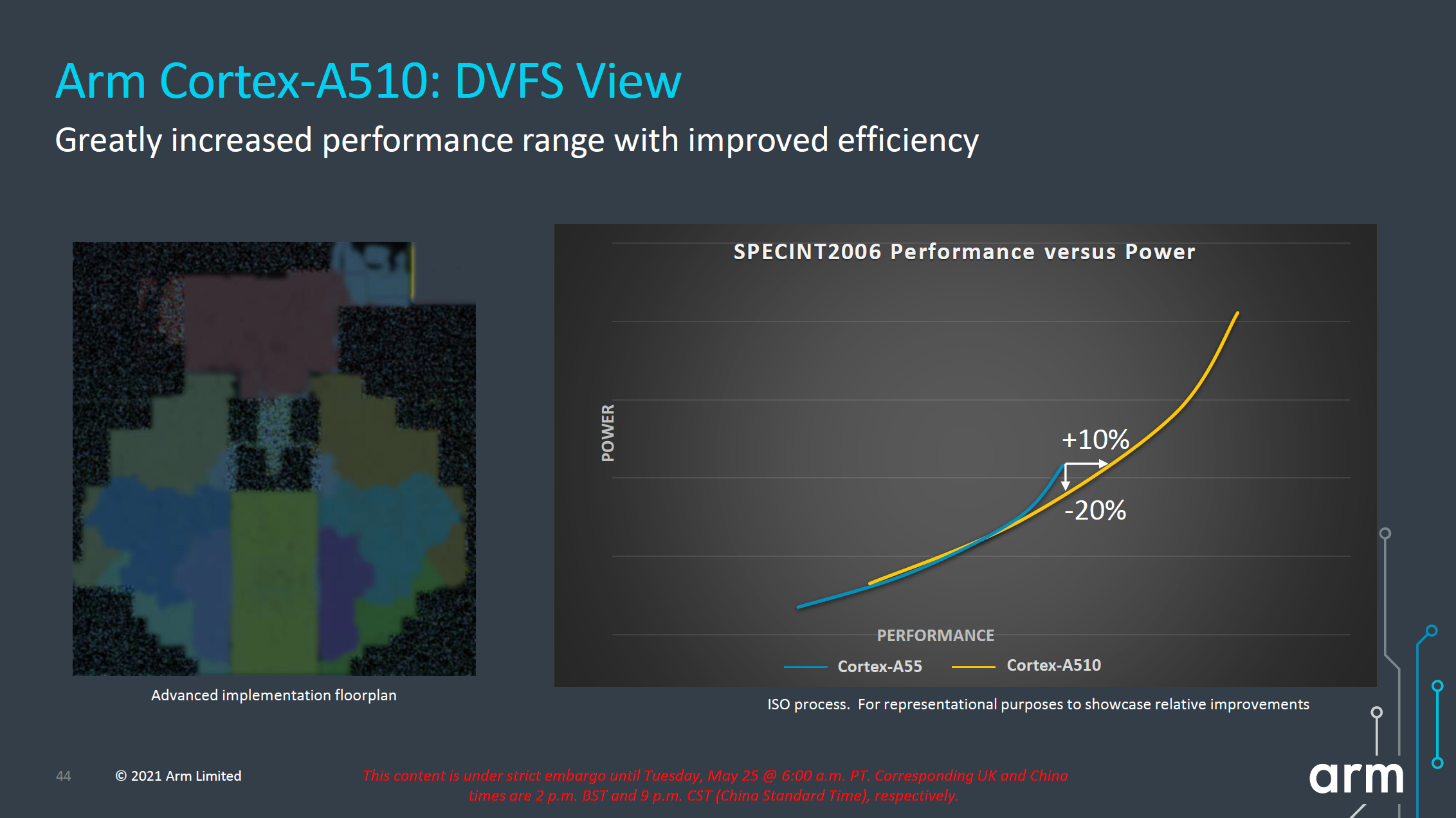
The Cortex-A510 is Arm's long-awaited update to the Cortex-A55, which was launched in 2017. It employs a "merged-core architecture", similar to AMD's maligned Bulldozer microarchitecture, except only the FP/SIMD back-end and L2 cache are shared between core pairs. Using pairs of merged A510 cores in a design is actually optional, but would be expected due to the smaller die size it can achieve. Arm's graph comparing performance and power usage for the A510 and A55 (again with 8 MB vs. 4 MB L3 cache) show that performance and efficiency is nearly identical until they reach higher frequencies, where the A510 pulls ahead by using 20% less power or having 10% more performance at some point.
See also: Arm Announces Armv9 Architecture: SVE2, Security, and the Next Decade
Previously: ARM Cortex-A75, Cortex-A55, and Mali-G72 Announced
ARM Announces Cortex-A78 and Cortex-X1
- Read More...
- 537 words in story
- 4 comments
Yuan Longping, Plant Scientist Who Helped Curb Famine, Dies at 90:
SHANGHAI — Yuan Longping, a Chinese plant scientist whose breakthroughs in developing high-yield hybrid strains of rice helped to alleviate famine and poverty across much of Asia and Africa, died on Saturday in Changsha, China. He was 90.
The cause was multiple organ failure, China's main state-run newspaper, People's Daily, reported. An earlier report from an official news service in Hunan Province, of which Changsha is the capital, said Mr. Yuan had been increasingly unwell since a fall in March during a visit to a rice-breeding research site.
Mr. Yuan's research made him a national hero and a symbol of dogged scientific pursuit in China. His death triggered messages of grief across the country, where Mr. Yuan — slight, elfin-featured and wizened in old age — was a celebrity. Hundreds left flowers at the funeral home where his body was being kept.
Mr. Yuan made two major discoveries in hybrid rice cultivation, said Jauhar Ali, the senior scientist for hybrid rice breeding at the International Rice Research Institute in Los Baños, the Philippines. Those discoveries, in the early 1970s — together with breakthroughs in wheat cultivation in the '50s and '60s by Norman Borlaug, an American plant scientist — helped create the Green Revolution of steeply rising harvests and an end to famine in most of the world.
Mr. Borlaug, who was awarded the Nobel Peace Prize in 1970, died in 2009. Mr. Yuan's research arguably had effects at least as broad, since rice is the main grain for half the world's population and wheat for a third.
[...] As recently as this year, Mr. Yuan was still working on developing new varieties of rice, according to Xinhua.
"There's no secret to it; my experience can be summed in four words: knowledge, sweat, inspiration and opportunity," Mr. Yuan said in a video message last year encouraging young Chinese to go into science. In English, he quoted the scientist Louis Pasteur: "Chance favors the prepared mind."
See also: China's Yuan Longping dies; rice research helped feed world
- Read More...
- 350 words in story
- 26 comments
Arthur T Knackerbracket has processed the following story:
Exposure to a chemical found in the weed killer Roundup and other glyphosate-based herbicides is significantly associated with preterm births, according to a new University of Michigan study.
The study, published in Environmental Health Perspectives, found that the presence of the chemical in women's urine in late pregnancy was linked to an increased risk for premature birth, while the association was inconsistent or null earlier in the pregnancy.
"Since most people are exposed to some level of glyphosate and may not even know it, if our results reflect true associations, then the public health implications could be enormous," said senior author John Meeker, professor of environmental health sciences and senior associate dean for research at the U-M School of Public Health.
[...] The researchers decided to measure glyphosate and aminomethylphosphonic acid (AMPA)—one of the primary degradation products of the herbicide—by testing urine, since the chemicals are not metabolized by mammals. They tested the urine of 247 pregnant women at the first and third study visit of their pregnancy, at 16-20 weeks and 24-28 weeks.
Looking at preterm births (babies born at less than 37 weeks of pregnancy) and comparing them to controls, the research team found that the odds of preterm birth were significantly elevated among women with higher urinary concentrations of glyphosate and AMPA at the third visit, while associations with levels at the first visit were largely null or inconsistent.
The researchers say that AMPA is formed not only from the degradation of glyphosate, but from other common industrial chemicals as well. AMPA is also highly persistent and can take months to break down in the environment.
"Despite the potential for widespread exposure to glyphosate and AMPA, there is very little information regarding the health effects of exposure during pregnancy," Silver said. "Ours is the first study to measure AMPA, and only the second to measure glyphosate in relation to birth outcomes."
Journal Reference:
Monica K. Silver, et al. Prenatal Exposure to Glyphosate and Its Environmental Degradate, Aminomethylphosphonic Acid (AMPA), and Preterm Birth: A Nested Case–Control Study in the PROTECT Cohort (Puerto Rico), Environmental Health Perspectives (DOI: https://ehp.niehs.nih.gov/EHP7295)
- Read More...
- 362 words in story
- 52 comments
How to see the 'Super Flower Blood Moon,' 1st lunar eclipse of this decade:
This week's full moon will be the second supermoon of the season, appearing brighter and larger than usual. According to the Farmer's Almanac, the "Flower Blood Moon" will be roughly 222,000 miles away from the Earth early Wednesday morning.
May's full moon is known as the "Flower Moon," and because a total lunar eclipse -- also known as a "blood moon" as it gives the moon a reddish hue -- is also set to happen at the same time, it's being called the "Super Flower Blood Moon."
The moon will be at its brightest and largest at 4:14 a.m. PT (11:14 UTC), according to astronomers.
People who live in western North America, western South America, eastern Asia, and Oceania, will have the best view of the "Flower Blood Moon," according to astronomers.
- Read More...
- 23 comments

https://techxplore.com/news/2021-05-compound-commonly-candles-grid-scale-energy.html
A compound used widely in candles offers promise for a much more modern energy challenge—storing massive amounts of energy to be fed into the electric grid as the need arises.
Scientists at the U.S. Department of Energy's Pacific Northwest National Laboratory have shown that low-cost organic compounds hold promise for storing grid energy. Common fluorenone, a bright yellow powder, was at first a reluctant participant, but with enough chemical persuasion has proven to be a potent partner for energy storage in flow battery systems, large systems that store energy for the grid.
Development of such storage is critical. When the grid goes offline due to severe weather, for instance, the large batteries under development would kick in, boosting grid resilience and minimizing disruption. The batteries can also be used to store renewable energy from wind and solar, for use when the winds are quiet or the sun's not shining.
"Flow battery technology is a critical part of the Department of Energy's goal to reduce the cost of grid energy storage over the next decade," said Imre Gyuk, director of Energy Storage at DOE's Office of Electricity. "Progress has been rapid, and the cost has come down significantly, but further research is needed to make grid-scale energy storage widely available."
Scientists are making tremendous strides toward creating better batteries—storing more energy at lower cost and lasting longer than ever before. The results touch many aspects of our lives, translating to a more resilient electric grid, longer-lasting laptop batteries, more electric vehicles, and greater use of renewable energy from blowing wind, shining sun, or flowing water.
For grid-scale batteries, identifying the right materials and combining them to create a new recipe for energy storage is a critical step in the world's ability to harness and store renewable energy. The most widely used grid-scale batteries use lithium-ion technology, but those are difficult to customize moment to moment in ways most useful to the grid, and there are safety concerns. Redox flow batteries are a growing alternative; however, most use vanadium, which is expensive, not easily available, and prone to price fluctuations. Those traits pose barriers to widespread grid-scale energy storage.
Journal Reference:
Ruozhu Feng, Xin Zhang, Vijayakumar Murugesan, et al. Reversible ketone hydrogenation and dehydrogenation for aqueous organic redox flow batteries [$], Science (DOI: 10.1126/science.abd9795)
- Read More...
- 397 words in story
- 18 comments
China will likely ban all bitcoin mining soon
Bitcoin took investors on another rollercoaster ride over the weekend after a top regulator in China announced a crackdown on mining, a new tack in the country's ongoing fight against the cryptocurrency.
The government will "crack down on bitcoin mining and trading behavior and resolutely prevent the transfer of individual risks to the society," said the statement, which was issued by the Financial Stability and Development Committee of the State Council, the country's cabinet equivalent. The committee is chaired by Vice Premier Liu He, who acts as President Xi Jinping's top representative on economic and financial matters.
"The wording of the statement did not leave much leeway for cryptocurrency mining," Li Yi, chief research fellow at the Shanghai Academy of Social Sciences, told the South China Morning Post. "When all mining activities are banned in China, it will be a turning point for the fate of bitcoin, as a large chunk of its processing power is taken out of the picture."
Also at Notebookcheck.
- Read More...
- 77 comments